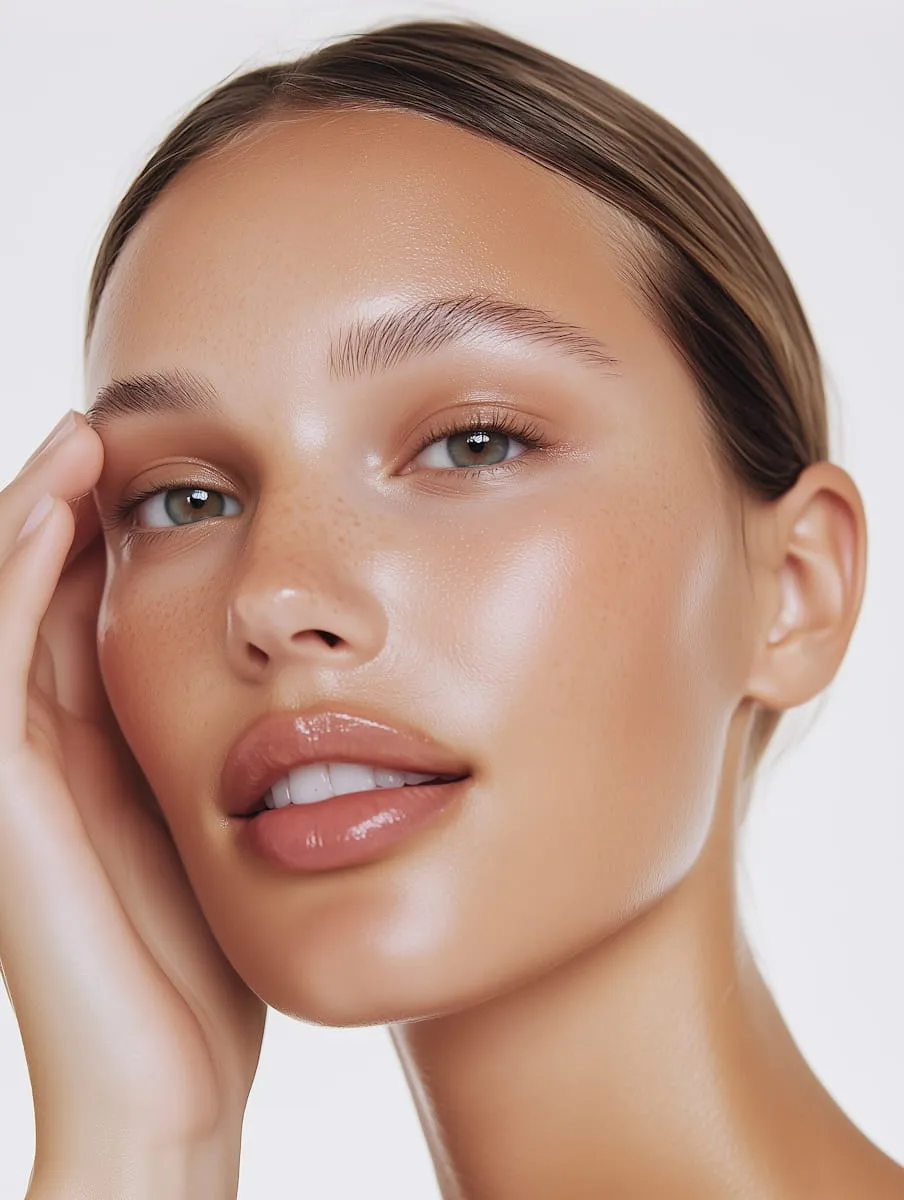
Nose shapes, tip
Snub nose (upturned nose): the lifted tip and its other names
A snub nose is short, with a bridge that often scoops in slightly and a tip that turns up, so you can see the nostrils from the side. Its underside angles up toward the forehead instead of running straight back to the lip. Snub and upturned nose are close cousins: every snub nose is upturned, and the word snub adds the shortness.
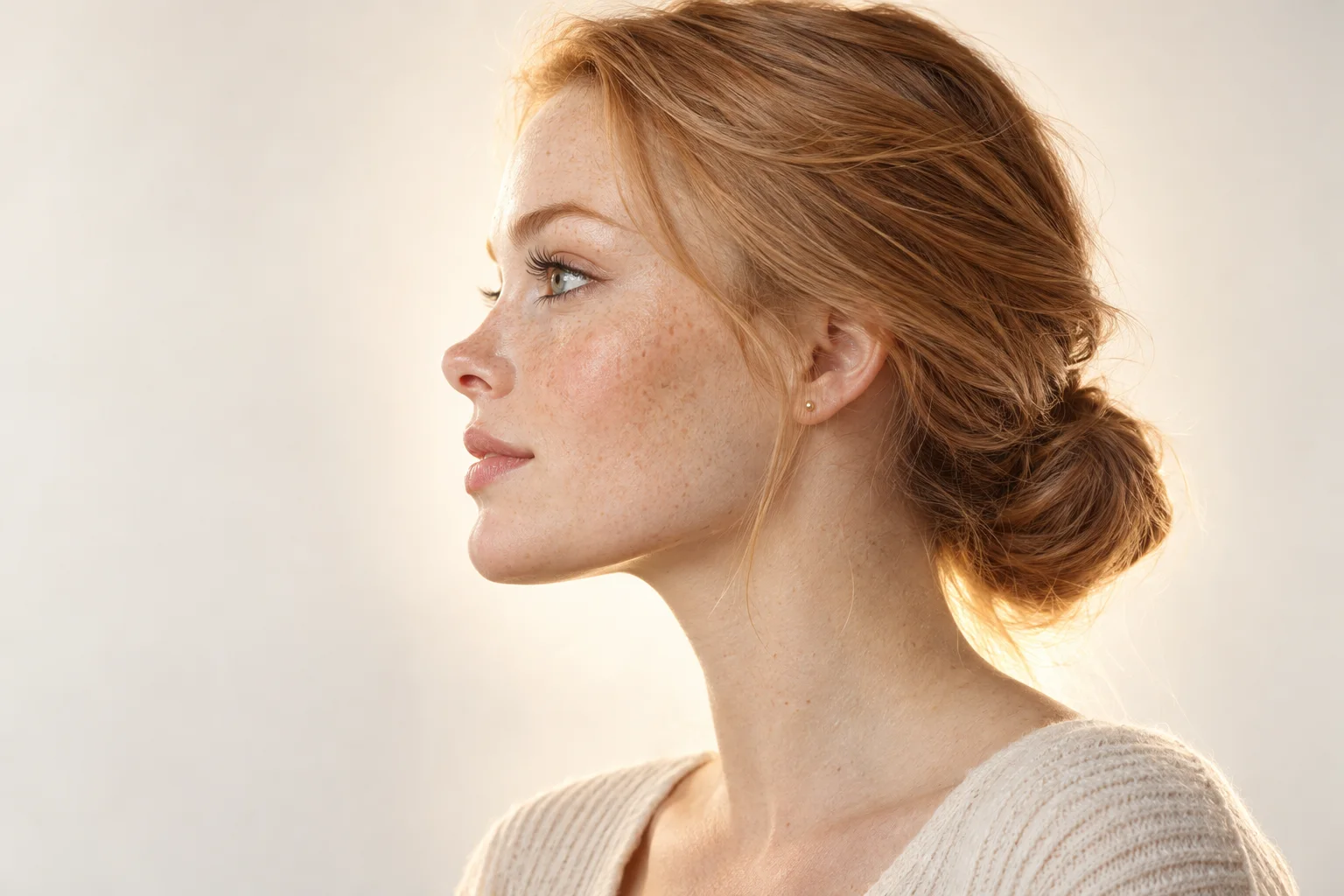
What is a snub nose?
Bridge The top line, brow to tip
Short, and often slightly scooped: it dips a little before rising to the tip.
Tip Its direction and fullness
Turns up, so the underside of the nose angles toward the forehead and the nostrils show in profile.
Defines the shapeBase Across the nostril wings
Usually slim to average; the nostrils are on show from the front as well.
What is an upturned nose?
An upturned nose is any nose whose tip points up rather than straight ahead. It is the broader term: a snub nose is a short upturned nose, a button nose is often a small, slightly upturned one, and a long nose can be upturned too.
What sets the direction is the angle between the underside of the nose and the upper lip, called the nasolabial angle. The more open that angle, the more the tip tilts up and the more of the nostrils you see from the side; the tighter it is, the more the tip points down.
- Points aheadNostrils hidden from the side
- A slight liftNostrils just peek out
- Turns upNostrils show in profile
Snub or button?
Which do you notice first?
Both are small and lifted, so ask which feature you notice first. On a button nose it is the small, round tip, and the lift is slight. On a snub nose it is the lift: the tip turns clearly up, the nostrils show from the side, and the tip can be slim and defined rather than round. A small nose with a round tip and a strong lift has both, and both guides apply.
Or is it the camera?
A low camera angle makes any nose look upturned, because the lens looks up into the nostrils. Take the photo with the camera at nose height and your chin level. If the tip still points up and the nostrils still show, the lift is real; if not, you may have a straight profile.
Ski-slope, celestial, turned-up: other names for it
A lifted tip collects nicknames, and they do not all mean exactly the same thing. They describe the same family of profiles, so the advice on this page applies to each of them.
Ski-slope nose
A bridge that scoops in partway down, then sweeps up into a lifted tip, like the curve of a ski jump.
Celestial nose
An older, poetic name for a tip that points toward the sky; it says nothing about length.
Turned-up nose
The everyday phrase for any upturned tip, short or long, scooped or straight.
How to check your tip in a side photo
The tip angle is easy to judge in a side photo with your head level. Tipping your chin up makes any nose look more upturned, so keep your gaze straight ahead and the camera at nose height.
Facing the mirror
- Looking straight into the mirror, you can see into both nostrils.
- The tip sits level with the nostril wings or higher.
- Your nose looks short for your face, measured from between your eyes to the tip.
In a level side photo
The view that matters most- The underside of your nose angles upward from the lip to the tip.
- From the side, your nostrils show as two openings.
- The bridge dips slightly before the tip rather than running dead straight.
- A pencil held along the underside of your nose would point up toward your forehead.
Contour for a lifted tip
An upturned tip catches the light from below. Contour here is about where that light lands: carried down onto the tip, it makes the nose read a touch longer in photos.
Very little shade
Barely-there lines down the sides of the bridge, and no shade under the tip, which would lift it further.
Light onto the tip
A highlight along the bridge that runs onto the tip and just over its front edge.
- Sketch two barely-there lines of shade from the inner brows along the bridge.
- Sweep highlight down the ridge of the bridge.
- Carry the highlight onto the tip and just over its front edge, which moves the light a little lower.
- Set the area around the nostrils with a skin-tone matte powder so the openings show less in photos.
Keep these off
- Shade under the tip: it lifts it even more.
- Dark contour on the nostril wings: from the front it frames the nostrils that already show.
Frames that suit a short nose
- Saddle bridge
- Keyhole bridgeSuits this shape
- Adjustable pads
- Low bridge fit
Clear of your cheeks
Snub noses are often short with a lowish bridge, so frames can sit low enough to touch your cheeks when you smile. Look for a bridge set high on the frame front, or pads that can be raised.
Bridges that show more nose
A high-set or keyhole bridge leaves more of the nose on show below it, and a clear or thin bridge does the same; a dark, heavy bridge set low covers more of it.
Light frames, longer pad arms
Light frames suit a short bridge best, because there is less nose for them to rest on. If the lenses touch your lashes, the frames sit too close: pads on longer arms move the lenses forward and away.
Check your tip with the detector
The nose shape detector measures from a selfie how long your nose is for your face, then asks which way your tip points and what your bridge does. A scooped bridge, or a straight one with a tip that turns up, reads snub; if the photo also finds your nose short, it reads button instead, and snub shows as a second trait.
Frequently asked questions
Can tape or exercises give you an upturned nose?
No. Nose tape and exercises cannot reshape the cartilage that sets the angle of the tip. Makeup can change how the tip reads in photos; only surgery changes the shape itself.
Is an upturned nose genetic?
Partly. Genes have been tied to the slope of the skin between the nostrils, which helps decide where a tip points; the Roman nose guide covers that study.
Will an upturned nose turn down with age?
Often a little. Nasal tips tend to droop over the decades, and the aquiline nose guide has the study that tracked it.