Pores & texture
Sebaceous filaments: what they are and how to minimize them
Sebaceous filaments are the gray dots on your nose that look like blackheads but aren't. How to tell them apart, why squeezing fails, and what really helps.
Key takeaways
- Sebaceous filaments are a normal lining inside your pores that carries oil to the surface. Everyone has them, and they are not acne.
- Unlike blackheads, filaments are flat, evenly spaced, and gray, tan, or yellowish, and they refill within about 30 days of being squeezed out.
- Squeezing, extractor tools, and pore strips only empty them for a short time and can irritate your skin, which makes pores look bigger.
- Salicylic acid, a retinoid, oil control, and daily sunscreen make filaments much less visible over 2-3 months, but nothing removes them for good.
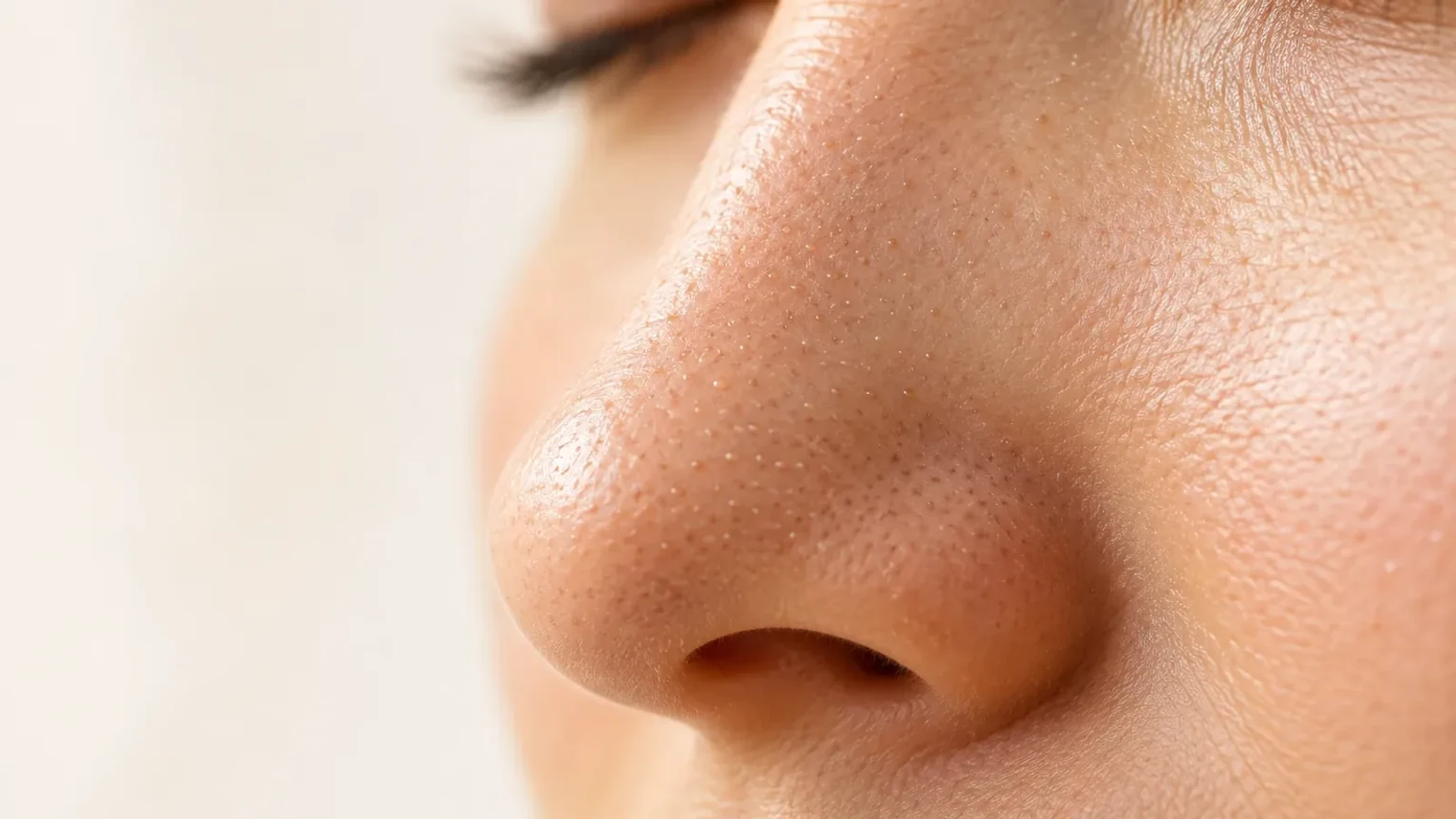
Sebaceous filaments are thin, threadlike linings inside your pores that carry oil (sebum) from your oil glands up to the surface of your skin. They show up as a grid of small, flat, gray, tan, or yellowish dots, mostly on the nose, and they are often mistaken for blackheads. They are a normal part of healthy skin. They are not acne, and they are not a sign that your face is dirty.
You can’t get rid of sebaceous filaments permanently, and squeezing them out only buys you a few weeks. What you can do is make them far less visible. Below: how to tell them apart from blackheads in a mirror, why the usual fixes backfire, and what actually helps, with realistic timelines.
What are sebaceous filaments?
Every pore on your face is the opening of a hair follicle with an oil gland attached. The sebaceous filament is the column of oil and shed skin cells that lines that follicle and lets sebum flow out to keep your skin soft. Cleveland Clinic describes them as a normal, healthy part of skin and notes that every person has them.
Dermatologists writing in Dermatology Practical & Conceptual define them as off-white to yellowish collections of sebum and dead cells around hair follicles, seen mostly on the noses of perfectly healthy people. In other words, what you are looking at is plumbing, not a problem.
Why are some people’s filaments so visible?
Everyone has them, but they are much easier to see on some faces. The main reasons:
- Oil output. The more sebum your glands make, the fuller and more visible the filaments. That is why they stand out on oily skin and in the T-zone.
- Pore size. Wider openings, whether from genetics, age, or sun damage, show more of what is inside.
- Thicker hair follicles. Thicker follicles make filaments easier to see.
- Over-drying. Cleveland Clinic notes that washing too often or spending a lot of time in the sun can dry your skin, which pushes your glands to make more oil.
Sebaceous filaments on the nose
The nose has some of the largest, busiest oil glands on your face, so sebaceous filaments on the nose are the most obvious. They usually cover both sides evenly, along with the tip. You can also find them on your chin, forehead, and cheeks, and occasionally on the chest, arms, or legs.
Sebaceous filaments vs blackheads: how to tell in a mirror
Both look like dots in your pores, but they are different things. A blackhead is a true clog: a plug of oil and dead skin that blocks the pore and turns dark at the surface. A sebaceous filament has no plug, so oil keeps flowing through it.
| Sebaceous filament | Blackhead | |
|---|---|---|
| Color | Gray, tan, or yellowish | Black or dark brown |
| Shape | Small and flat, level with the skin | Often slightly raised, can be larger |
| Pattern | An even grid of similar dots across many pores | Scattered and uneven, a few at a time |
| What comes out if pressed | A thin, pale, waxy strand, or almost nothing | A firmer plug with a dark tip |
| After removal | Refills within about 30 days | Can stay clear if you treat the cause |
| Is it acne? | No | Yes, a mild form (an open comedone) |
A few other things can look similar. The same dermatology report lists tiny trapped hairs (trichostasis spinulosa) and the tails of Demodex mites as lookalikes. If your “dots” look spiky, feel rough like sandpaper, or itch, a dermatologist can tell the difference quickly with a magnifying scope. For more on blackheads, whiteheads, and true clogs, see our guide to what clogged pores look like and how to clear them.
Why squeezing and pore strips backfire
The pale strand you can squeeze out is real oil, and getting it out feels productive. But the pore isn’t damaged or blocked, so it simply refills. According to Cleveland Clinic, a squeezed-out filament comes back within 30 days. At best, you are signing up for monthly squeezing.
The costs add up:
- Bigger-looking pores. The American Academy of Dermatology warns that picking, squeezing, or digging into pores irritates the skin and makes pores more noticeable, which is the opposite of what you want.
- Marks and scars. Your nails are much harder than your skin. Pressing hard can break the surface and leave red or dark marks that last longer than the filament would have, especially on deeper skin tones.
- Pore strips. They rip out the tops of filaments along with any blackheads. Your nose looks smooth for a day, then the filaments refill. Cleveland Clinic also notes that removing filaments this way can dry out your skin and let in acne-causing bacteria.
- Extractor tools and pore vacuums. Same problem, more force. Save extraction for real blackheads, done by a dermatologist or trained professional.
How to get rid of sebaceous filaments (or make them far less visible)
Since the goal isn’t removal, think of it as making filaments emptier and less noticeable: less oil, less dead skin at the opening, and firmer skin around each pore. These are the steps with the most support behind them.
1. Salicylic acid (BHA)
Salicylic acid is a beta hydroxy acid that dissolves in oil, so it can get inside the pore and loosen the mix of sebum and dead cells. Look for 0.5-2% in a leave-on toner, serum, or gel. A leave-on product stays on your skin far longer than a cleanser you rinse off after a minute.
Start 2-3 times a week. If your skin doesn’t sting or flake, build up to daily. Give it 6-8 weeks before you judge the results.
2. A retinoid at night
Retinoids help skin shed normally so cells don’t pile up at the pore opening, and over months they support the collagen that keeps pores looking tight. Options, from gentlest to strongest:
- Retinol (over the counter)
- Adapalene 0.1% gel (over the counter in the US)
- Tretinoin (prescription)
Use a pea-sized amount on dry skin every other night for the first 2-3 weeks, then increase if your skin is comfortable. Expect some dryness at first. Don’t start a retinoid and salicylic acid in the same week; add one, then the other, and use them on alternate nights. Results take 2-3 months. Skip retinoids if you are pregnant or breastfeeding.
3. Niacinamide for oil
Niacinamide (vitamin B3) is gentle and works for most skin types. In a placebo-controlled trial, a 2% niacinamide moisturizer lowered the rate of oil production after 2 and 4 weeks in one group of adults, and reduced surface oil after 6 weeks in a second group. Less oil means less to fill each filament. Treat it as a helper, not a fix on its own.
4. Clay masks for a quick reset
Clay absorbs surface oil, so filaments look emptier and your nose looks matte for a day or so. That makes a clay mask a nice pre-event step, once or twice a week at most. Used more often, it can dry your skin out, and dry skin tends to make more oil.
5. Oil cleansing: fine, but not magic
You will see claims that “oil dissolves oil,” so oil cleansing melts filaments out of your pores. Oil cleansers and balms are good at removing sunscreen and makeup, and many people like them. But there is no research showing they shrink sebaceous filaments, and they don’t change how much oil your glands make.
The viral “grits” people collect after long oil massages don’t prove anything, and rubbing your nose for minutes at a time just adds friction. If you enjoy oil cleansing, follow it with a gentle water-based cleanser and pick a non-comedogenic formula. Curious about heavier products? Our guide on whether Vaseline clogs pores covers occlusives.
6. Sunscreen every day
This one works slowly but matters. The AAD explains that the more sun damage your skin has, the less firm it is, and pores look more noticeable as skin loosens. Wider-looking pores make filaments more obvious. Use a broad-spectrum, lightweight SPF 30 or higher every morning.
7. Gentle cleansing and blotting
Wash twice a day with a mild, non-comedogenic cleanser and warm (not hot) water. During the day, blotting papers lift surface oil without disturbing makeup.
To check whether all this is working, compare photos taken in the same light every few weeks rather than staring into a magnifying mirror. GoodSkin’s AI skin analysis scores pores as one of 14 traits from a single selfie, and Premium’s scan history lets you see the trend over time.
A simple routine for sebaceous filaments
Morning
- Gentle cleanser
- Niacinamide serum (optional)
- Lightweight, non-comedogenic moisturizer
- Broad-spectrum sunscreen, SPF 30 or higher
Evening
- Gentle cleanser
- Salicylic acid on some nights, retinoid on others
- Moisturizer
- Clay mask once a week, if you like
Already have products of your own? The skincare routine builder puts them in this order and flags the ones that shouldn’t share a night.
Your skin type changes how hard you can push this. Oily skin usually handles salicylic acid every day, while dry or sensitive skin may only tolerate it twice a week. If you aren’t sure which you have, the free skin type quiz takes a couple of minutes.
Free toolSkin type quizOily, dry, combination, normal, or sensitive in about a minute.Can you get rid of sebaceous filaments permanently?
No. Sebaceous filaments are part of how your skin works, and you wouldn’t want to lose them: they carry the oil that keeps your skin and hair from drying out. Cleveland Clinic puts it simply: you will always have them, but a good routine can make them smaller.
The only treatments that make a lasting difference target the oil glands themselves, and those are medical decisions. A dermatologist can prescribe medicines that reduce oil production, usually for people who also have significant acne. Lasers are being explored too. In a 2026 case report, a man whose nose filaments barely improved after six months of tretinoin saw clear improvement four weeks after a single session with a 1726-nm laser designed to target oil glands. That is one patient with short follow-up, and the authors call for proper studies, so it isn’t a standard option yet.
Even after a successful treatment, your oil glands keep working. Ongoing care (salicylic acid, a retinoid, and sunscreen) is what keeps filaments looking small. If enlarged pores are your bigger worry, our guide on how to make pores look smaller goes deeper.
When should you see a dermatologist?
Sebaceous filaments themselves are harmless, so treating them is always optional. But book a visit if:
- Three months of consistent over-the-counter care hasn’t helped and the look bothers you. A dermatologist can offer prescription retinoids, in-office peels, or medicines that reduce oil.
- The dots come with inflamed pimples, painful bumps, or scarring. That is acne, and it responds best to a proper treatment plan.
- You have soft, raised, yellowish bumps with a small dip in the center, especially after age 40. These may be enlarged oil glands (sebaceous hyperplasia) rather than filaments, and they are worth a professional look because they can resemble other growths.
- Any single spot grows, bleeds, or changes. That always needs to be checked.
Sources
- Cleveland Clinic: Sebaceous Filaments
- PubMed Central: Sebaceous Filaments (Dermatology Practical & Conceptual, 2021)
- American Academy of Dermatology: What can treat large facial pores?
- PubMed: The effect of 2% niacinamide on facial sebum production
- PubMed: Sebaceous filaments of the nose treated with a 1726-nm diode laser: A case report and description of the 'Lunar crater sign'
Frequently asked questions
Does everyone have sebaceous filaments?
Yes. Every pore with an oil gland has one. They are simply easier to see if you have oily skin, larger pores, or thicker hair follicles, which is why they usually stand out most on the nose.
Can sebaceous filaments turn into blackheads?
They can. If dead skin cells build up and seal the top of the pore, the oil gets trapped and forms a plug, which is a blackhead. Keeping pores clear with salicylic acid or a retinoid lowers the odds.
Why do my sebaceous filaments look worse some weeks?
Their visibility depends mostly on how much oil they hold. Heat, humidity, hormonal shifts, and a few days off your routine can all make them look fuller for a while.
Do pore vacuums work on sebaceous filaments?
They pull out some oil, much like a pore strip, so your nose looks clearer for a day or two. The filaments refill, and strong suction can bruise the skin, so the trade-off isn't worth it.
This article is general education, not medical advice. GoodSkin is a cosmetic tool and does not diagnose skin conditions. If something hurts, spreads, bleeds, or changes quickly, see a dermatologist.