12 season color analysis: find your color season
Seasonal color analysis sorts natural coloring into 12 seasons by three qualities: how warm or cool, how light or deep, and how soft or bright your skin, hair, and eyes are. Each season has a palette that repeats those qualities, so the colors look like they belong to you.
The 12 color seasons wheel
Autumn family, soft and warm
Soft Autumn
Golden but muted, with colors like dried herbs and clay.
- Muted peach
- Dusty coral
- Warm rose
- Soft terracotta
- Soft brick
- Soft mustard
- Camel
- Sage
- Olive
- Moss
- Muted teal
- Warm taupe
- Hue
- CoolWarm
- Value
- LightDeep
- Chroma
- SoftBright
Hover a season to see its palette. Click to open its guide.Tap a season to see its palette. Tap it again to open its guide.
What is 12 season color analysis?
12 season color analysis is a way to find the clothing, makeup, and hair colors that flatter your natural coloring. It starts with four color families named after the seasons (Spring, Summer, Autumn, and Winter) and splits each into three, so every one of the 12 color seasons has a strongest quality and a second one it shares with the season beside it.
The four-season version, popularized in the 1980s, left many people stuck between families: a Summer with some warmth, or an Autumn too dark for the rest of the palette. Twelve seasons give those in-between colorings a home, which is also why neighbors on the wheel are the easiest seasons to confuse.
Color analysis is a styling system, not a science. There is no test that proves your season, and two analysts can disagree about the same face. What it gives you is a practical shortlist: colors that tend to make your skin look even and your eyes look clear, and colors that tend to cast shadows. Use it as a starting point and let the mirror decide.
Hue, value, and chroma: the three axes
Every color can be described by three qualities, the same three the painter and teacher Albert Munsell used to map color in the early 1900s. Color analysis applies them to your skin, hair, and eyes.
Hue
Warm or cool
Whether your coloring leans golden and peachy (warm) or pink and blue (cool). Springs and Autumns are warm; Summers and Winters are cool.
Value
Light or deep
How light or dark your coloring is overall, from fair skin and blonde hair to deep skin and black hair. Springs and Summers are lighter; Autumns and Winters are deeper.
Chroma
Soft or bright
How clear or muted your coloring looks. Bright coloring has clear eyes and strong contrast; soft coloring blends together. Springs and Winters are bright; Summers and Autumns are soft.
Each season is named for whichever quality is strongest. Light Spring is light first and warm second; Deep Winter is deep first and cool second. The True seasons in the middle of each family are led by temperature: True Spring and True Autumn are the warmest of the twelve, True Summer and True Winter the coolest.
The 4 color families and their 12 seasons
Open any season for its full palette with hex codes, the makeup and hair colors that suit it, and how to tell it from its neighbors.
Spring
WarmLightBrightGolden or peachy coloring with clear eyes, at home in fresh, warm color.
Summer
CoolLightSoftRosy or ash coloring with gentle contrast, at home in powdery, blue-based color.
Autumn
WarmDeepSoftGolden or bronze coloring with earthy depth, at home in spice and forest tones.
Winter
CoolDeepBrightClear, high-contrast coloring that can wear black, pure white, and jewel tones.
- Deep and cool
Deep Winter
Also called Dark WinterDark hair and eyes that can wear black and jewel tones. - Cool and bright
True Winter
Also called Cool WinterHigh contrast between hair and skin, made for pure, icy color. - Bright and cool
Bright Winter
Also called Clear WinterSparkling eyes and contrast that wants electric color.
How to find your color season
The quickest route is the free tool. To check by hand, you need a mirror, daylight, and a few colored fabrics or clothes.
- 1
Use daylight
Sit facing a window on a bright day, out of direct sun. Indoor bulbs push every color warmer or cooler.
- 2
Go bare
Take off makeup and cover dyed hair with a white or gray towel so it does not sway you.
- 3
Check temperature
Hold gold and silver, or a peach and a pink fabric, under your chin. Warm coloring looks even and healthy in gold and peach, cool coloring in silver and pink. The undertone test can help with this step.
- 4
Then depth
Compare a light color with a dark one, like cream and chocolate. One makes your face look clearer; the other washes you out or overpowers you.
- 5
Then clarity
Compare a bright color with a muted one, like kelly green and sage. If the bright one makes your eyes look clearer, you lean bright; if it seems to wear you, you lean soft.
- 6
Name the strongest
The test with the biggest difference is your strongest quality, and the runner-up points to your exact season: light and warm is Light Spring, deep and cool is Deep Winter.
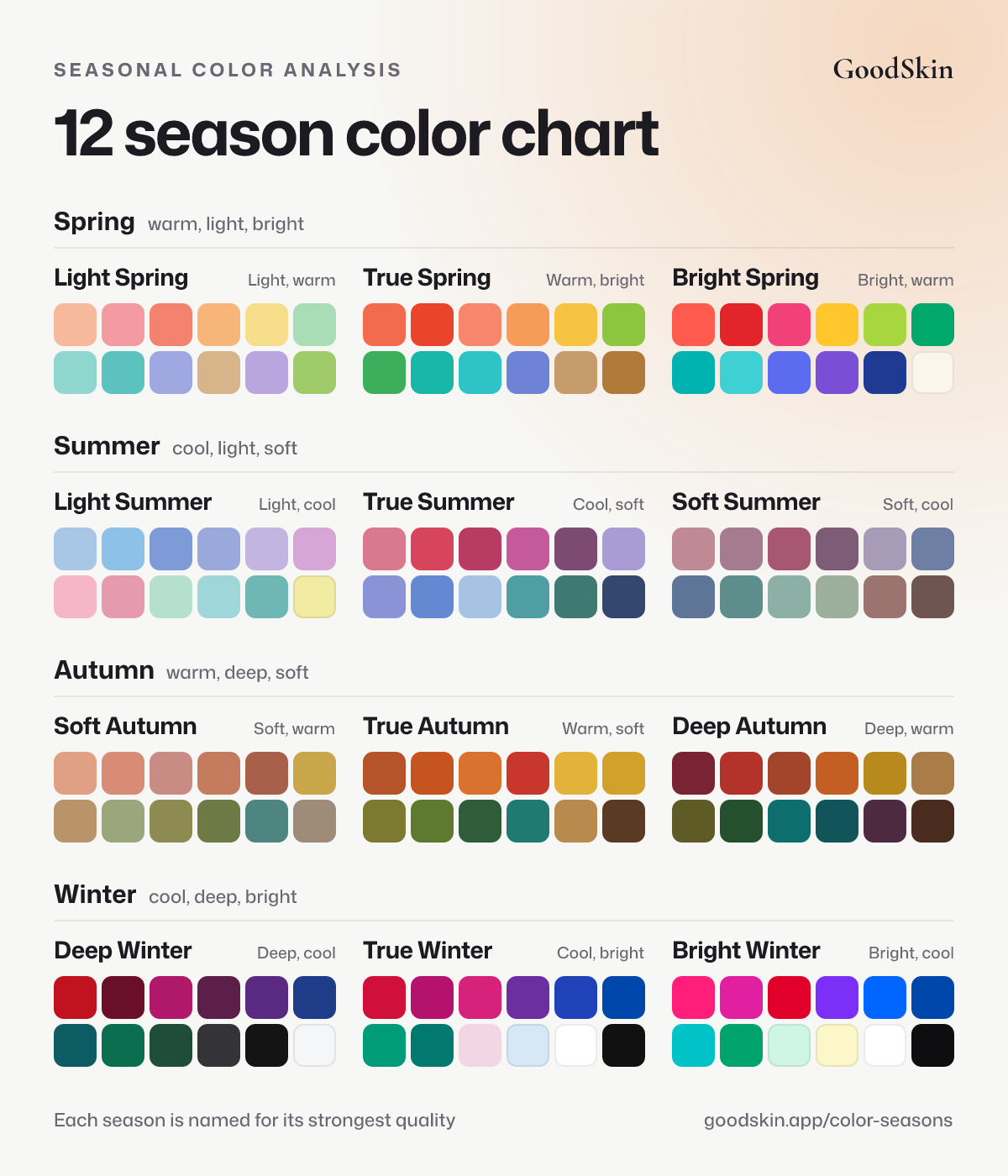
Seasonal color analysis chart
This color season chart puts all 12 palettes side by side, grouped by family. Save it, or open it full size to zoom in.
Download the chart| Season | Strongest | Second | Best metals |
|---|---|---|---|
| Light Spring | Light | Warm | Light yellow gold and rose gold |
| True Spring | Warm | Bright | Yellow gold and brass |
| Bright Spring | Bright | Warm | Bright gold and polished silver |
| Light Summer | Light | Cool | Silver, white gold, and rose gold |
| True Summer | Cool | Soft | Silver and white gold |
| Soft Summer | Soft | Cool | Pewter, brushed silver, and rose gold |
| Soft Autumn | Soft | Warm | Brushed gold and bronze |
| True Autumn | Warm | Soft | Gold, copper, and brass |
| Deep Autumn | Deep | Warm | Antique gold, bronze, and copper |
| Deep Winter | Deep | Cool | Silver, platinum, and gunmetal |
| True Winter | Cool | Bright | Silver and platinum |
| Bright Winter | Bright | Cool | Polished silver and platinum |
Color season FAQ
What are the 12 color seasons?
Light Spring, True Spring, Bright Spring, Light Summer, True Summer, Soft Summer, Soft Autumn, True Autumn, Deep Autumn, Deep Winter, True Winter, and Bright Winter. They come from the four seasons, each split into three by its strongest quality.
What is the rarest color season?
There is no reliable data on how common each season is. Analysts disagree, and the answer depends on who is analyzed and how, so treat any claim about the rarest or most common season with caution.
Can your color season change?
Your season is based on your natural coloring, which stays fairly stable. Graying hair, a deep tan, or dyed hair can shift which colors look best, so some people find they move to a neighboring season as they age.
What if I am between two seasons?
That is common. Neighboring seasons share a quality, so their palettes overlap. Wear the colors both palettes share, and use the side-by-side checks in each guide to see which one wins.
Does your skin undertone decide your season?
It is a big part of it, but not all of it. Undertone tells you warm or cool; depth and clarity come from your hair, eyes, and contrast. Our guide to skin undertones covers that first step.
Know the skin behind your palette
A GoodSkin scan shows your skin tone and skin type, and scores 14 traits like glow, redness, and pigmentation from one selfie.


Scan with your phone camera