Nose shape guide
Nose types: the 11 nose shapes and how to find yours
Nose types are named for four things: the line of the bridge in profile, the tip, how wide and how high the nose sits, and whether it runs straight down the face. Each of the 11 nose shapes is a strong reading on one of them, so many noses fit two at once, like a Roman bridge over a wide base.
Front and side view
Nose shape chart: all 11 types
Each shape drawn from the front and in profile, grouped by what defines it. Open any one for its guide.
Bridge line Straight, bumped, or curved?
The line the top of your nose draws in profile, from between the brows to the tip.
Tip Lifted, small, or round?
Which way the tip points, and how full it is next to the bridge.
Width and height How wide, how high?
How wide the nostril wings sit, and how far the bridge rises from the face.
Line Centered or bent?
Whether the nose runs straight down the middle of the face, seen from the front.
- CrookedBends off the center line
Many noses fit two of these at once. A Roman bridge can sit over a wide base, and a straight nose can end in a round tip. Read every guide that matches one of your readings.
Take the profile testOr measure from a photo
What is my nose shape? The profile and mirror test
You need a mirror and two photos, one straight on and one from the side. It takes about five minutes, and each check points to the guide that fits.
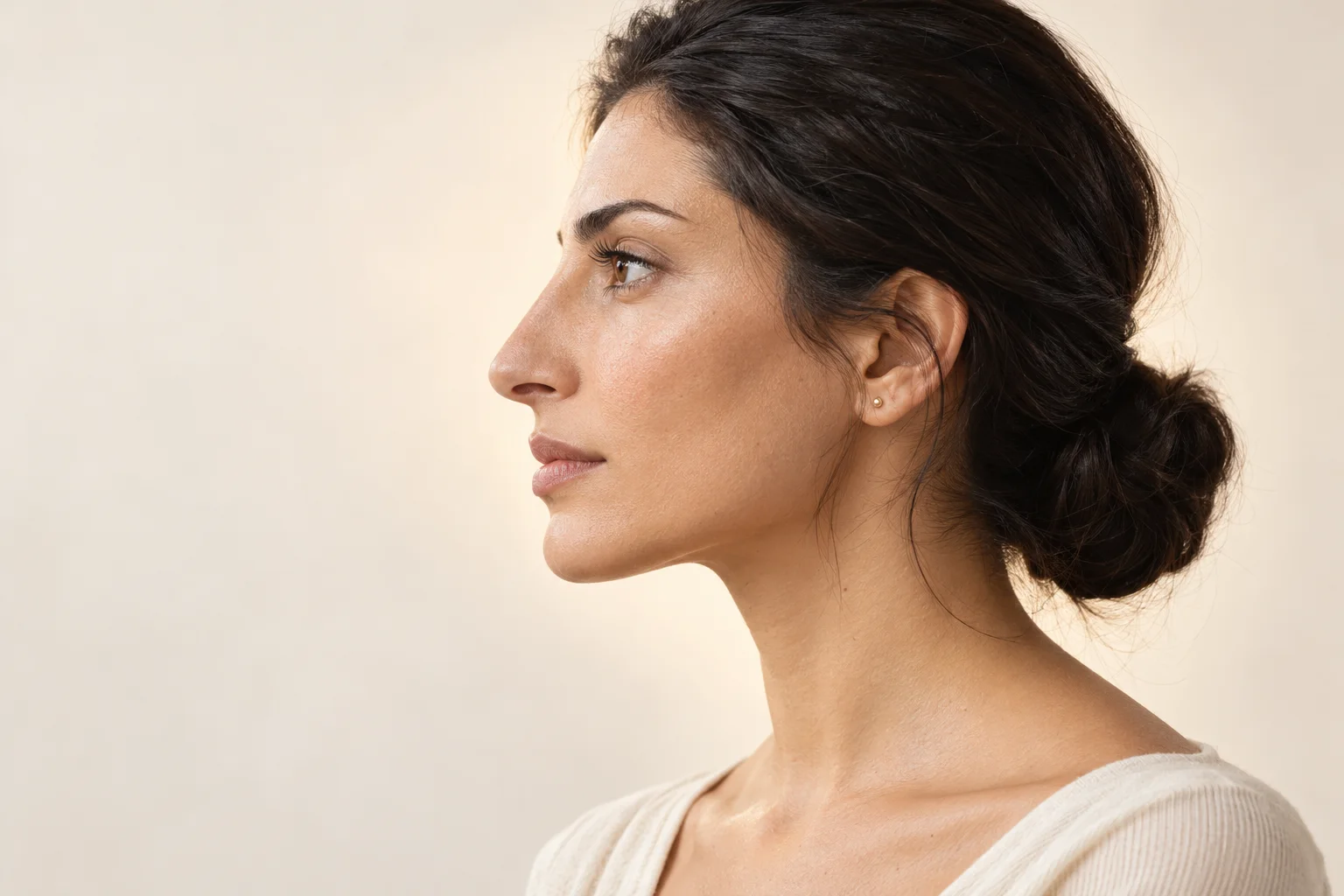
Take two photos
Ask someone to photograph you from a few steps away, once facing the camera and once in full profile, with your hair back, your face relaxed and your chin level. Distance matters more than people expect, because a close phone camera enlarges the nose; the wide nose guide explains.
The top: a dip, or one line from the forehead?
Look where the nose meets the brow. Most noses dip in there. If your forehead runs on into the bridge with almost no step, the profile is Greek.
Bridge height: does it rise from the face?
A bridge that barely rises above the eyes and cheeks, the kind glasses slide down, is flat.
Line: does it run down the middle?
Imagine a vertical line through the middle of your face. A bridge or tip that strays from it is crooked.
Put your answers together, strongest first: for example a Roman bridge on a wide base, or a straight nose with a round tip. Then read the guide for each part.
Different nose shapes compared
The fastest way to tell different nose types apart, with the first thing to try in contour and in glasses for each. Contour on any nose is optional: it changes how a shape reads in photos, and no shape needs correcting.
| Shape | What defines it | Quick check | Contour first | Glasses first |
|---|---|---|---|---|
| Straight | Straight bridge below a dip at the brow | A ruler sits flush in profile | A thin, even highlight | Saddle or keyhole |
| Greek | Forehead and bridge in one line | No step between brow and nose | Highlight from forehead to tip | Keyhole or pads, set low enough |
| Roman | A bump high on a long bridge | A ruler rocks on a ridge | Highlight above and below the bump | Pads set above the bump |
| Aquiline | Whole bridge curves out, tip points down | One curved line, nostrils hidden | Shade under the tip | Saddle, or pads that grip |
| Snub | Short, with a tip that turns up | Nostrils show in profile | Carry the highlight onto the tip | High-set or keyhole bridge |
| Button | Small and short, with a round tip | Small nose, gentle lift | A light touch and a dot on the tip | Low bridge fit |
| Bulbous | Round tip wider than the bridge | The tip is the widest part | Shade the tip sides, light the center | Some weight in the top rim |
| Wide | Base wider than the eye gap | Wings reach past the inner eye corners | Optional shade beside the wings | A wider bridge size |
| Flat | Low bridge, close to the face | Glasses slide or touch your lashes | Shade beside the top of the bridge | Low bridge fit |
| Nubian | Long bridge over a wide, flared base | Long in profile, wide from the front | Highlight the long bridge | A matched bridge width |
| Crooked | Leaves the center line of the face | A line from brows to chin | Draw it straight, ignore the bend | Pads set unevenly |
All 11 nose types, with a photo










Nose shape FAQ
How many nose types are there?
There is no official number. One survey sorted 1,793 pictures of noses, from artworks and from photos taken in Europe and Israel, into 14 groups (Tamir, 2011). This guide uses 11 shapes that you can check in a mirror and that cover the names people search for most.
What is the most common nose shape?
Nobody has measured it worldwide. In that survey the most frequent group, at 24.2%, was what the author called the fleshy nose, but a sample of artworks and of photos from Europe and Israel says little about everyone else (Tamir, 2011).
What are the female nose types?
The same 11. Nose shapes are named for the bridge, the tip and the base, and every one of them appears in women and in men. Men's noses measure larger on average (Sforza et al., 2011), but the shapes, and the advice on contour and glasses, are the same.
Can your nose shape change?
Slowly. The nose keeps growing into old age (Sforza et al., 2011), and the tip tends to droop over the decades (Pecora et al., 2008), so a nose can read longer or more downturned later in life. A nose that bends or sinks after a blow is worth a doctor's look.
Which nose shape is the most attractive?
None of them. Ranking noses is an old habit with an ugly history, which the Greek nose guide traces back to the 18th century. What people find attractive depends on the whole face and on who is looking.
Does GoodSkin tell you your nose shape?
No. GoodSkin is a skin analysis app: it scores skin traits such as pores, oiliness and redness, which show clearly on the nose, and reads your face shape. Your nose shape comes from the free nose shape detector on this site.
Your nose, and the skin on it
GoodSkin doesn't read nose shape. One selfie scores 14 traits, from the pores and oil that gather on the nose to redness and texture, and tracks them month to month.


Scan with your phone camera