Nose shapes, bridge line
Straight nose: the profile other nose shapes are measured against
A straight nose has a bridge that runs in one straight line from the top of the nose to the tip, with no bump rising from it and no scoop dipping into it. Above the bridge there is a soft dip where the nose meets the brow, and the tip points forward rather than up or down. It is the reference line most other shapes are described against: add a bump and it turns Roman, a curve and it turns aquiline, lose the dip and it turns Greek.
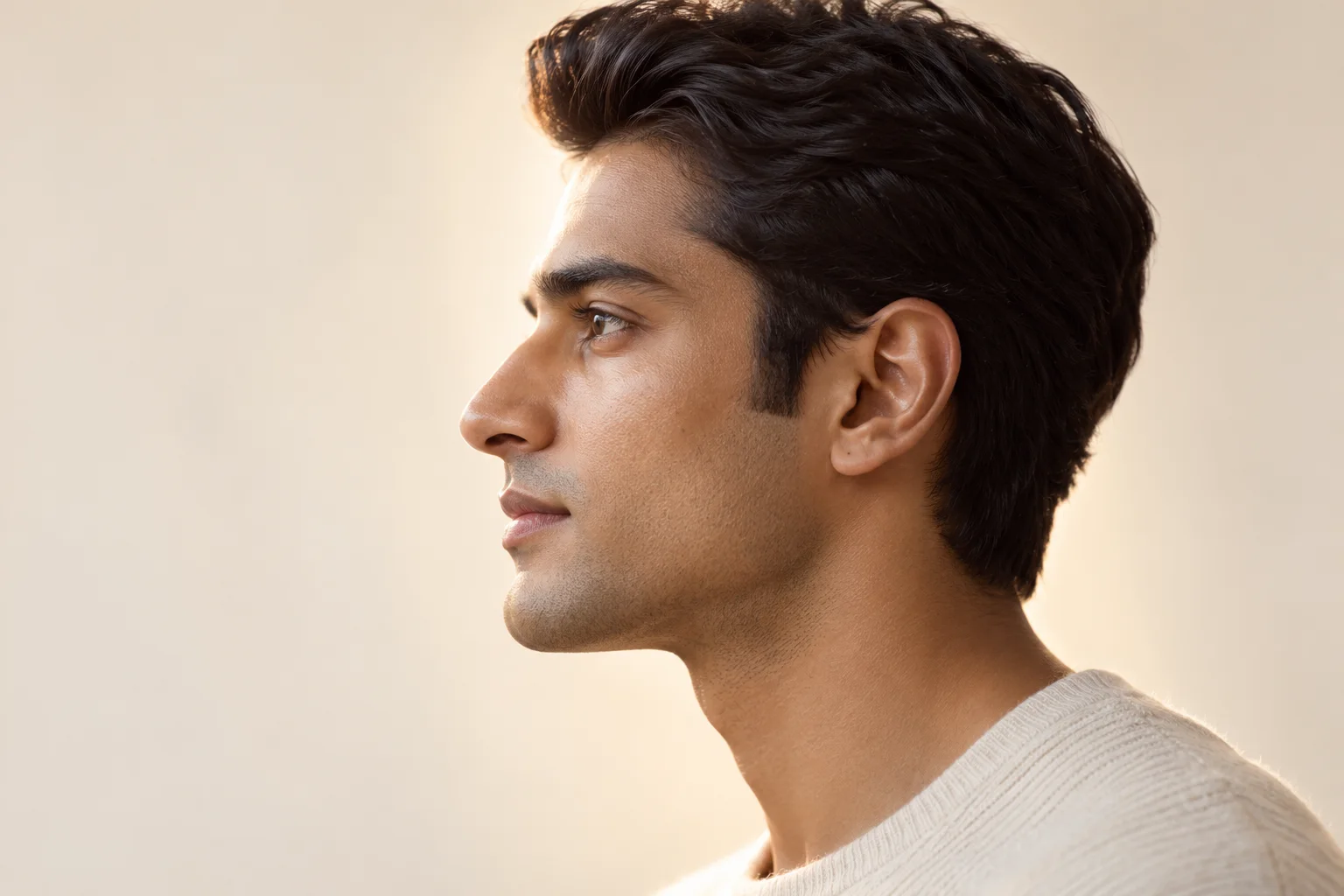
What makes a nose straight?
Bridge The top line, brow to tip
Unbroken from where it leaves the brow down to the tip: no bump, no scoop.
Defines the shapeTip Its direction and fullness
Points forward, neither lifted nor dropping, about as wide as the bridge or a little wider.
Base Across the nostril wings
Average for the face: the nostril wings sit roughly below the inner corners of the eyes.
The ruler test: is your nose straight?
Straightness is a side-view trait, so you need your profile. Ask someone to photograph you from the side at a normal portrait distance with your chin level, or use two mirrors. If the ruler sits flush but your forehead runs on into the bridge, read the Greek nose guide; if it rocks on a ridge, the Roman one.
Square to the mirror
- The two soft shadows down the sides of your bridge run parallel, without pinching in or bowing out partway down.
- Light catches the bridge in one even stripe, not a bright spot on a ridge.
- Your tip sits on the center line of your face, in line with the bridge above it.
The ruler test, in profile
The view that matters most- A ruler laid along your bridge sits flush from the top of the nose to the tip.
- There is a visible dip between your brow and the top of your nose.
- Your tip points straight ahead, so you cannot see into your nostrils from the side.
- The underside of your nose runs back to your upper lip at roughly a right angle, or a little more open.
One straight bridge, three different tips
The bridge is only half of a profile. Put three different tips on the same straight line and you get three different noses, which is why so many people with a straight bridge call their nose something else.
A very slight ridge or dip still counts as straight. Run a fingertip down the bridge: if you can feel a rise but cannot see it in a side photo, the line reads straight to anyone looking at you.
- A round, full tipIf the tip is clearly the widest part, read the bulbous guide.
- A lifted tipThe nostrils start to show; on a short nose this is snub.
- A dropped tipIt points toward the lip; on a curved bridge, aquiline.
Why a straight nose can look bumped or bent in photos
Three things bend a straight bridge in a picture, and none of them is your nose. Rule each one out before you decide your profile has a bump.
Light from above
Overhead light, like a ceiling lamp or midday sun, throws a shadow just below the hard upper part of the bridge and lights the part above it, and the camera reads that as a ridge. A window you are facing shows the real line.
A close camera
A phone at arm's length enlarges whatever is nearest to the lens, which is your nose. The wide nose guide has the study that measured how much.
A slight turn
In a three-quarter view the bridge crosses the far cheek, whose edge can make a straight line look curved. Take your side photo at a full 90 degrees and your front photo square on.
Contour that keeps a straight line crisp
A straight nose needs very little contour, and plenty of people skip it. Used at all, it keeps the line crisp in photos rather than changing it.
Two parallel lines
A cool, matte shade one or two tones deeper than your skin, drawn from the inner brows down the sides of the bridge and stopped just above the tip.
One thin stripe
A thin line of highlight, or concealer one shade lighter, along the top of the bridge, plus a small touch on the tip.
- Start each shade line at the inner end of the brow, where it meets the side of your nose.
- Run it straight down the side of the bridge to just above the nostril wing, keeping both lines the same distance apart.
- Lay a thin stripe of highlight along the top of the bridge, between the brows and the start of the tip.
- Tap a little highlight onto the tip itself, the same width as the stripe.
- Blend the shade lines outward toward the cheeks with a small, dense brush until no edge shows.
Leave out
- Shade under the tip: it shortens a nose that does not need shortening.
- A broad highlight: a wide stripe makes a straight bridge look flatter in photos.
Frames for a straight bridge
- Saddle bridge
- Keyhole bridgeSuits this shape
- Adjustable pads
- Low bridge fit
Almost any bridge fits
A straight bridge of average height suits almost every bridge style. Keyhole bridges, which rest on the sides of the nose and leave a small arch over the top, and saddle bridges, which sit across the top in one smooth curve, both sit level on it.
Choose by face and brows
Choose by face shape and brow line rather than by nose. Frames whose top rim follows your brows look the most settled; the face shape guides cover which shapes suit which faces.
If frames slide
Frames that slide are too wide at the bridge for you. An optician can pinch adjustable pads closer together, and the wide nose guide explains the bridge size printed on the arm.
Check your profile with the detector
A front photo cannot see the line of your bridge, so the nose shape detector asks about your profile. Answer that your bridge is straight, your tip points ahead and you have a dip between your brows, and you read straight, as long as the photo does not find a wide base, a full tip or a short nose first. Those measured parts still show up beside the result.
Frequently asked questions
Is a straight nose rare?
No one has counted reliably. Nose shape surveys use different categories and small, local samples, so any claim about how common a straight nose is would be a guess.
Why does my nose look crooked in photos but straight in the mirror?
A mirror shows your face flipped, the version you see every day. A photo shows it the other way round, so any small lean or uneven shadow looks unfamiliar, even when the nose itself is straight.
Can a straight nose get a bump after an injury?
Yes. A break can leave a ridge on the bridge, sometimes with a lean to one side. If your nose changed shape after a knock, the crooked nose guide covers when to get it checked.
How do I check if my nose is straight from the front?
Stand square to a mirror in even light and check that the bridge and tip line up with the middle of your lips and chin. If they do, it is straight from the front as well as in profile.