Nose shapes, bridge line
Greek nose: the forehead-to-tip line and where the name began
A Greek nose is a straight nose with one extra feature: in profile, forehead and nose make a single, nearly unbroken line, because the bridge begins with barely any notch at the brow. The name comes from classical Greek sculpture, where gods and goddesses were often carved with exactly that line. From the front it looks like any straight, slim to average nose; the difference only shows from the side.
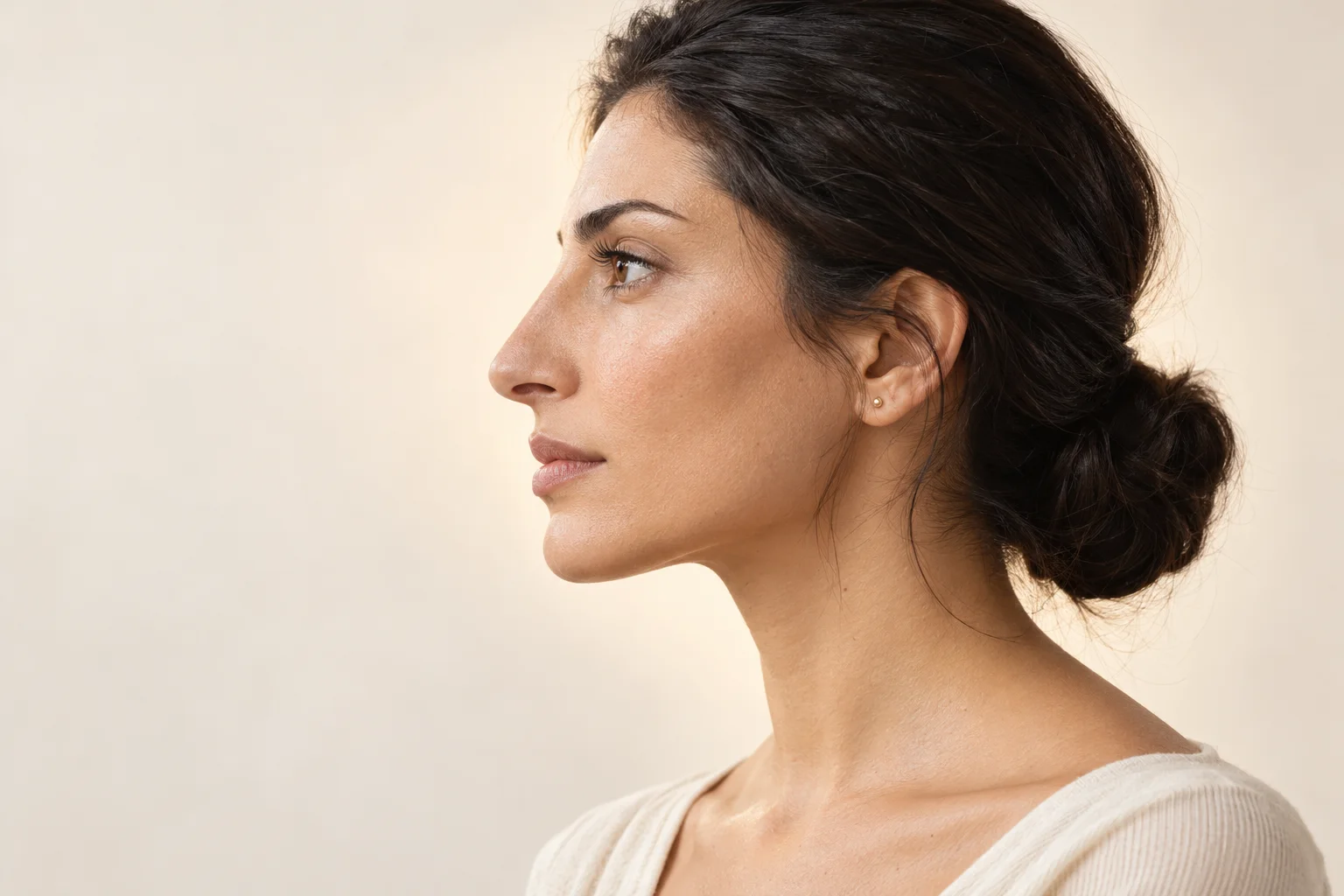
What is a Greek nose?
Bridge The top line, brow to tip
Straight, and continuous with the forehead: almost no dip at the top of the nose.
Defines the shapeTip Its direction and fullness
Points forward and is fairly narrow, in line with the bridge.
Base Across the nostril wings
Usually slim to average, with nostril wings that sit close to the tip.
Where the "Greek profile" comes from
The idea is old. In his History of the Art of Antiquity (1764), the art historian Johann Joachim Winckelmann made the Greek profile his chief sign of high beauty, and in an earlier essay he noted that the brow and nose of gods and goddesses on Greek statues and coins form almost a straight line (Gao, 2023).
He did not stop at describing it. Winckelmann used the profile to rank whole peoples, and a 2023 study of Winckelmann ties that ranking to the racism of his era (Gao, 2023). The shape is real and easy to see; the idea that it is the best nose is an 18th-century opinion, not a finding.
The so-called Greek profile is the chief characteristic of high beauty.
Greek or straight? Check the top of the nose
The pencil test
Both bridges are straight, so check the top. A straight nose has a clear dip where it meets the brow, like a small step down from the forehead; a Greek nose skips the step. Hold a pencil against your forehead and tip it down toward your nose: if it lies along both at once, you lean Greek.
Greek or Roman?
A Roman nose can also start high, close to the brow, but it breaks the line with a bump partway down. If your profile is one line until a ridge appears below your eyes, you are closer to Roman.
Hair, brows and the Greek line
The forehead is half of a Greek profile, so anything that covers or shapes it changes how the line reads. A gently sloping forehead shows the line best, while a strong brow ridge that juts forward makes a dip even above a high bridge, which is why the same nose can read Greek on one face and straight on another. In real faces, a Greek line usually has a very shallow dip rather than none at all.
A fringe hides it
Bangs cover the top half of the line, so in photos a Greek nose reads as a plain straight one.
Pulled-back hair shows it
A ponytail, bun or swept-back cut leaves the forehead clear, and the line from brow to tip is easy to see.
Brows set the step
Full, low brows add weight where the dip would be; softer, lighter brows keep the line smooth from the side.
Other signs of a Greek profile
Past the top of the nose, a few other signs point to a Greek profile. Take the side photo with your hair pulled back off your forehead.
Looking straight on
- Between your eyes, the bridge looks full and raised rather than set back in a notch.
- The bridge looks long and even, with parallel sides from top to tip.
- Your nostrils barely show when you look straight ahead.
In a side photo
The view that matters most- There is no clear notch at the top of your nose; your brow flows into it.
- Below that, the bridge runs straight to the tip with no bump.
- The tip points ahead, level with the line above it.
Frames on a high, straight bridge
- Saddle bridge
- Keyhole bridgeSuits this shape
- Adjustable pads
- Low bridge fit
A high bridge holds frames
With almost no dip at the top, a Greek bridge is high close to the eyes, so frames rest higher on the face than on most noses. Keyhole bridges and adjustable pads both sit securely on it.
Keep the rim under the brows
Because the frame sits high, check the top rim against your brows: it should sit just under them, not over them. A frame with a slightly lower-set bridge brings the lenses down to the center of your eyes.
Close the gaps
A high, slim bridge can leave a saddle bridge perched with gaps on both sides, so try frames on and look for even contact. Pads that can be moved closer together close most gaps.
Makeup that follows the long line
Makeup on a Greek profile follows the long line rather than breaking it. The one optional extra is a little depth between the eyes, which shows in photos taken from the front.
Depth at the inner brows
A soft, matte shade pressed into the inner corners of the brows, where the top of the nose meets the eye socket, with a whisper of it on the lower sides of the bridge.
One line from forehead to tip
One straight, slim highlight that starts on the lower forehead and runs down the bridge, so forehead and nose stay a single line.
- Press a little shade into each inner corner of the brow, beside the top of the nose, and blend it up into the brow and down toward the eye.
- Soften the lower two thirds of the bridge's sides with a whisper of the same shade, keeping the two edges parallel.
- Run one slim highlight from the center of the lower forehead down to the tip, with no break between the brows.
- Blend with a damp sponge, pressing rather than wiping so the highlight stays slim.
Two things to avoid
- A dark spot right between the brows: it reads as a smudge, not depth.
- Stopping the highlight at the brows: the break interrupts the line that makes a Greek profile.
Find out if your nose reads Greek
The nose shape detector measures your width, length, tip and flare from a selfie, then asks about your side view. A Greek reading needs two answers: a straight bridge, and no dip between your brows. That second question only appears once you say the bridge is straight, because it is the one thing that separates Greek from straight.
Frequently asked questions
Is a Greek nose the same as a Grecian nose?
Yes. Grecian is an older word for the same profile: a straight bridge that runs on from the forehead with almost no dip between the brows.
Can a Greek nose be wide?
It can. Greek describes the line in profile, so it says nothing about width. A Greek line over a broad base is less common in shape charts than in real faces, and both guides apply.
Do Greek people have Greek noses?
Not as a rule. The name comes from ancient statues, not from a study of faces, and the profile turns up in people of many backgrounds, in Greece and everywhere else.