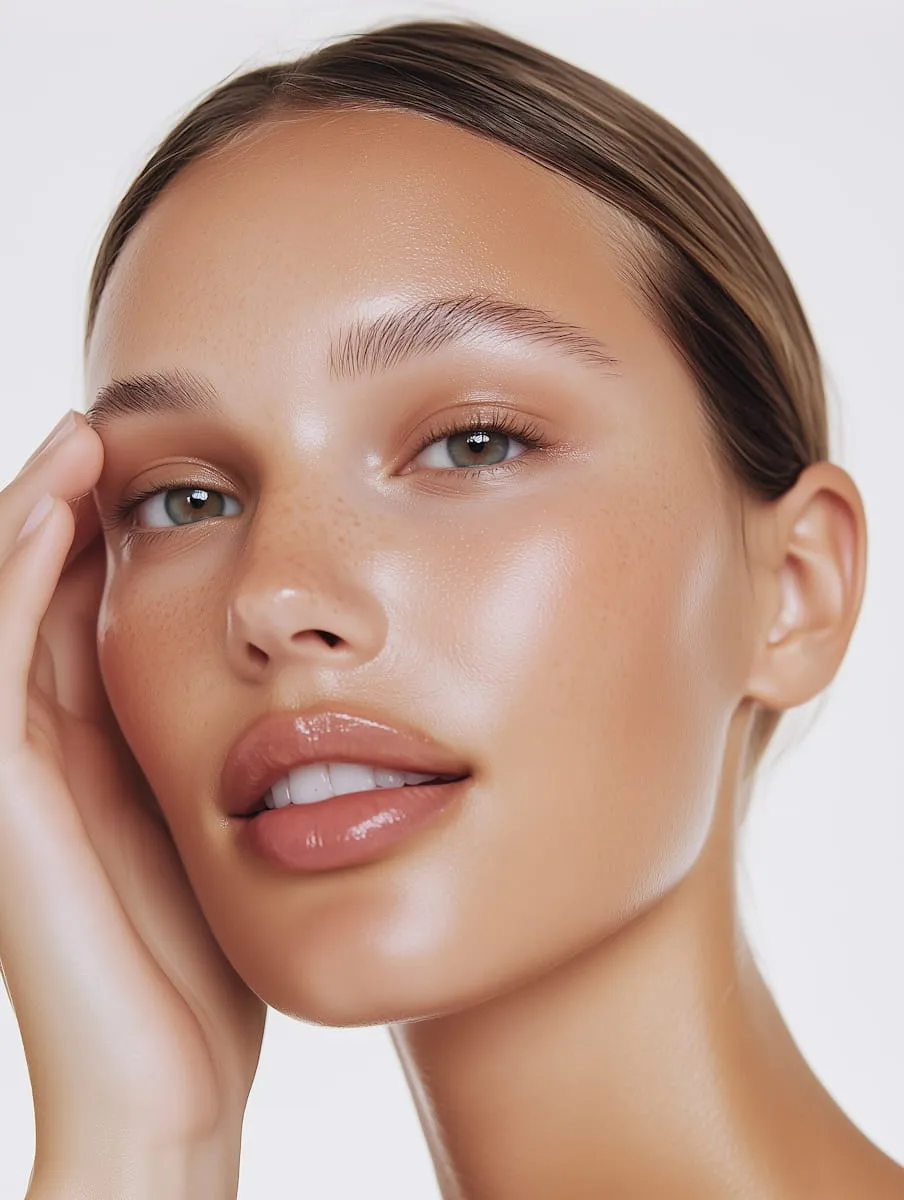
Nose shapes, bridge line
Aquiline nose (hawk nose): the curved bridge and how it ages
An aquiline nose has a bridge that curves outward along its whole length in one smooth arc, often ending in a tip that points slightly down, like the beak of an eagle. The name says as much: aquiline comes from the Latin word for eagle. It is a close relative of the Roman nose, but where a Roman nose has one bump on a straight line, an aquiline nose is curved from top to tip.
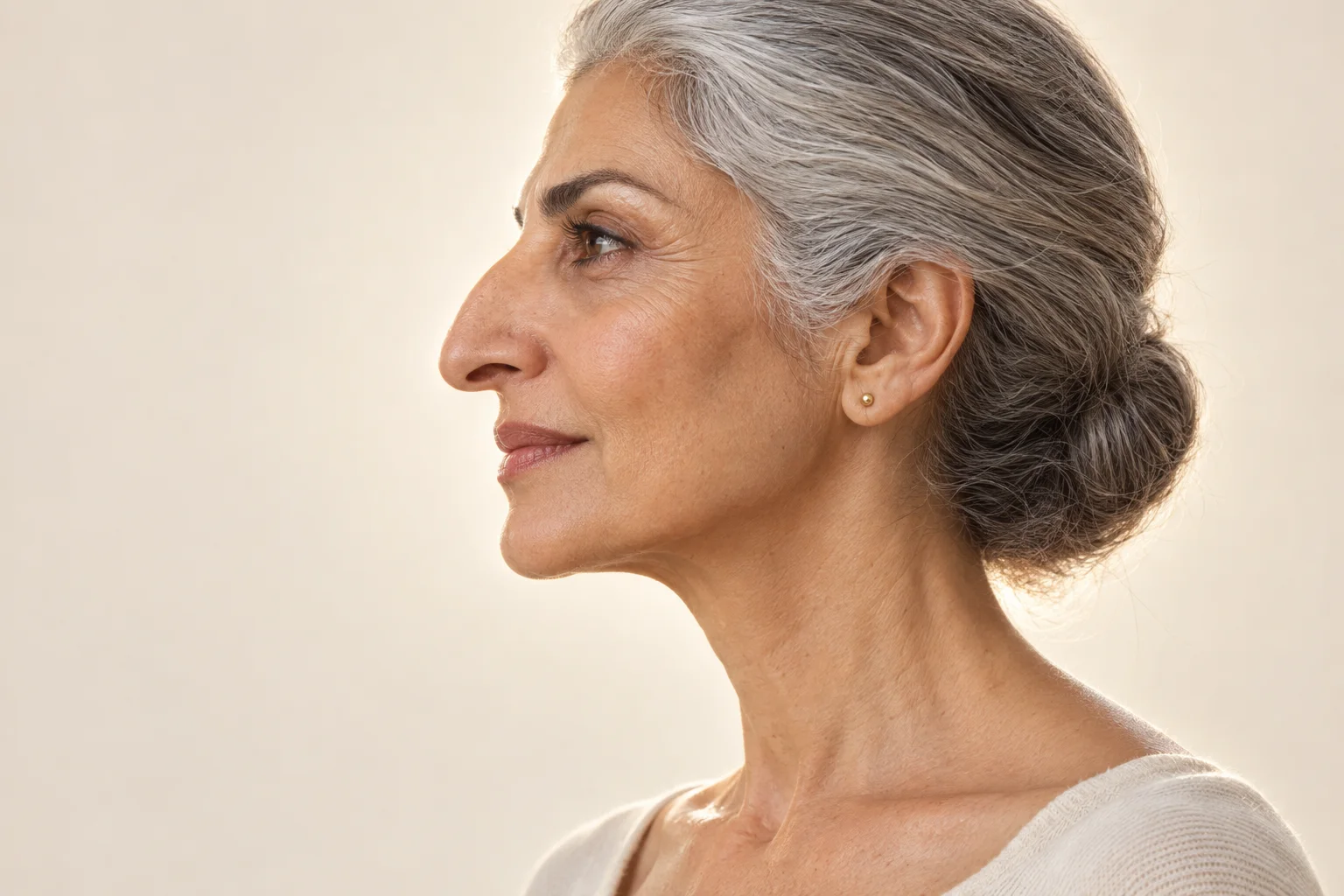
What is an aquiline nose?
Bridge The top line, brow to tip
Convex: it bows outward in one long, smooth curve rather than a single short bump.
Defines the shapeTip Its direction and fullness
Points down a little, closing the angle where the nose meets the upper lip.
Base Across the nostril wings
Often slim to average, with nostrils hidden in profile.
What is a hawk nose?
"Hawk nose" is the everyday name for the most pronounced aquiline profile: a strongly arched bridge and a tip that hooks down past the nostrils, like a bird of prey's beak. Every hawk nose is aquiline, but a gently curved aquiline nose with a level tip is not usually called a hawk nose.
The difference is mostly the tip. On a hawk nose the tip hangs below the nostril wings, so from the side the nostrils are fully hidden and the angle under the nose is tight. On a milder aquiline nose the tip sits about level with the wings.
Writers use "hawk-nosed" as shorthand for a striking, serious face. That is a storytelling habit; the shape says nothing about the person wearing it.
How to spot an aquiline profile
You are looking for two things in profile: the curve of the bridge, and the direction of the tip. Relax your face first, because a smile can pull the tip down.
Seen from the front
- The tip sits lower than the nostril wings, so you see little or none of your nostrils.
- The bridge catches light in a long, soft stripe rather than one bright spot.
- The tip can look a little narrower and more defined than the bridge.
Seen from the side
The view that matters most- The bridge bows out along its length, with no straight stretch above or below a ridge.
- The tip points down, toward your upper lip.
- The angle where the underside of your nose meets your lip is tighter than a right angle.
- Your nose looks longest in profile and noticeably shorter from the front.
Aquiline or Roman?
Look at the tip first
Skip the bridge for a moment and look at the tip. An aquiline tip usually points down, so in profile your nostrils are hidden and the angle under the nose is tight; a Roman tip usually points ahead. The Roman nose guide has the full bump-or-curve test.
A straight bridge with a low tip
A straight bridge can end in a tip that points down without being aquiline. The test is the bridge itself: lay a straight edge on it. If the edge sits flush and only the tip falls away, the bridge is straight; if the edge rocks on a long curve, it is aquiline.
How an aquiline nose changes with age
Tips tend to drop over the decades. A study that followed the same 39 people from about 17 to their late 50s found the nasal tip, and the strip of skin between the nostrils, drooping over time, which closed the angle under the nose (Pecora et al., 2008).
A tip that sits lower makes the curve above it look longer, so many noses read more aquiline at 60 than they did at 20, and a gentle arc can become a clear hawk profile without the bridge itself changing.
Glasses for a hawk or aquiline nose
- Saddle bridgeSuits this shape
- Keyhole bridge
- Adjustable pads
- Low bridge fit
Grip at the top of the slope
A long, sloping bridge gives frames plenty to rest on, but the slope means heavier frames creep down. Frames that grip at the top of the nose, with a saddle bridge that matches your bridge or with pads, stay where they belong.
Low-set bridges and strong rims
A low-set bridge, one that joins the lenses lower down the frame front, and a strong, straight top rim suit a long, curved nose; aviators and other frames with a double bar across the top have both.
Stop the slide
If frames slide, ask for pads set slightly higher and closer together, or swap hard pads for silicone ones, which grip better. Lighter frames slip less on a sloping bridge.
Lifting the tip with contour
Most of the work on an aquiline nose happens at the tip. A little shade underneath lifts it in photos, and leaving the arch unlit keeps the curve soft.
Under the tip
Side lines that follow the curve of the bridge, plus a small, soft shade on the underside of the tip, between the nostrils.
Upper bridge only
A narrow highlight on the upper bridge only, stopping before the highest point of the arch, and none on the tip.
- Shade both sides of the bridge softly, following its curve rather than straightening it.
- Dab a little shade under the tip, on the strip between the nostrils, and blend it until no edge shows.
- Highlight the upper third of the bridge, from between the brows to just above the arch.
- Leave the tip bare or set it with a matte powder, so it does not catch the light and look lower.
Where light goes wrong
- Highlight on the tip: it brings the lowest point forward.
- A shimmery highlight down the whole bridge: it traces the curve in light.
Check your nose shape
The nose shape detector reads your width, length and tip from a front photo, and your bridge and tip direction from two side-view questions. Say your bridge curves out and your tip points down, and the result is aquiline; with a tip that points ahead, the same bridge reads Roman.
Frequently asked questions
What do you call a nose that points down?
A tip that points down is often called a drooping or downturned tip. On a bridge that curves out, it makes an aquiline or hawk nose; on a straight bridge, it is simply a straight nose with a low tip.
Does an aquiline nose affect breathing?
The curve is on the outside of the nose, and breathing depends mostly on the inside, such as the wall between the nostrils. If one side often feels blocked, the crooked nose guide covers when to see a doctor.
Can an aquiline nose look straighter in photos?
A camera held slightly below eye level, or a three-quarter angle, hides much of the arc, while a full side view at eye level shows all of it. A little shade under the tip lifts it in photos too.