Eye shapes, lid
Monolid eyes: how to tell, and makeup that shows
Monolid eyes have no crease on the upper lid: the lid is one smooth surface from the lashes to the brow, often with a soft fold of skin over the inner corner. They are common in people of East Asian descent, where about half of people have no upper lid crease (EyeWiki), and they are a normal, harmless variation that needs no treatment (Cleveland Clinic). Makeup on a monolid works in gradients and lines rather than crease shading, because there is no crease to blend into.
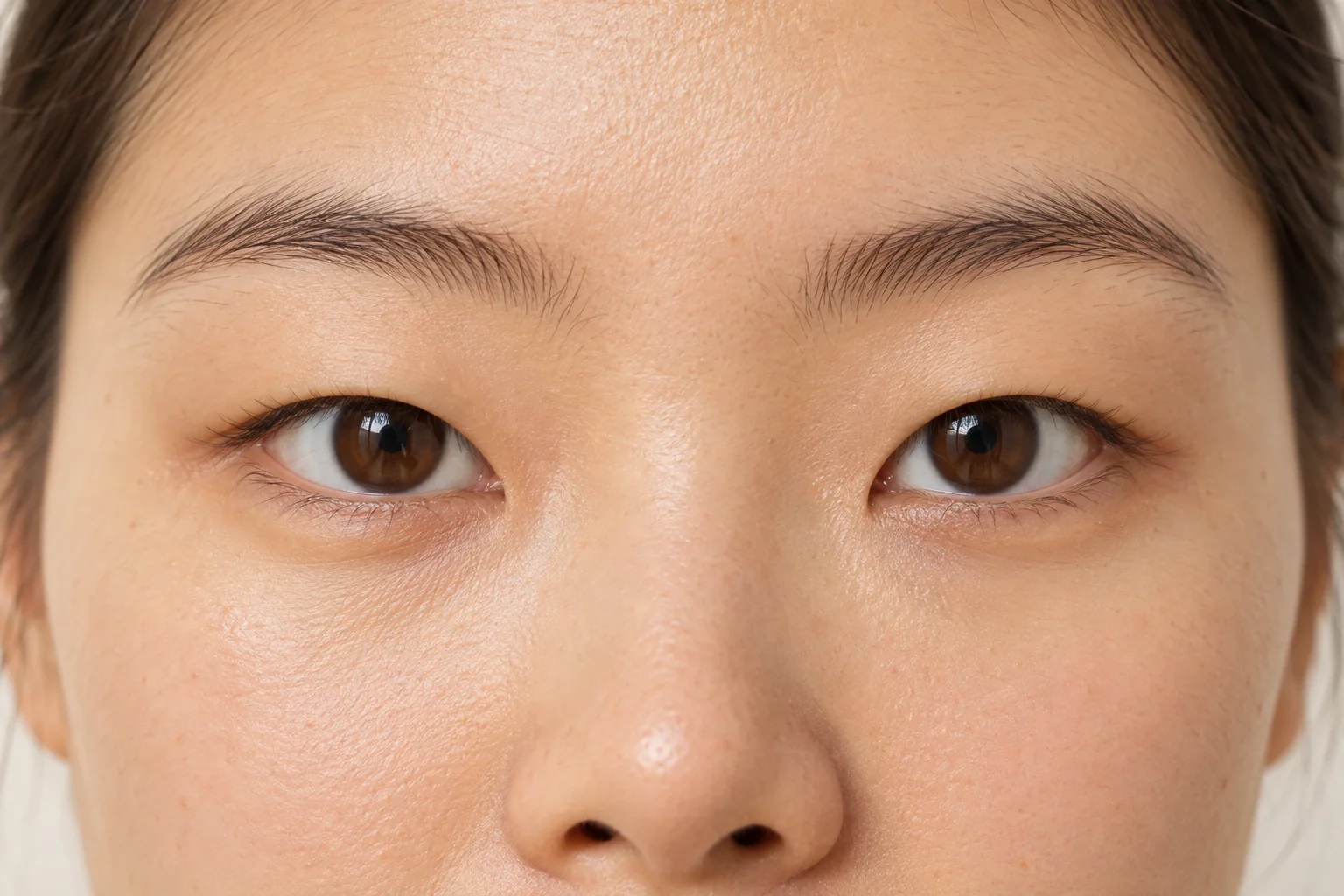
How to tell if you have monolid eyes
Look straight into a mirror in daylight, with your face relaxed and your chin level, and check these:
- With your eyes open, you see smooth lid skin from your lashes up to your brow, with no line across it.
- Close your eyes: the lid stays smooth, with no crease appearing.
- A small fold of skin may curve over the inner corner of each eye, covering the pink tissue there.
- Lashes tend to point straight out or slightly down rather than curling up on their own.
- Shadow placed on the lid stays visible when your eyes are open, rather than folding away.
How monolid eyes vary
A crease forms where fibers from the muscle that lifts the lid attach to the skin. In lids without a crease, that attachment sits lower and a pad of fat extends further down, giving a fuller, smooth lid (EyeWiki).
Lids vary between true monolids and very low or partial creases. Some people have a crease that only shows near the outer corner, or one that appears on one eye and not the other; makeup artists sometimes call this an inner double lid. If you have a faint line close to the lashes, the monolid techniques still apply, with a little more room at the outer corner.
The fold over the inner corner, called an epicanthal fold, often comes with a monolid but is a separate trait. It is found in almost all newborns, in up to 90% of Asian adults, and in about 2% of non-Asian adults (EyeWiki). It can make the eyes look a little farther apart, because it covers the inner corner.
Monolid vs hooded vs almond eyes
Monolid vs hooded
Close your eyes. Hooded eyes show a crease that hides under a fold when the eyes open; monolids stay smooth either way.
Monolid vs almond
Monolid describes the lid and almond describes the opening, so they are not alternatives: most monolid eyes have an almond-shaped opening. Use the monolid advice for shadow and the almond advice for the line.
Makeup for monolid eyes
Eyeliner
A line that is thin at the inner corner and gradually thickens toward the outer corner shows best on a monolid, because with your eyes open only the top part of a thick line shows. Draw it slightly thicker than you want it to look, check with your eyes open, and extend it in a straight or slightly lifted wing. A puppy liner, with the tail following the lower lash line, suits monolids that tilt down.
Eyeshadow
Use gradients instead of crease shading. Put the deepest shade at the lash line and blend it upward into lighter shades, so the color fades toward the brow. Look straight ahead as you blend to decide how high the color should go. A soft shimmer in the center of the lid adds dimension to a smooth lid without needing a crease.
Mascara and lashes
Straight lashes are common on monolids, so a heated or firm curler and a waterproof, lightweight mascara help the curl hold. Start at the root and wiggle upward. Clear or thin-band false lashes sit more comfortably on a smooth lid than heavy bands.
What to skip
- Drawing a fake crease with dark shadow: on a smooth lid it usually looks like a stripe.
- A thin line that you can only see with your eyes closed: check every line with your eyes open.
- Heavy, wet mascara: it weighs straight lashes down and smudges on the lower lid.
An everyday look, step by step
- Prime the lid and set it with a matte powder close to your skin tone.
- Press a medium shade along the lash line and blend it upward with your eyes open, fading it before it reaches the brow.
- Tap a satin shimmer onto the center of the lid for dimension.
- Draw a line that starts thin at the inner corner and thickens outward, then lift the tail slightly.
- Curl your lashes in two or three steps from root to tip and add a waterproof mascara.
Double eyelid tape, glue, and surgery
Some people with monolids choose to create a temporary crease with eyelid tape or glue, and some choose surgery. None of it is necessary: monolids are a normal eyelid type and need no treatment.
Tape and glue hold a fold in place for the day. Adhesives on thin lid skin can irritate it, so check with a healthcare provider before relying on them (Cleveland Clinic), keep them away from the lash line, and take them off at night.
Double eyelid surgery (Asian blepharoplasty) creates a lasting crease by linking the skin to the tissue underneath, either with buried sutures or through an incision, sometimes with removal of a little fat. It is one of the most requested cosmetic operations in Asia, and it has real risks: uneven creases are the most common problem, and a crease set too high, a drooping lid, dry eye, and a crease that fades over time can all happen (EyeWiki).
Brows and glasses for monolid eyes
Brows
With a smooth lid, the brow does a lot of framing. Straight or softly arched brows suit monolids well and keep the look balanced; a very high arch leaves a large expanse of lid between the lashes and the brow.
Glasses
Frames with a slight cat-eye or upswept top line add lift at the outer corner. Low nose bridges are common with monolids, so look for adjustable nose pads or frames labeled low bridge fit or Asian fit, which keep the lenses from resting on your cheeks.
Common combinations
Each eye shape describes one part of the eye, so most monolid eyes come with other traits too. These pairings come up most often:
Most monolid eyes have an almond opening. The monolid gradient works for shadow, and almond liner rules work for the line.
Upturned monolids have a natural lift at the outer corner. A short wing that follows the lower lid keeps it crisp.
An inner corner fold can make the eyes look farther apart. A little shadow or liner at the inner corner draws them in.
Check your eye shape from a photo
Whether you have a crease is not something a photo can measure reliably, so the detector asks: look in a mirror and say whether your lid has a crease. If you answer that it does not, your result reads monolid, and the shape of your opening (usually almond), your tilt, and your spacing come from the photo.
Frequently asked questions
Are monolid eyes rare?
No. About half of people of East Asian descent have no upper lid crease (EyeWiki), and monolids are found in people of many other backgrounds too.
What is the difference between monolid and hooded eyes?
A hooded eye has a crease that is covered by skin when the eye is open. A monolid has no crease at all, even when you close your eye.
Can monolids change over time?
Lids change with age: skin loosens and fat shifts, and some people develop a faint crease while others find a crease becomes hidden. Children often have an inner corner fold that becomes less visible as the nose bridge grows.
How do I make my monolid eyes look bigger?
Curl your lashes and use a waterproof mascara, tightline the upper waterline, and blend shadow in a gradient that is darkest at the lash line. A touch of light shimmer on the center of the lid adds dimension.