Eye shapes, lid
Hooded eyes: how to tell, and makeup that works on them
Hooded eyes have a fold of skin that drops from just below the brow bone over the eyelid crease, so when your eyes are open you see little or none of the lid between your lashes and the fold. You still have a crease; it is simply hidden, which is what separates a hooded eye from a monolid. Hooding can sit over any eye shape, often deepens with age, and changes one rule above all: do your makeup with your eyes open.
How to tell if you have hooded eyes
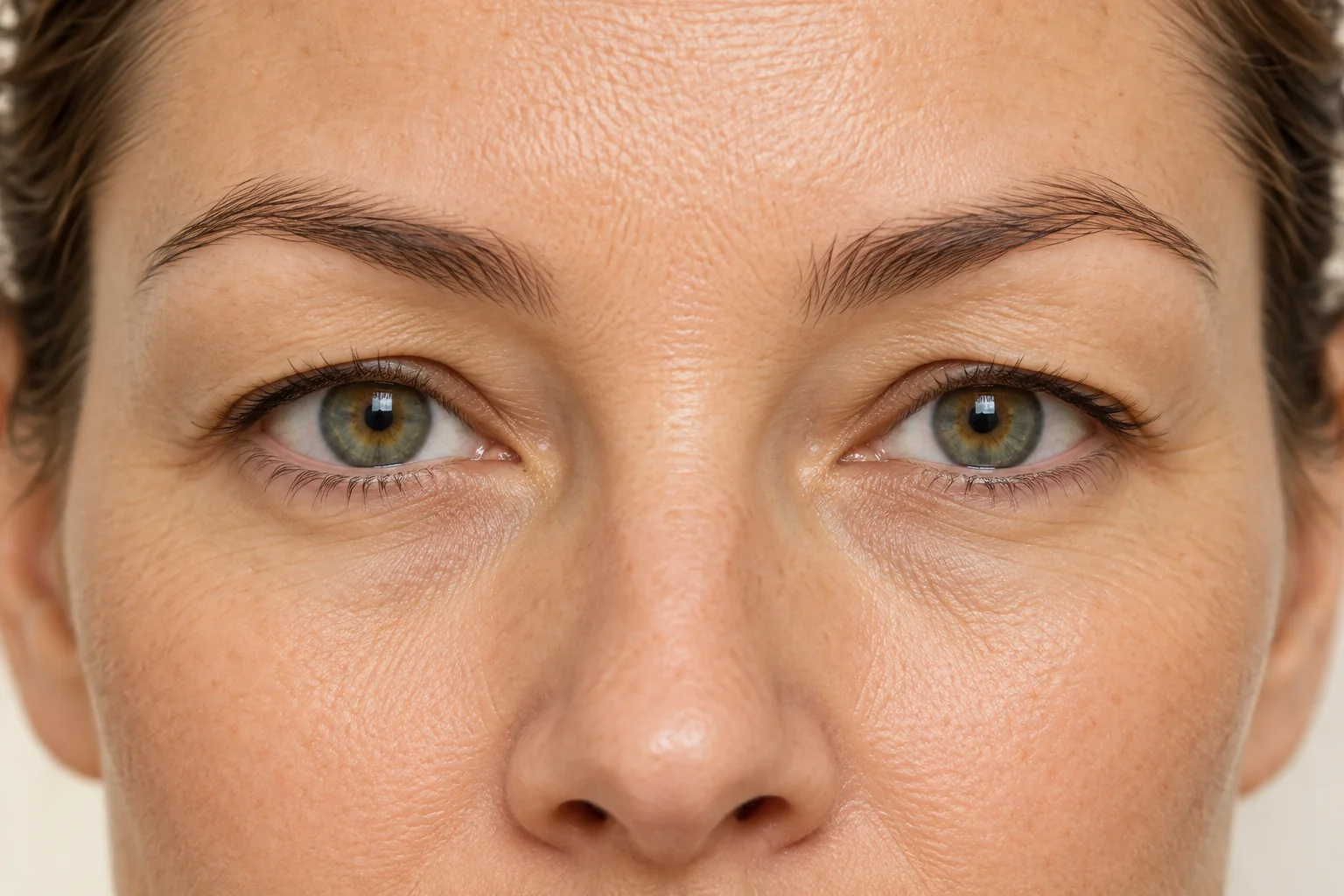
Look straight into a mirror in daylight, with your face relaxed and your chin level, and check these:
- Looking straight ahead, you see a thin strip of lid between your lashes and the skin above, or none at all.
- Close your eyes and a crease appears that you cannot see when they are open.
- Eyeshadow on your lid disappears when you open your eyes, or prints onto the fold above it by the afternoon.
- A winged liner drawn with your eyes closed looks bent or broken once you open them.
- The fold sits lowest over the outer third of each eye, and may touch your lashes there.
How hooded eyes vary
Hooding runs from slight to full. With slight hooding a thin strip of lid still shows in the middle, and most techniques work with small adjustments. With full hooding the fold rests on or near the lashes and covers the whole lid. Outer hooding drops only over the outer corner, often making the eye look a little downturned.
Hooding tends to increase with age. Upper lid skin loosens and the brows sit a little lower over time, so a fold that was slight at 25 may cover the lid at 55. When the extra skin is marked, doctors call it dermatochalasis, and it can be heavy enough to block part of your upper field of vision (EyeWiki, American Academy of Ophthalmology).
Hooding is a lid trait, so it combines with every opening and tilt. Hooded almond eyes are the most talked-about version, but hooded round eyes, hooded downturned eyes, and hooded deep-set eyes are all common, and each changes the advice slightly.
Hooded vs monolid vs deep-set eyes
Hooded vs monolid
Close your eyes and look for a crease. A hooded lid has one that hides under the fold when your eyes open; a monolid is smooth from the lashes to the brow with no crease at all.
Hooded vs deep-set
On deep-set eyes the brow bone sits forward and the lid falls into its shadow, but the lid space is usually still visible. On hooded eyes it is skin, not bone, that covers the lid. Many people have both: a prominent brow and a fold beneath it.
Hooded eyes makeup: eyeliner, eyeshadow, and lashes
Eyeliner
Line with your eyes open, looking straight ahead into the mirror. Keep the line thin and tight to the lashes across the inner half, then thicken it at the outer third, where the fold hides less of it. For a wing, map it with your eyes open: mark the tip, then draw it straight back to the lash line in a shape that skips over the fold (often called a bat wing or hooded wing), so it looks straight when your eyes are open even though it bends when they are closed. Tightlining the upper waterline defines the eye without using any lid space. The fold presses on the lid all day, so choose a smudge-proof gel or waterproof pencil.
Eyeshadow
Place your crease shade above your real crease, on the fold itself, where it can be seen when your eyes are open. Look straight ahead and blend a soft matte just above the line where the fold sits, in small side-to-side strokes, then take it a little higher at the outer corner to lift it. Save shimmer for the small visible strip of lid and the inner corner; shimmer on the fold makes it look fuller. Primer is not optional on hooded lids, because the fold rubs shadow into lines.
Mascara and lashes
Curl firmly at the root, because straight lashes disappear under the fold. A lengthening, waterproof mascara holds the curl better than a heavy volumizing one. If you wear falsies, a short, wispy half lash on the outer corner lifts the eye without weighing the fold down.
What to skip
- Thick liner across the whole lid: it vanishes under the fold, then prints onto it.
- A dark shade only in your natural crease: it is invisible when your eyes are open.
- Cream or glossy shadow without primer: the fold creases it within hours.
- Doing a wing with your eyes closed: check it with your eyes open before you finish.
An everyday look, step by step
- Prime from the lash line up to the brow bone and set it with a sheer powder.
- With your eyes open, blend a soft matte transition shade just above the fold, a little higher at the outer corner.
- Press a light shimmer onto the visible strip of lid and into the inner corner.
- Tightline the upper waterline, then draw a thin line along the outer third and flick it up with your eyes open.
- Curl your lashes and apply waterproof mascara to the upper lashes, wiggling at the root.
- Brush your brows up and fill only the tail, keeping it from drooping.
Eyeliner for hooded eyes: four styles that show
Four styles show up on a hooded lid instead of vanishing under it. Try them with your eyes open and your chin level, and judge each one from the front.
Tightlining. A soft pencil pressed along the upper waterline, under the lashes. It makes the lash line look fuller with no line on the lid at all, which is ideal when the fold reaches your lashes.
The hooded wing. With your eyes open, mark the tip of the wing on the fold, angled toward the tail of your brow. Close one eye and join the tip to the outer corner of your lash line, then fill the shape. It looks like a bent arrow with the eye closed and a straight wing with it open.
The smoked-out outer corner. Pencil along the outer third of the upper and lower lash lines, then smudge it up and out with a small brush. Soft edges hide where the fold crosses the line, so the shape stays even.
Floating liner. A thin line drawn just above the fold, following its curve, so it sits on skin that shows when your eyes are open. It works best in a color, like brown or navy, and over a primer so it does not print onto the lid.
Hooded eyes or droopy eyelids (ptosis)?
Hooding is extra skin above a lid that sits in the normal place. Ptosis is different: the upper lid margin itself, where the lashes grow, sits too low, often covering the top of the pupil, because the muscle that lifts it has stretched or weakened (Cleveland Clinic).
A quick check: lift the fold gently with a fingertip while looking straight ahead. If your lash line sits just above the pupil and the lid opens fully, it is hooding. If the lash line itself still sits low over the pupil, or one lid is clearly lower than the other, it may be ptosis.
See a doctor promptly if one eyelid starts drooping suddenly, or if drooping comes with double vision, a headache, or weakness elsewhere. Sudden ptosis can be a sign of a nerve problem and needs to be checked the same day.
Can you get rid of hooded eyes?
Makeup changes how hooded eyes look, but nothing applied to the skin removes the fold. Eye creams can hydrate and smooth the lid for a few hours, and no cream or eyelid exercise has been shown to lift a fold of skin.
The lasting options are medical. An upper eyelid lift (blepharoplasty) removes excess skin, and sometimes fat or muscle, from the upper lid through a cut hidden in the crease. Most people take about two weeks off work, bruising can take weeks to fade, and the risks include lids that are hard to close for a while, watery or sensitive eyes, uneven-looking eyes, and noticeable scars (NHS). When the hood is heavy enough to block your upper vision, see an eye doctor first: that is a medical question, not only a cosmetic one.
When the brow has dropped, a brow lift addresses the cause rather than the lid, and a clinician can lift the brow tail slightly with wrinkle-relaxing injections, an effect that wears off in a few months. A board-certified oculoplastic or plastic surgeon can tell you which part, brow or lid, is creating your hood.
Eyelid tape and strips create a temporary crease by holding the fold up. They work best on slight hooding, can irritate thin lid skin, and should come off before sleep.
Makeup for mature hooded eyes
As lid skin thins, matte and satin finishes look smoother than shimmer and glitter, which catch in fine lines. A cream-to-powder shadow pressed on with a fingertip and set with a matte powder lasts longer than a powder alone on crepey skin.
Lifting the brow tail does more for a mature hooded eye than any shadow technique. Fill the tail slightly upward rather than following hairs that have started to drop, and keep the line under the brow clean so the brow bone reads as lifted.
Skip heavy lower liner, which draws attention down, and put the definition in the upper lashes: tightline, curl, and mascara.
Brows and glasses for hooded eyes
Brows
Brows frame hooded eyes more than any other shape, because the space under them is limited. Keep the tail from sloping down, brush the hairs up, and avoid filling the underside of the brow so low that it crowds the fold. A lifted, well-groomed brow can add a few millimeters of visible lid on its own.
Glasses
Choose frames whose top rim sits at or just above the brows, so the lid area stays open. Thin or clear top rims, cat-eye, and upswept shapes lift the outer corner, where hooding is usually heaviest. Heavy, low-set rims that sit right across the fold make it look deeper.
Common combinations
Each eye shape describes one part of the eye, so most hooded eyes come with other traits too. These pairings come up most often:
Hooded almond eyes are the classic combination: an almond opening with the crease hidden. Liner can follow the almond shape; shadow goes above the fold.
Hooding at the outer corner often pulls an eye into a downturned look. Angle liner and shadow up toward the brow tail, never straight out.
Deep-set and hooded together means a prominent brow bone with a fold beneath it. Keep shadow light and matte on the fold, and let lashes do the defining.
Check your eye shape from a photo
A photo cannot reliably tell a hidden crease from an open lid, so the detector does not guess. It measures your opening, tilt, and spacing from the photo, then asks you to look in a mirror and say whether a fold covers your crease. If it does, your result reads hooded, and your other measurements stay as they were.
Frequently asked questions
Are hooded eyes common?
Yes. Hooded lids are one of the most common eyelid types, and they become more common with age as lid skin loosens and brows lower. There are no reliable figures for how many people have them, because hooding is a description, not a medical diagnosis.
Should I wear eyeliner if I have hooded eyes?
Yes, but apply it with your eyes open. Tightlining the upper waterline and a thin line that thickens at the outer third show best; a thick line across the whole lid disappears under the fold.
Are hooded eyes the same as monolids?
No. Hooded eyes have a crease that is covered by a fold of skin when the eyes are open. Monolids have no crease at all. Close your eyes and look: if a crease appears, your lids are hooded.
Why do my eyes look more hooded some days?
Puffiness adds fullness to the lid and the fold. Salty food, alcohol, short sleep, allergies, and crying all make lids swell for a few hours. Our guide to eye bags and puffiness covers what helps.
Can hooded eyes go away?
Not on their own; hooding usually increases slowly with age. Eyelid surgery (blepharoplasty) or a brow lift can reduce it, and makeup placed with your eyes open changes how much it shows.