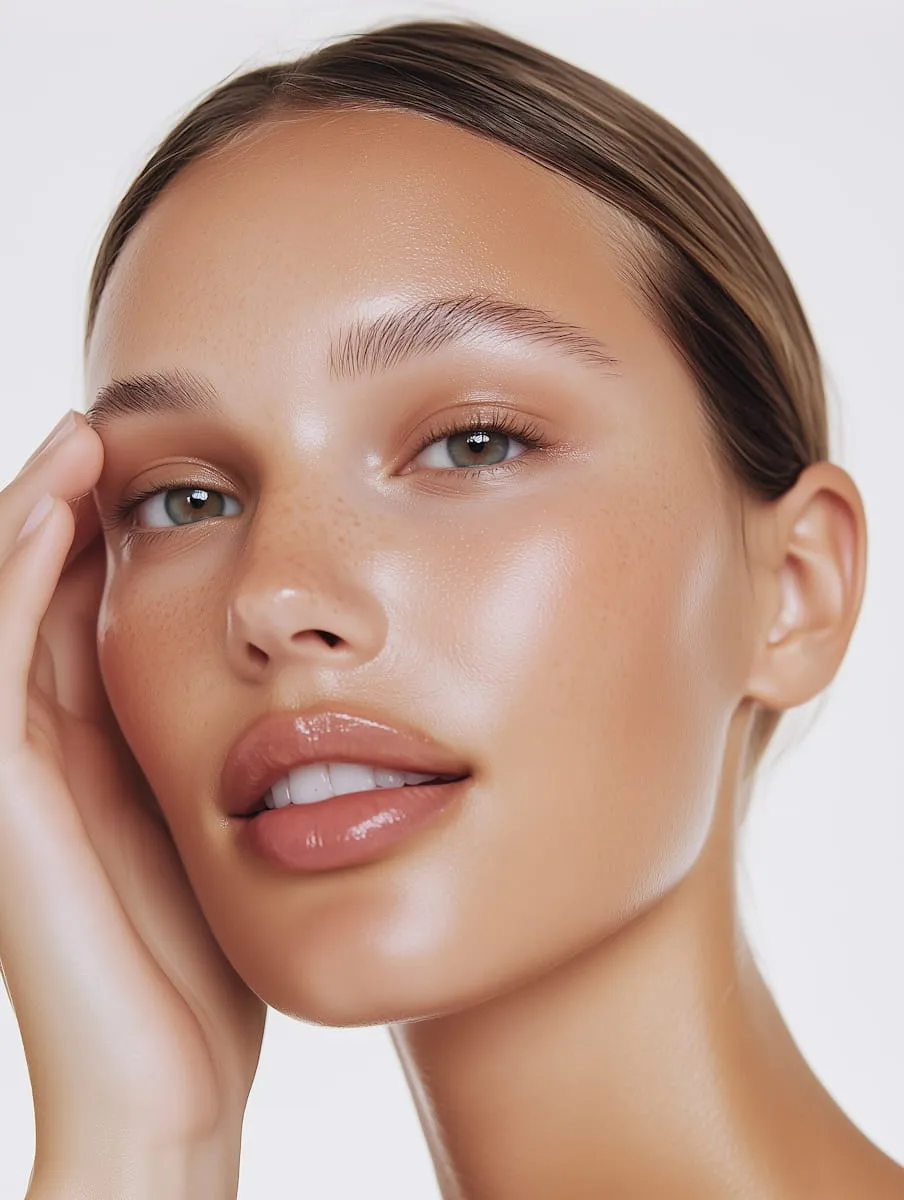
Eye color guide
Hazel eyes: why they seem to change color, and how to tell
Hazel eyes have two colors in one iris: brown or gold around the pupil that fades into green, olive, or gray toward the outer edge. The center holds more melanin, the brown pigment of skin and hair, and the outer part less, so it shows the green or gray made by light scattering in the iris fibers. Because those two zones respond differently to light, clothing, and pupil size, hazel is the eye color most often said to change.

What makes eyes hazel: two colors in one iris
Hazel is less a single color than a pattern. Inside the collarette, the wavy ridge about halfway out from the pupil, the iris is brown or gold. Past it the color thins out to green, olive, or gray.
- Brown or gold center. More melanin, packed around the pupil.
- Collarette. The ridge where the brown starts to fade.
- Green or gray edge. Less melanin, so scattered light shows through.
- Dark rim. The limbal ring, which frames both zones.
People noticed the pattern long before anyone could explain it. In the 1880s Francis Galton described eyes whose outer iris was dark gray and whose inner part was hazel (quoted in Sturm and Larsson, 2009). Today most studies still fold hazel into a single green-hazel group, and the American Academy of Ophthalmology says the genetics of hazel are still being explored (AAO).
Why do hazel eyes change color?
The iris stays the same from hour to hour. What changes is how much of each zone you can see and what light lands on it. Pupil size and the light source both change how an eye's color is perceived (Sturm and Larsson, 2009), and hazel, with two zones, shows it most.
- Window daylightBoth zones show
- Cloudy dayCool light: greener
- Warm lampWarm light: browner
- Direct sunGold center glows
Warm bulbs give off little blue, which tips a hazel eye toward brown and gold; daylight and shade bring the green back. Clothing near your face reflects a little color and changes the contrast your brain reads, so a green top makes the green zone look stronger and a brown one the brown.
Over years, a few eyes really do shift. In a long study of twins, most people had settled eye color by age 6, but 10% to 15% of white participants showed changes through adolescence and adult life (Bito et al., 1997). Some glaucoma eye drops can also darken mixed-color irises like hazel ones for good; our heterochromia guide covers those drops.
How to tell if you have hazel eyes
- Use daylightFace a window with no makeup near your eyes and a plain white top, so nothing tints the iris.
- Look at the centerCheck the area right around your pupil. Hazel eyes show brown, gold, or amber there.
- Then the outer halfIf it turns green, olive, or gray, with the brown fading into it instead of stopping at a sharp line, that is hazel.
- Step backFrom arm’s length, hazel eyes often read light brown; up close, the green appears.
- Compare morning and nightLook in daylight, then under an indoor lamp. A clear swing between greener and browner is typical of hazel.
Hazel vs amber, light brown, and green eyes
These three are the colors hazel gets mistaken for most, and each has its own giveaway.
Hazel vs amber eyes
Amber eyes are one even gold from edge to edge. Hazel always has two zones, and some green or gray at the edge.
Hazel vs light brown eyes
Light brown eyes stay brown all the way out. Look at the outer half in sunlight: that is where hazel shows its green.
Hazel vs green eyes
Green eyes can have a gold ring too. On green eyes it stays narrow; on hazel it spreads toward the edge.
Shades of hazel
How much of the iris the brown center covers, and what color the edge turns, give four common kinds of hazel.
- Green hazelMostly green, gold center
- Gold hazelBright gold center, olive edge
- Brown hazelBrown nearly to the rim
- Gray hazelBrown center, gray-blue edge
Makeup and colors for hazel eyes
Eyeshadow
Decide which half of the iris to feature. Purple, plum, and aubergine sit opposite green and bring the outer zone forward; bronze, gold, and copper match the center and make the eye read warmer and browner.
Eyeliner
Deep plum or olive liner suits hazel better than black, which flattens both colors. A gold pencil on the inner corner lights up the center of the iris.
Lashes and brows
Brown mascara keeps the look soft; black adds drama. Warm brown brows tie in with the gold center.
Clothes near your face
Clothing near your face can tip hazel eyes either way: olive, moss, and sage pull the green zone forward; rust, camel, and mustard make the gold center glow; eggplant and teal work for both.
OliveMossRustCamelEggplantTealWhich color season has hazel eyes?
A mix of warm and cool lets hazel fit many palettes. Soft Autumn and True Autumn have warm, golden hazel; True Spring has bright golden hazel; Soft Summer has a muted, grayish hazel.
- Soft and warm
Soft Autumn
Golden but muted, with colors like dried herbs and clay. - Warm and soft
True Autumn
Also called Warm AutumnGolden or copper coloring that comes alive in spice tones. - Warm and bright
True Spring
Also called Warm SpringGolden skin, golden hair, and colors like a fruit bowl. - Soft and cool
Soft Summer
Low contrast, smoky eyes, and dusty, blended color.
Frequently asked questions
Are hazel eyes rare?
Nobody has counted hazel on its own across the world, because studies fold it into one green-hazel group, so any precise percentage for hazel is a guess.
Do hazel eyes change color with mood?
Not directly. Strong emotion can widen or narrow the pupil, and that changes how much of the brown center shows, but the pigment in the iris stays the same.
Is hazel a kind of brown?
It is usually treated as its own color, between brown and green. Hazel eyes that are mostly brown, with green only at the rim, often get called brown in everyday life.
Do hazel eyes run in families?
Eye color is inherited through several genes, so hazel can run in a family and can also skip around in it. Our brown eyes guide explains how the genes work.