Eye color guide
Green eyes: how rare they really are, and what makes them green
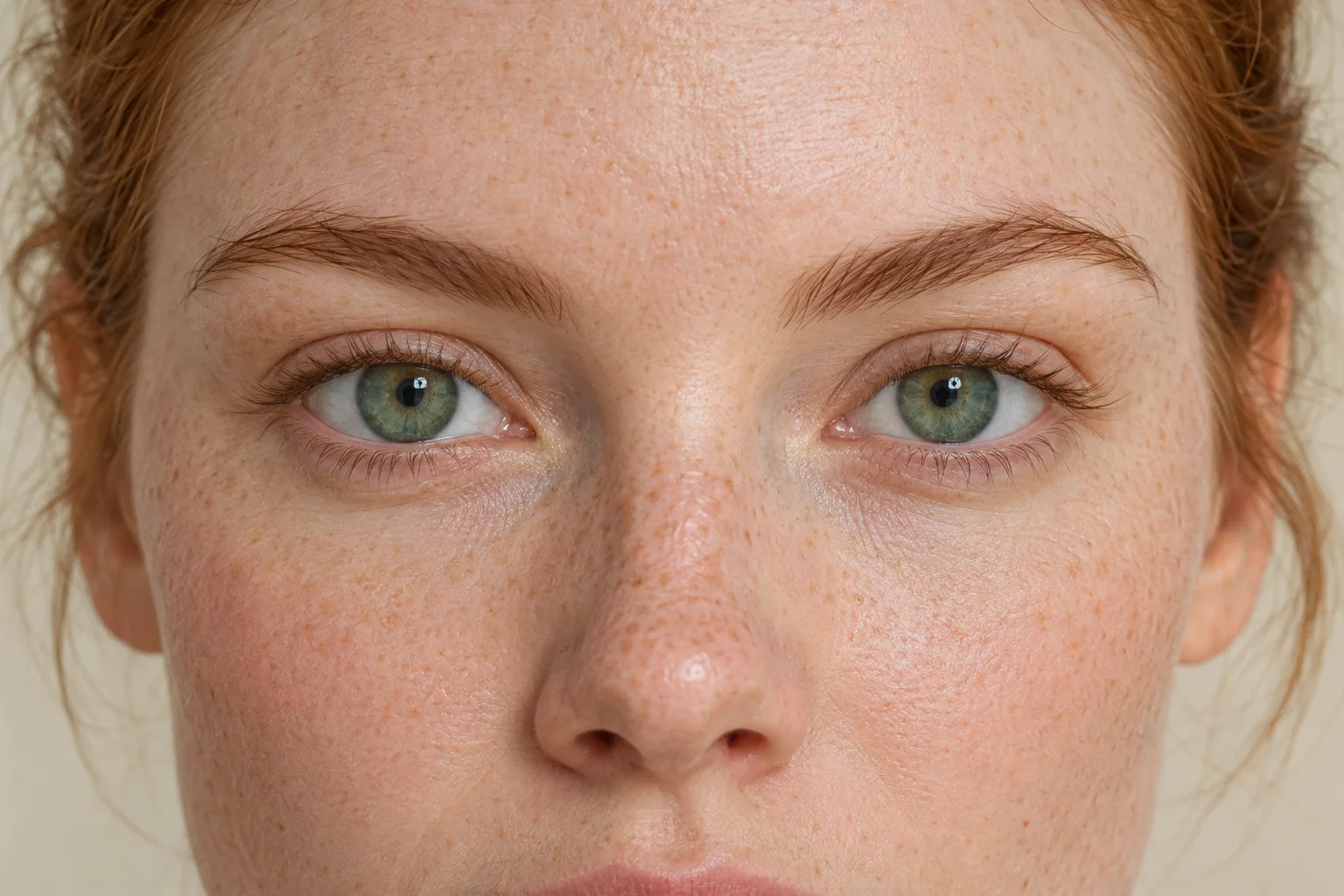
Green eyes get their color from a mix: a small amount of yellow-brown pigment in the front of the iris, laid over the same light scattering that makes blue eyes blue. The American Academy of Ophthalmology calls green the rarest eye color, at about 2% of people worldwide, but that figure hides a lot: in parts of Europe, green and green-brown eyes are ordinary. Many green eyes also have a ring of gold or light brown around the pupil.
How rare are green eyes, really?
Green is rare on a world scale for a plain reason: light eye colors are found almost only in people with European ancestry, and most of the world's people do not have it (Sturm and Larsson, 2009). Within Europe the picture flips.
- About 2%of people worldwide have green eyes, by the AAO estimateAmerican Academy of Ophthalmology
- 19% to 32%of Dutch adults in each Rotterdam Study group were rated green or mixed with brown spotsLiu et al., 2010
Treat the 2% as a rough estimate. Most studies put green and hazel in one group, the line between them is drawn by eye, and no survey has counted green on its own across the world. The Dutch group above also includes many eyes others would call hazel.
What makes eyes green?
Every iris has a dark back layer and a front layer of fibers, the stroma. Melanin, the pigment behind the color of skin, hair, and eyes, is almost absent from that front layer in blue eyes and plentiful in brown ones. Green sits between them, and the kind of melanin matters as much as the amount.
Melanin comes in two forms: eumelanin, dark brown to black, and pheomelanin, red-yellow. Chemical tests on irises linked green ones with the red-yellow form (Prota et al., 1998), and pigment cells from light irises, green among them, carried slightly more of it, though the difference could have been chance (Wakamatsu et al., 2008).
- White light enters the iris.
- The fibers scatter blue, which passes back out through a thin layer of yellow-brown pigment and reads as green.
- A modest amount of melanin, much of it the red-yellow kind, sits in the front layer.
- Red light reaches the dark back layer and is absorbed.
Put that thin yellowish layer over the blue scattered by the fibers beneath and the eye reads green, much as yellow and blue paint mix to green. The American Academy of Ophthalmology puts it the same way: green eyes depend on how light scatters off the eye as well as on how much melanin it holds (AAO).
The gold ring around the pupil
Look closely at many green eyes and you will see gold, amber, or light brown right around the pupil. Researchers call it a peripupillary ring. In a study of adolescent twins photographed for eye color, 73.5% of those with green-hazel eyes had a brown ring around the pupil (Sturm and Larsson, 2009).
- Gold ring. Extra pigment around the pupil, inside the collarette.
- Collarette. The wavy ridge where the ring stops.
- Green body. Thin yellow pigment over blue scatter.
- Limbal ring. The darker rim that frames it.
How wide that ring is decides where an eye lands between green and hazel. A thin gold rim inside a mostly green iris reads as green; a wide brown center that takes up half the iris reads as hazel. Our hazel guide has the full green vs hazel comparison.
Green vs blue-green eyes
Blue-green eyes sit right on the border, and the color around the pupil usually decides it.
Shades of green eyes
Green covers a wide range, from cool, grayish greens to warm olives with a strong gold center. Most green eyes fall into one of these four.
- Gray-greenMuted, with silver in it
- OliveGreen with a brownish cast
- EmeraldClear, saturated green
- Green-goldBright green, wide gold center
Makeup and colors that make green eyes stand out
Eyeshadow
Reds and purples sit opposite green on the color wheel, so plum, burgundy, aubergine, and mauve make green eyes look greener. Copper and rose gold warm the gold ring around the pupil.
Eyeliner
Plum or deep brown liner frames green more softly than black. A burgundy pencil smudged along the lower lashes makes the green look brighter by contrast.
Lashes and brows
Brown-black mascara keeps the focus on the iris. Warm brown brows suit green eyes with a strong gold center; cooler taupe suits gray-green.
Clothes near your face
Wear green to echo your eyes, or reds and purples to make them pop. Olive and forest bring out an olive-green iris; plum and wine make any green look brighter.
OliveForestTealPlumWineColor seasons for green eyes
Warm seasons hold most green eyes. True Spring and Bright Spring have clear, bright greens; Soft Autumn and True Autumn have olive and green-gold, often flecked with copper.
- Warm and bright
True Spring
Also called Warm SpringGolden skin, golden hair, and colors like a fruit bowl. - Bright and warm
Bright Spring
Also called Clear SpringClear eyes, high contrast, and saturated color. - Soft and warm
Soft Autumn
Golden but muted, with colors like dried herbs and clay. - Warm and soft
True Autumn
Also called Warm AutumnGolden or copper coloring that comes alive in spice tones.
Frequently asked questions
Can two brown-eyed parents have a green-eyed child?
It can happen, though a brown-eyed child is more likely. Our brown eyes guide explains why eye color does not follow simple rules.
Why do my green eyes look brown in photos?
Warm indoor light and a wide pupil both push a green eye toward olive and brown, and a phone exposing for a dim room loses the green. Face a window in daylight, turn off flash, and tap your eye to focus.
Do green eyes change color in different light?
They shift between brighter green in daylight and deeper olive under warm bulbs, because part of their color comes from scattered light. The iris itself stays the same.