Eye color guide
Gray eyes: what makes them gray, and how to tell gray from blue
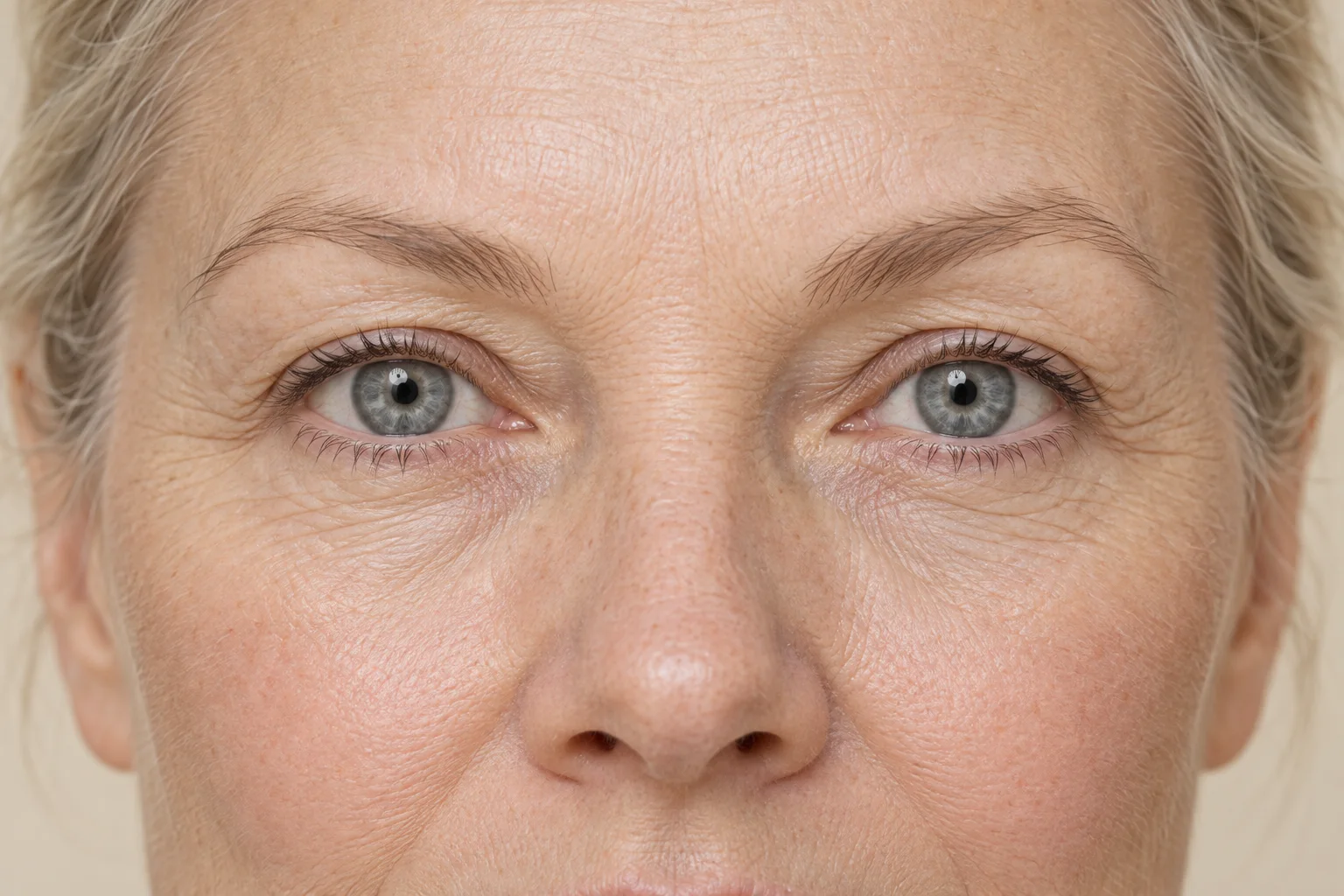
Gray eyes have very little melanin, the brown pigment found in skin, hair, and eyes, in the front of the iris, like blue eyes, but they scatter light more evenly, so they look silver, slate, or smoky instead of clearly blue. Researchers usually count gray together with blue, so nobody knows how many people have gray eyes, and the little that is known about what separates the two points to the iris fibers: how thick and dense they are, and how much white collagen they hold.
Gray vs blue eyes: how to tell them apart
Gray and blue sit next to each other on the same scale, and plenty of eyes are somewhere in between. Judge the middle band of the iris, between the ring around the pupil and the dark rim, in good daylight.
Gray vs blue eyes
In good daylight, blue eyes show a definite blue in the middle of the iris. Gray eyes show silver, pewter, or slate there, with blue only as a tint.
The scarf test for gray eyes
Pale eyes pick up the color held under the chin, and how far they move tells gray from blue. Stand at a window in daylight and try three scarves or tops, one at a time.
- CharcoalGray reads at its most silver. Blue stays blue.
- Denim blueGray drifts a little toward blue; blue turns vivid.
- OliveGray shows a hint of green; blue goes teal.
If the denim makes a big change, your eyes lean blue. If every scarf moves them only a little and charcoal makes them look brightest, they are gray. Somewhere in the middle is blue-gray, which is common.
What makes eyes gray?
Gray irises hold little pigment in the stroma, the front layer of fibers. In their review of iris color genetics, Sturm and Larsson describe the shades of blue, gray, green, and hazel as set by how thick and dense the iris is and how much white collagen fiber builds up in it. They also note that where the front layer is thin, the dark back layer absorbs the light that gets through and gives the white fibers a gray tinge (Sturm and Larsson, 2009).
- Daylight enters the iris.
- Thicker, denser fibers scatter more of every color, so what comes back looks silver, not blue.
- Like a blue iris, the front layer holds very little melanin.
- Some light still reaches the dark back layer, which can show through a thin front layer as a gray tinge.
A common explanation adds that denser fibers scatter all colors of light more evenly, the way a cloud looks white while the open sky looks blue. That fits what is known, but no study has measured it in gray eyes directly, so treat it as the best current idea rather than a settled fact.
Even ophthalmologists say this part is unfinished: the American Academy of Ophthalmology lists bluish-gray among the colors scientists are still working out (AAO).
How rare are gray eyes?
No one has counted them. Most eye color studies sort people into three groups, blue, green-hazel, and brown, which puts gray in with blue (Sturm and Larsson, 2009). One large Dutch study used five groups, but its palest group was gray and light blue together:
- 42% to 58%of Dutch adults in each Rotterdam Study group were rated gray or light blue, one shared categoryLiu et al., 2010
- 3groups in the scale most eye color research uses: blue, green-hazel, and brownSturm and Larsson, 2009
So claims that gray is the rarest eye color, or that a precise small percentage of people have it, have no data behind them. What can be said is that gray belongs to the light-eyed end of the scale, which is common in parts of Europe and rare elsewhere.
Makeup and colors for gray eyes
Eyeshadow
Gray is close to neutral, so almost any shade shows up against it. Charcoal and smoky plum make gray look deeper and more silver; copper and warm brown pull out any blue in it; soft taupe keeps the whole look quiet.
Eyeliner
A charcoal or plum pencil smudged along the upper lashes frames gray without the harsh edge of black. Silver or pewter on the inner corner picks up the iris itself.
Lashes and brows
Black-brown mascara gives pale eyes contrast. Brows filled in a cool taupe, not warm brown, sit well with the gray.
Clothes near your face
Gray eyes take on the color next to them. Slate and silver make them look their most silver; denim and navy tip them blue; olive and sage can bring out a hint of green.
SlateSilver graySoft navyDusty roseBurgundyColor seasons with gray eyes
Soft, cool coloring is where gray eyes turn up most. Light Summer pairs them with pale ash hair, True Summer and Soft Summer with gentle, blended contrast, and Bright Winter with dark hair, where clear gray eyes look almost luminous.
- Light and cool
Light Summer
Soft ash or pale hair, gentle contrast, and powdery pastels. - Cool and soft
True Summer
Also called Cool SummerPink or rosy skin, ash hair, and blue-based mid-tones. - Soft and cool
Soft Summer
Low contrast, smoky eyes, and dusty, blended color. - Bright and cool
Bright Winter
Also called Clear WinterSparkling eyes and contrast that wants electric color.
Frequently asked questions
Is it gray eyes or grey eyes?
Both. Gray is the usual American spelling and grey the British one; they describe the same eye color.
Can gray eyes change color?
Their look shifts with light and clothing all the time, but the iris itself rarely changes in adults. Our hazel guide covers the real changes some eyes go through over years, and if one eye changes and the other does not, see when to see an eye doctor.
Can you have gray eyes and dark hair?
Yes. Gray eyes come with every hair color. In seasonal color analysis, clear gray eyes against dark hair are one of the looks described under Bright Winter.