Eye color guide
Amber eyes: the golden eye color, and amber vs hazel
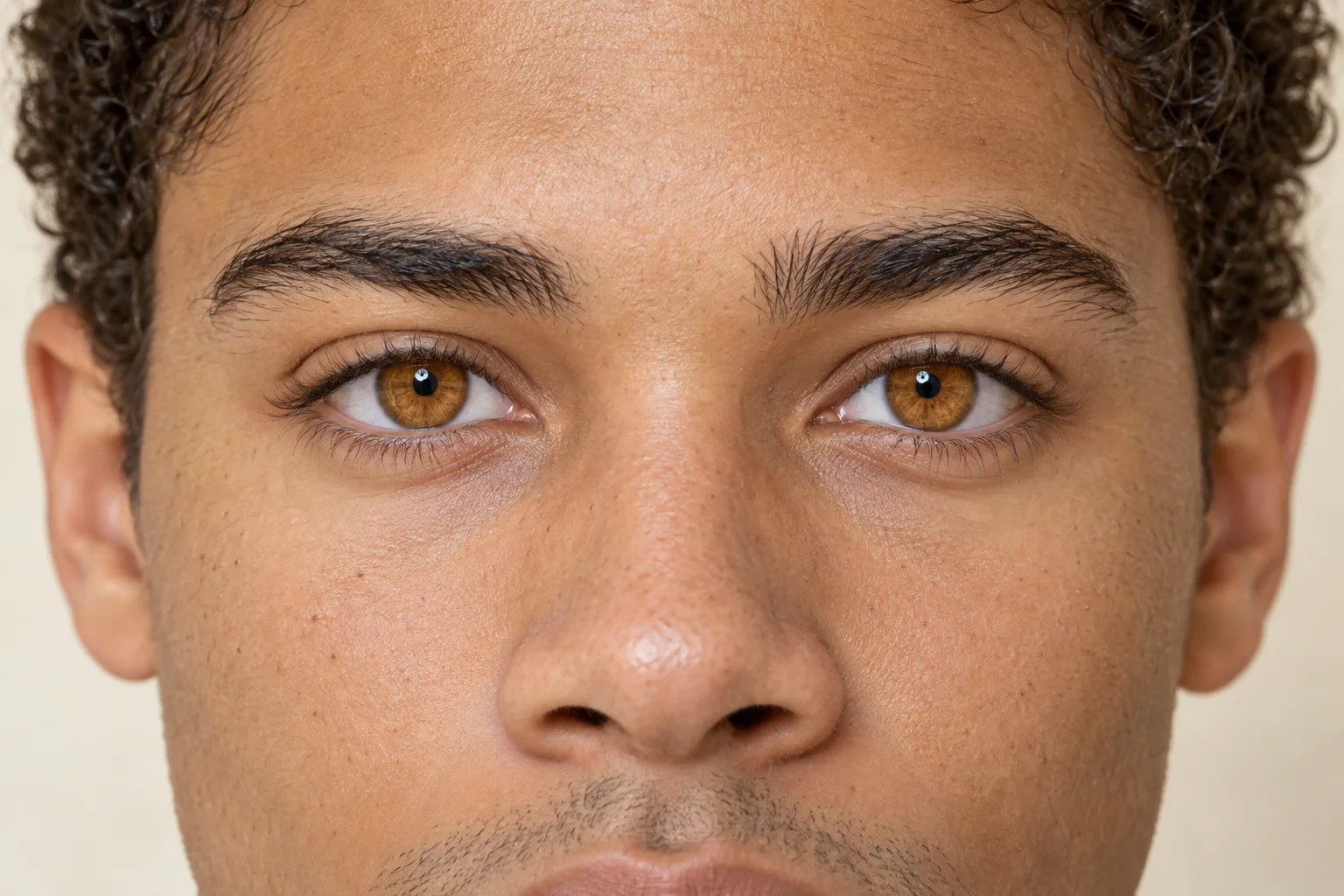
Amber eyes are one even golden color across the whole iris, from honey and gold to copper, with none of the green that marks hazel eyes. They are uncommon and almost never studied on their own, so a lot of what you read about them, including the idea that a pigment called lipochrome makes them gold, is not backed by research. What is known points to melanin, the pigment that colors eyes, skin, and hair: amber irises seem to hold a modest amount of it, with relatively more of its red-yellow form.
What makes eyes amber? The lipochrome myth and the evidence
You will often read that a yellow pigment called lipochrome makes amber eyes gold. The pigments that have actually been measured in human irises are the two forms of melanin, dark eumelanin and red-yellow pheomelanin (Prota et al., 1998), and we found no modern study that identifies lipochrome in the human iris.
No study has looked at amber eyes as a group of their own either. The closest evidence comes from lab work on the pigment cells of the iris. In one study, cells from light-colored irises, a group that put yellow-brown eyes alongside hazel, green, and blue ones, held a little more pheomelanin than cells from dark irises, though that difference was small enough to be chance. Cells from dark irises held much more melanin overall, with a far higher share of the dark form (Wakamatsu et al., 2008).
- Daylight enters the iris.
- Warm gold light comes back out; the blue that the fibers scatter is soaked up before it can escape.
- The front layer holds a moderate amount of melanin, likely with more of the red-yellow form than brown eyes have.
- Little light reaches the dark back layer.
That fits what amber looks like: enough melanin to hide the blue scatter that makes eyes blue or green, but a lighter, yellower mix than brown. It is a reasonable explanation, not a measured one, and until someone studies amber eyes directly, red-yellow pheomelanin is the better-supported answer.
Amber vs hazel eyes: the two-spot check
Amber and hazel are easy to confuse, and one question settles it: is the color the same all the way across the iris? In a mirror, by a window, look at two spots, one just outside the pupil and one just inside the dark rim.
Not sure it is amber rather than light brown? Hold a sheet of white paper beside your face: amber reads yellow-gold to copper against it, light brown reads tan or caramel. For how hazel behaves in warm light and shade, see hazel vs amber, row by row.
How rare are amber eyes?
No survey has counted them. Research scales either fold amber into light brown or into the green-hazel group, and no medical body publishes a figure for it. Any percentage you see for amber eyes is a guess.
What can be said is that a truly even gold iris is unusual, and that many eyes called amber are really light brown or hazel with a strong gold center. The two-spot check above sorts out which one you have.
Why amber eyes glow in sunlight
Gold reflects warm light strongly, so amber eyes change more with the time of day than with clothing. Low evening sun can turn them almost orange.
- Window daylightHoney gold
- Direct sunBright gold to copper
- Warm lampDeeper, coppery
- Cloudy dayCloser to light brown
Shades of amber
- HoneySoft, light gold
- GoldBright yellow-gold
- CopperRed-gold, almost orange
Makeup and colors for amber eyes
Eyeshadow
Cool, deep shades make gold look brightest: navy, plum, aubergine, and deep teal. Copper and gold shadow match the iris instead, for a warm, glowing look.
Eyeliner
Navy or deep teal liner along the upper lashes is the quickest way to make amber eyes look lit from inside. Plum works on the lower lash line.
Lashes and brows
Black mascara gives the gold a strong frame. Brows in warm brown keep everything in the same family.
Clothes near your face
Blue-greens and purples sit opposite gold, so teal, navy, and deep purple make amber eyes glow. Rust, mustard, and camel echo the gold for a softer effect.
TealNavyDeep purpleRustMustardColor seasons for amber eyes
Amber is a warm color, and it belongs with warm seasons. True Autumn lists amber among its eye colors; True Spring and Bright Spring have the brighter golden and topaz versions.
- Warm and soft
True Autumn
Also called Warm AutumnGolden or copper coloring that comes alive in spice tones. - Warm and bright
True Spring
Also called Warm SpringGolden skin, golden hair, and colors like a fruit bowl. - Bright and warm
Bright Spring
Also called Clear SpringClear eyes, high contrast, and saturated color.
Frequently asked questions
Can amber eyes be natural?
Yes. Amber is a natural eye color, just an uncommon one. An iris that looks orange or yellow only in one photo is more often a trick of warm light.
Are amber eyes the same as golden eyes?
Yes, the two names describe the same thing: an iris that is one even gold, honey, or copper color.
Why are amber eyes called wolf eyes?
It is a nickname borrowed from the golden eyes of wolves. It describes the same even gold iris; it is not a separate eye color.
What ethnicity has amber eyes?
No study has counted amber eyes by ancestry, so claims that tie them to one group have no data behind them. Amber eyes are seen in people of many backgrounds.