Tone & undertone
Skin tone chart: complexion names from fair to deep
A skin tone chart with common skin complexion names, from porcelain and ivory to caramel and espresso, plus how the Fitzpatrick and Monk scales work.
Key takeaways
- Most skin complexion names fit five depth groups: fair, light, medium, tan, and deep.
- Descriptive names like ivory, honey, caramel, and espresso describe depth, and many also hint at an undertone.
- The Fitzpatrick scale classifies skin by how it reacts to the sun, not by color names.
- The 10-shade Monk Skin Tone Scale was released by Google with sociologist Ellis Monk to describe a wider range of skin tones fairly.
- There is no single official naming system, so pair a depth name with your undertone for the most useful description.
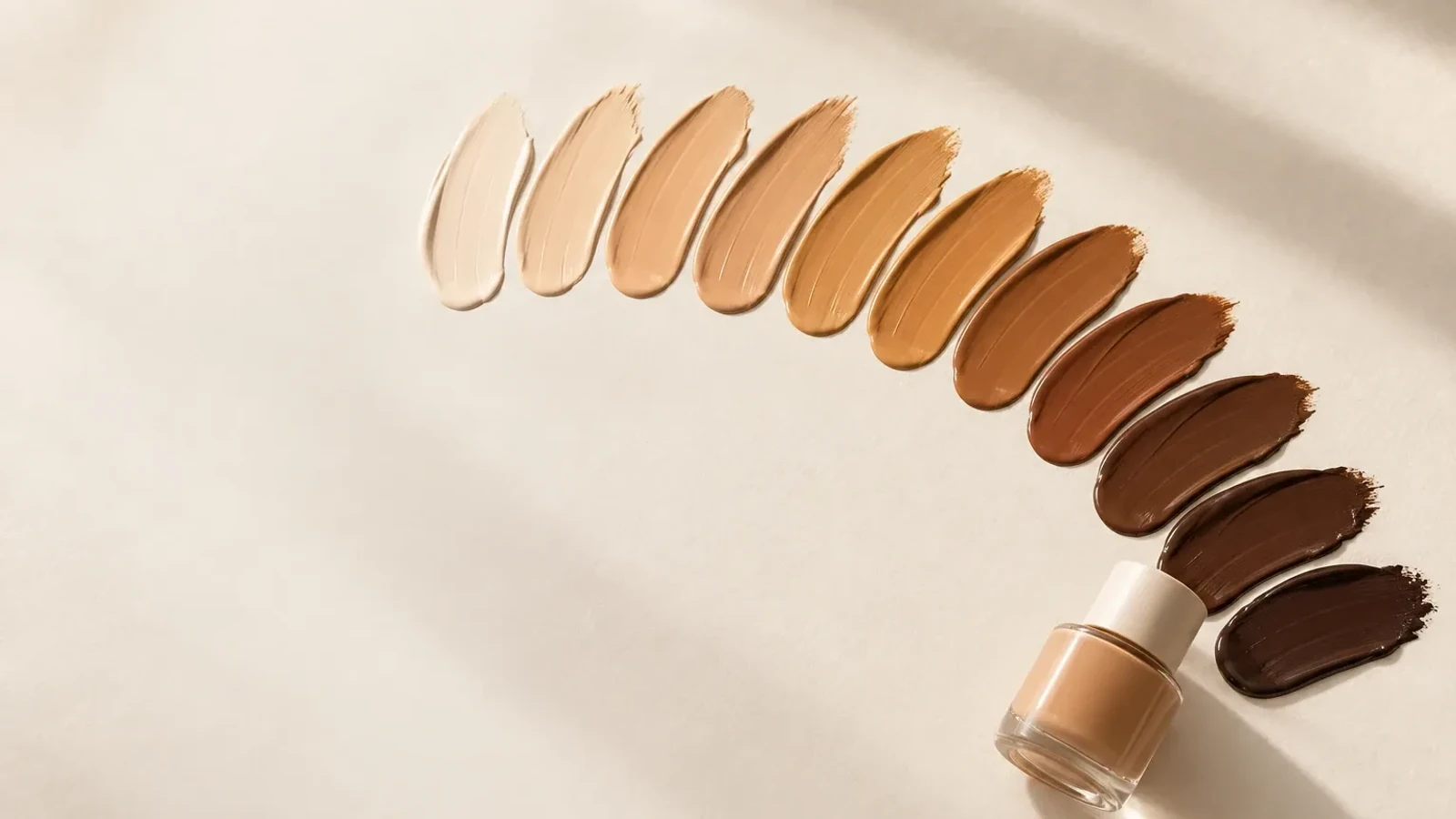
Most skin tones fall into five depth groups: fair, light, medium, tan, and deep. Within those groups, people use descriptive complexion names such as porcelain, ivory, beige, honey, olive, caramel, mocha, and espresso, and many add an undertone word like warm, cool, or neutral. There is no single official system, but the chart below covers the names you will see most on foundation labels, in color analysis, and online.
Dermatologists and researchers use different tools. The Fitzpatrick scale sorts skin by how it reacts to the sun, and the 10-shade Monk Skin Tone Scale was built to describe a wider range of skin colors fairly. We cover both below.
The skin tone chart: five depth groups
Depth describes how light or deep your skin is. It is the first thing to know when you name your complexion or match foundation.
- Fair
- Light
- Medium
- Tan
- Deep
| Depth group | Common names | What it usually looks like |
|---|---|---|
| Fair | Porcelain, ivory, alabaster, pale | Very light skin that burns easily and shows redness readily |
| Light | Beige, sand, peach, light olive | Light skin with visible warmth, pinkness, or olive |
| Medium | Honey, golden, olive, almond | Mid-depth skin that usually tans |
| Tan | Caramel, bronze, amber, chestnut | Deeper golden or brown skin |
| Deep | Mocha, cocoa, espresso, ebony, mahogany | Rich brown to very deep brown skin |
Screens vary, so treat the colors on any skin color chart, this one included, as approximations. Your skin will also look different in daylight, under warm bulbs, and in summer versus winter.
Skin complexion names, explained
These descriptive names come from cosmetics and everyday language rather than medicine. Brands use them loosely, so the same word can mean slightly different shades in different lines.
Fair and light skin colors
Porcelain and alabaster describe the palest skin, often with a cool pink or neutral cast. Ivory is slightly deeper and often warmer or more yellow. Beige and sand describe light skin with a soft yellow or neutral cast, while peach suggests light skin with a warm pink-orange glow. Light olive is light skin with a muted green-yellow undertone.
- Porcelain
- Ivory
- Peach
- Beige
- Sand
- Light olive
Medium skin colors
Honey and golden describe medium skin with a warm, glowing yellow cast. Almond is a neutral medium tan. Olive at medium depth is the classic olive most people picture, often tanning easily and looking greenish-beige in winter. Our guide to the olive skin tone covers it in detail.
- Honey
- Golden
- Almond
- Olive
Tan skin colors
Caramel is a warm, golden-brown tan (more on it below). Bronze is a deeper, often slightly red-brown tan, amber leans orange-gold, and chestnut is a rich medium-deep brown with red warmth.
- Caramel
- Amber
- Bronze
- Chestnut
Deep skin colors
Mocha and cocoa describe deep brown skin, often warm or neutral. Mahogany suggests deep skin with a red undertone. Espresso and ebony describe the deepest browns, which can carry warm, neutral, or cool undertones.
- Mocha
- Mahogany
- Cocoa
- Espresso
- Ebony
What is a caramel skin tone?
A caramel skin tone is a medium-to-tan skin color with a warm golden-brown cast, like the candy it is named after. It sits between honey and bronze on most charts. Caramel skin usually has a warm or warm-neutral undertone and tans easily.
People of many backgrounds describe their skin as caramel, including Black, Latin American, South Asian, Middle Eastern, and mixed-heritage people. Gold jewelry, warm earth tones, and rich jewel tones like emerald and cobalt tend to flatter it. In foundation, look for medium-tan shades labeled warm or golden, and check that they do not turn orange as they dry.
- Light caramel
- Caramel
- Deep caramel
Skin colors vs skin complexion: is there a difference?
People use the two terms interchangeably, but there is a useful distinction. Skin color, or skin tone, is the shade itself: fair, medium, deep, and so on. Skin complexion often means the overall look of the skin, which includes color but also clarity, texture, evenness, and glow. “A clear complexion” says nothing about color.
That is why two people with the same skin color can describe their complexion very differently. One may see redness, the other dark spots, the other a dull surface. Color names help you shop for makeup. Complexion is what most skin care is trying to improve.
How dermatologists classify skin: the Fitzpatrick scale
The Fitzpatrick scale is the system you will hear about at a dermatologist’s office, but it does not name colors. It sorts skin by how it reacts to ultraviolet light. Harvard dermatologist Thomas Fitzpatrick created it in 1975, originally for people with white skin, to help choose UV doses for psoriasis treatment, as a 2021 review in Skin Health and Disease explains. Darker types were added later.
| Type | Typical description | Sun reaction |
|---|---|---|
| I | Pale white skin, often light eyes and blond or red hair | Always burns, does not tan |
| II | Fair skin | Burns easily, tans poorly |
| III | Darker white skin | Tans after an initial burn |
| IV | Light brown skin | Burns minimally, tans easily |
| V | Brown skin | Rarely burns, tans darkly and easily |
| VI | Dark brown or black skin | Never burns, always tans darkly |
Descriptions above follow DermNet’s phototype guide. The scale has real limits. Self-reported types are often inaccurate, and the same review argues that labels like “never burns” can give people with darker skin a false sense of security about sun damage and skin cancer. Everyone needs sun protection.
You can estimate your own type with our free Fitzpatrick skin type test. Use it for sun-care planning, not as a color name.
Free toolFitzpatrick skin type testThe dermatology scale for how your skin reacts to sun.The Monk Skin Tone Scale
The Monk Skin Tone Scale is a 10-shade scale developed by Harvard sociologist Dr. Ellis Monk, who studies skin tone and colorism. Google announced it in May 2022 and released it openly for anyone to use in research and product development. In Google’s research with US participants, people said it represented their skin better than the existing tech industry standard, especially people with darker skin.
Its main job is fairness in technology: checking that cameras, image search, and AI systems work well across skin tones. At launch, Google said it would use the scale in image search, where people could refine some makeup searches by skin tone. The shades below are the published MST swatches from Google’s skin tone site, split into two rows.
- MST 1
- MST 2
- MST 3
- MST 4
- MST 5
- MST 6
- MST 7
- MST 8
- MST 9
- MST 10
Notice how many more steps the Monk scale gives the medium and deep range than older systems do. It is not a foundation guide, but it is a fairer reference point when you want to describe where your skin sits.
Other ways skin color is measured
Researchers who need precise numbers measure skin with a colorimeter and calculate the individual typology angle (ITA), which groups skin into six categories from very light to dark. A review in the International Journal of Molecular Sciences describes this method and notes that skin color comes mainly from melanin, with smaller contributions from carotenoids and blood. It is used in studies, not in everyday shopping.
Using skin tone names to shop for foundation
Foundation brands often mix both ideas: a depth number and an undertone letter. Many lines number their shades from light to deep and add W for warm, N for neutral, or C for cool, and a few also offer O for olive. The shade name on top, like “Ivory” or “Caramel”, is mostly marketing.
That has two practical consequences. First, numbers and names do not transfer between brands. A shade called “Sand” in one line can be lighter, deeper, or pinker than “Sand” in another. Second, the undertone letter is often more useful than the name, because it tells you which family to swatch first.
The most reliable shortcut is to start from a shade you already know matches you. Many brand websites and retailers let you search for an equivalent shade across lines, which is a better starting point than guessing from names. Then swatch two or three options on your jaw and check them in daylight after 10 minutes, since many formulas darken slightly as they dry.
How to find your place on the skin tone chart
- Use daylight. Stand near a window, out of direct sun, with a clean face and no makeup.
- Look at your jaw and neck, not your hands, which are often a different shade.
- Pick a depth group first, then the descriptive name that feels closest.
- Add your undertone. “Medium, warm” or “deep, neutral” is far more useful than a name alone. Our guide to warm, cool, and neutral undertones shows you how to tell.
- Expect to shift. Many people move one step lighter or deeper between winter and summer.
Color names are a starting point, not a box. Once you know your depth and undertone, foundation shopping gets faster, and you can turn your attention to how your skin is actually doing. A selfie-based AI skin analysis is one way to see that in a single report.
Sources
- PubMed: Skin cancers in skin types IV-VI: Does the Fitzpatrick scale give a false sense of security?
- DermNet: Skin phototype (Fitzpatrick skin type)
- Google: Improving skin tone representation across Google
- Google: Skin Tone Research
- PubMed: Clinical and Biological Characterization of Skin Pigmentation Diversity and Its Consequences on UV Impact
Frequently asked questions
What is the most common skin tone?
There is no reliable global count of skin tones by name, and the answer depends on the scale used. Medium and tan to deep shades describe a large share of the world's population, which is why fuller foundation ranges matter.
What is the difference between skin tone and skin type?
Skin tone is your color and depth. Skin type describes how your skin behaves: oily, dry, combination, normal, or sensitive. You need both to choose products well, and they are unrelated to each other.
Is olive a skin tone or an undertone?
Strictly, olive is an undertone: a muted green-yellow cast that can sit under fair, medium, or deep skin. People often use it as a skin tone name for medium olive skin, which is why it shows up on most charts.
Can your skin tone change over time?
Your depth shifts with sun exposure and the seasons, and dark spots or redness can make it look uneven. Your undertone stays fairly stable, so recheck your foundation shade when the seasons change rather than assuming you have a new undertone.
This article is general education, not medical advice. GoodSkin is a cosmetic tool and does not diagnose skin conditions. If something hurts, spreads, bleeds, or changes quickly, see a dermatologist.