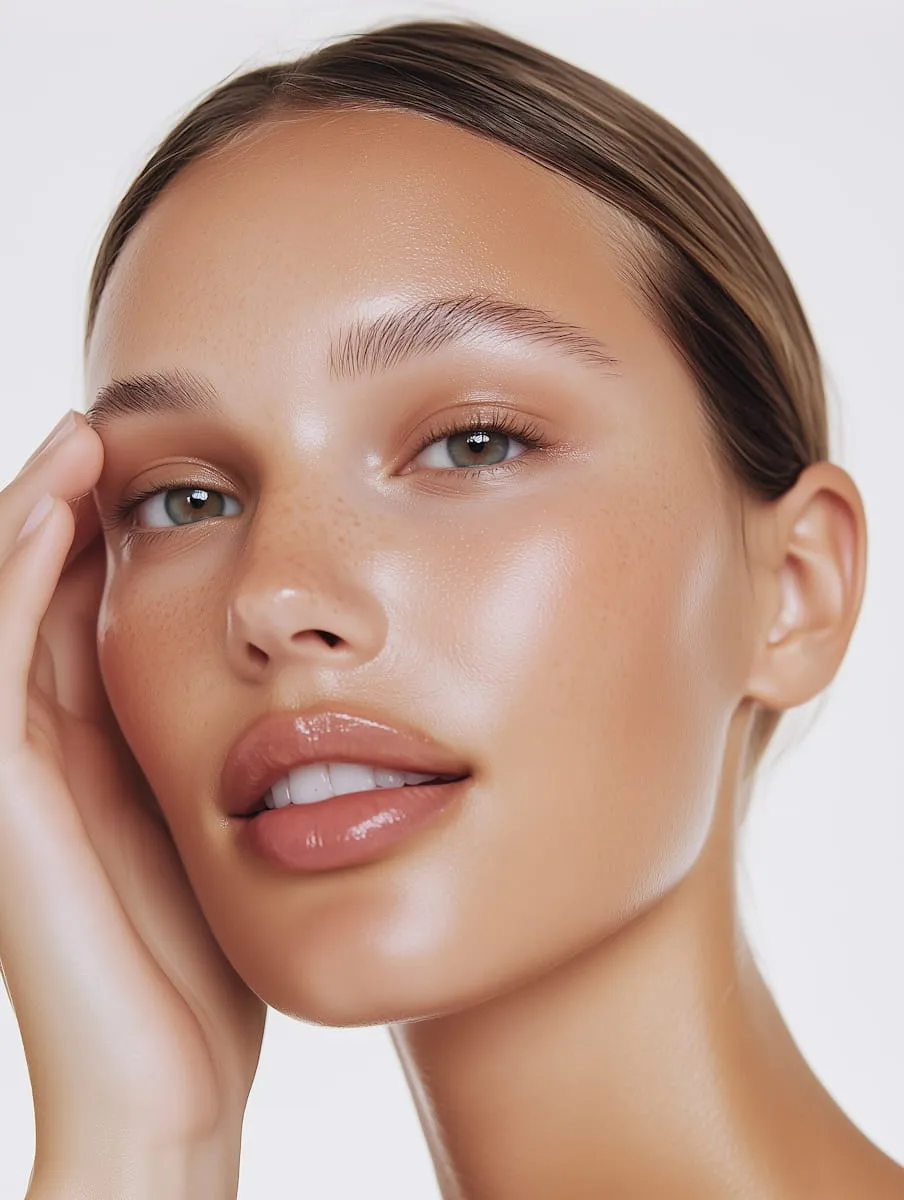
Skin tone guide, Fitzpatrick I
Porcelain skin: what it is, best colors, makeup, and care
Porcelain skin is the lightest skin tone: very pale skin with almost no tan, often with a slight translucency that lets a flush show through. It can lean cool and pink, neutral, warm and ivory, or, less often, olive. Porcelain skin usually matches Fitzpatrick type I, so it burns quickly and barely tans, which shapes everything from your best colors to your sunscreen.

What is porcelain skin?
Porcelain sits at the very top of every skin tone chart, a step lighter than fair. Hold your inner arm next to a sheet of white paper by a window: porcelain skin looks only slightly off-white, with a soft pink, ivory, or neutral cast rather than beige.
With so little pigment, whatever happens under the surface shows. Cheeks flush quickly with heat or exercise, and freckles, redness, and dark circles stand out more than they would on deeper skin. Many people with porcelain skin have light eyes and red, blonde, or light brown hair, but dark hair with porcelain skin is common too, and it makes for striking contrast.
Porcelain skin is found in families from Northern and Western Europe and in some East Asian families, among others. It changes little with the seasons: in summer it is more likely to freckle or turn pink than to tan.
Tap any swatch to copy its hex code.
- Fitzpatrick type
- I always burns, does not tan
- Closest Monk shades
- 1 to 2 of 10
- Next to
- fair
Porcelain, alabaster, or pale skin?
They describe the same end of the scale. Pale is the everyday word, porcelain and alabaster are the beauty words, and both suggest smooth, even, very light skin. Brands use porcelain for their first one or two shades, and alabaster sometimes for an even lighter one.
Porcelain skin undertones
Depth is only half of your skin tone. Underneath it, porcelain skin can lean cool, neutral, warm, or olive, and that undertone decides which colors, foundations, and metals look most natural. Here is how each one looks at this depth.
- Cool undertone
Pink porcelain
The classic porcelain: rosy cheeks and a pink cast in daylight. Silver looks bright on you, and golden makeup can turn orange.
- Neutral undertone
Neutral porcelain
Neither pink nor yellow leads. The palest N shades match best, and gold and silver both work.
- Warm undertone
Ivory porcelain
Very pale with a soft ivory or peach glow instead of pink, often with freckles and red or golden hair.
- Olive undertone
Olive porcelain
Very pale with a faint green-gray cast. Pink shades look chalky and yellow ones too bright, so olive shades help.
More on olive skin
Not sure which is yours? Compare gold and silver, or bright white and cream, next to your bare face by a window, or let the undertone test read it from a selfie. Our guide to skin undertones explains every check.
Best colors for porcelain skin
Choose your undertone to see the clothing colors that tend to flatter porcelain skin. Each swatch shows your skin above a neckline of the color, the way it sits when you wear it.
Pink porcelain, pink, red, or blue castClear, cool color and soft pastels. Sapphire and raspberry suit you if your hair and brows are dark; with light hair, stay closer to rose and lavender.
Neutral porcelain, neither pink nor goldenGentle mid-tones that echo a natural flush. Soft white beats stark white, and dusty shades look polished rather than dull on you.
Ivory porcelain, golden, peach, or yellow castLight, fresh warm color: peach, coral, mint, and warm turquoise. Soft navy does the job of black without the hard edge.
Olive porcelain, muted green-gray castSoft, earthy color with a little gray in it, which echoes the muted cast of your skin without draining it.
Colors that wash porcelain skin out, and what to wear instead
Instead of
nude beige, wear blushBeige that matches your skin makes face and fabric blur together. Blush gives the same softness with a hint of color.
Instead of
neon yellow, wear mintVery bright yellow reflects a sallow cast onto pale skin. Mint is just as fresh and far kinder.
Instead of
heavy brown, wear soft navyDark warm brown can look heavy next to porcelain skin unless your hair is just as dark. Navy adds depth with less weight.
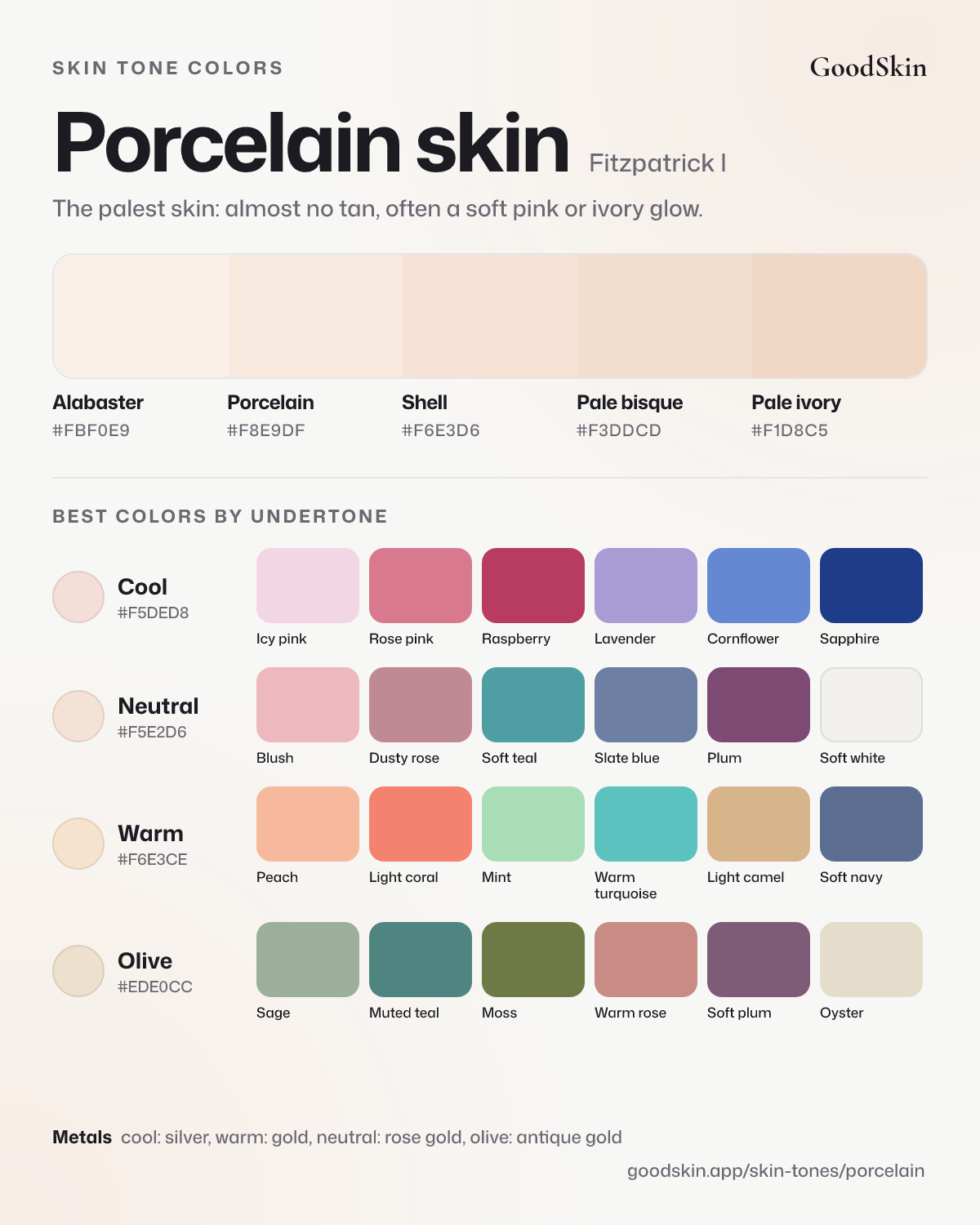
Save the porcelain skin colors
The skin swatches and all four undertone palettes on one card, with hex codes. Keep it on your phone and hold it next to clothes when you shop, near a window if you can.
Download the colorsMakeup for porcelain skin
Foundation
Porcelain skin is where most foundation ranges begin, so the lightest shade in a line can still be a step too deep or too yellow. Swatch the two lightest shades on your jaw and check them by a window: C or N if you lean pink, W or N if you lean ivory, O if both look off. When nothing is light enough, a white foundation mixer, added a drop at a time, can lift a close shade, and a sheer skin tint hides a near miss better than full coverage.
Foundation by undertone
- Cool
- Neutral
- Warm
- Olive
Most brands mark undertone with a letter after the shade number: C for cool, N for neutral, W for warm, and O for olive where they offer it.
Blush
- Soft pink
- Peach
- Rosy mauve
Sheer soft pink, peach, or rosy mauve. Cream and liquid blush build gently, so you can stop at a flush instead of a stripe.
Bronzer
- Light taupe
- Fawn
Skip orange bronzer. A light taupe or fawn powder adds shape without looking like a tan you do not have.
Lipstick
- Sheer pink
- Rose
- Berry
- Blue red
Sheer pink and rose for every day, berry or a blue-red for evening. A strong lip looks especially bold on porcelain skin, which is part of the appeal.
Best hair colors for porcelain skin
- Soft blackIf your brows and lashes are naturally dark, soft black gives the classic high-contrast look. Jet black can look harsh.
- Cool ash brownA light-to-mid ash brown suits pink porcelain skin and keeps contrast gentle.
- Champagne blondeA pale, creamy blonde for porcelain skin with light eyes. It stays soft instead of stark.
- Strawberry blondeIvory porcelain skin with freckles comes alive with a soft copper-pink blonde.
Hair colors to skip
- Brassy gold: heavy yellow-orange tones can make very pale skin look sallow.
- Deep mahogany: a dark red-brown pulls out any redness in your cheeks.
Whatever you choose, test it first: the NHS advises testing hair dye at least 48 hours before you use it.
Gold or silver for porcelain skin?
Delicate, polished pieces suit porcelain skin best: fine chains, small studs, and pearls. Pink porcelain looks clear in silver and platinum, ivory porcelain in pale yellow gold, and neutral porcelain in rose gold. Soft stones like aquamarine, rose quartz, and moonstone stay in proportion with very light coloring.
Sun care for porcelain skin
Usual Fitzpatrick type
I
Always burns, does not tan
Whatever your depth, the American Academy of Dermatology recommends a broad-spectrum, water-resistant sunscreen with SPF 30 or higher, reapplied about every two hours outdoors. For porcelain skin, add these:
- Plan time outdoors around shade. The AAD notes that the sun is strongest between 10 a.m. and 2 p.m., and if your shadow is shorter than you are, it is time to find some.
- A wide-brimmed hat and UV-blocking sunglasses cover what sunscreen often misses: the scalp line, ears, and the skin around your eyes.
- Want color? A self-tanner gives it without UV. Keep wearing sunscreen with it, since a fake tan does not protect you.
Common skin concerns for porcelain skin
Every skin tone can have any skin concern, but some show up more often, or more visibly, at each depth. These are the ones worth knowing for porcelain skin.
Sunburn and skin cancer risk
Very pale skin burns fastest. The Skin Cancer Foundation lists fair skin, light or red hair, light eyes, and skin that burns easily among the risk factors for skin cancer, so daily sun protection and regular skin checks matter more for you than for most.
Redness and flushing
Redness shows clearly on porcelain skin, and the American Academy of Dermatology notes that rosacea is more likely in fair-skinned people with light hair and eyes. Flushing that comes and goes, or redness that stays, is worth showing a dermatologist.
Freckles
Freckles increase in number with sun exposure, and DermNet notes they are most common in people with very fair skin and red hair. They are harmless, but they show how quickly your skin responds to UV. Check moles and spots regularly, and see a dermatologist about anything new or changing.
See a board-certified dermatologist about any spot, rash, or color change that is new, growing, or worrying you.
Color seasons for porcelain skin
Porcelain skin with light hair and eyes is most at home in the light seasons: Light Summer if you lean cool, Light Spring if you lean warm. Porcelain skin with dark hair has the high contrast of the winters, especially True Winter and Bright Winter.
Want a full palette for your coloring? Try the free seasonal color analysis.
Frequently asked questions
What is the difference between porcelain and fair skin?
Porcelain is the lightest end of fair: paler, with almost no tan and often a slightly translucent look. Fair skin is a step deeper and may tan a little. In foundation ranges, porcelain usually means the first one or two shades.
Can porcelain skin tan?
Very little. Porcelain skin usually burns or freckles instead of tanning, which is why a self-tanner is the safer way to add color.
What colors should porcelain skin avoid?
Colors very close to your skin, like pale beige and nude, make your face blend into your clothes. Neon yellow and very heavy browns can overpower it. Blush pink, mint, and soft navy do the same jobs better.
Is porcelain skin cool or warm?
Either, or neutral. Porcelain describes depth, not undertone. Pink porcelain is cool, ivory porcelain is warm, and some porcelain skin has an olive cast. The undertone test helps you tell.