Skin tone guide, Fitzpatrick V to VI
Deep skin tone: best colors, makeup, and care for dark skin
A deep skin tone, also called a dark skin tone, is rich brown skin, from chestnut and mocha to the deepest espresso. It can lean warm and golden or red, neutral, cool with a blue or plum cast, or olive. Deep skin roughly matches Fitzpatrick types V and VI: it rarely burns, but it still needs sun protection, and dark marks and dry, ashy patches show more on it than on lighter skin.

What is a deep skin tone?
By a window, a deep skin tone ranges from a warm chestnut or mocha to cocoa, espresso, and ebony. Depth can vary across one face too: many people with deep skin are a little lighter in the center of the face and deeper at the forehead and jawline, which matters for foundation.
Deep skin is common among people of African, Caribbean, Afro-Latin, South Asian, Melanesian, and Aboriginal Australian heritage, among others. Undertones can be harder to read by eye on deep skin, and the vein test is especially unreliable, so compare colors and metals against your skin instead.
Tap any swatch to copy its hex code.
- Fitzpatrick type
- V to VI rarely or never burns, tans darkly
- Closest Monk shades
- 7 to 10 of 10
- Next to
- tan
Deep or dark skin tone?
Both are used, and neither is wrong. Beauty brands and color analysts tend to say deep, which pairs with fair, light, medium, and tan. In everyday speech and search, dark skin tone is more common. This guide uses both.
Deep skin undertones
Depth is only half of your skin tone. Underneath it, deep skin can lean cool, neutral, warm, or olive, and that undertone decides which colors, foundations, and metals look most natural. Here is how each one looks at this depth.
- Cool undertone
Cool deep
A deep brown with a red, blue, or plum cast. Fuchsia, cobalt, and icy pastels look electric; orange can fall flat.
- Neutral undertone
Neutral deep
An even cocoa or espresso with no strong cast. True red, jade, and lilac all work, and so do both metals.
- Warm undertone
Warm deep
A golden or red-brown glow, like mahogany. Mustard, burnt orange, coral, and kelly green echo it.
- Olive undertone
Deep olive
Deep brown with a muted green-gold cast, often mistaken for warm. Emerald, wine, and saffron suit it.
More on olive skin
Not sure which is yours? Compare gold and silver, or bright white and cream, next to your bare face by a window, or let the undertone test read it from a selfie. Our guide to skin undertones explains every check.
Best colors for deep skin
Choose your undertone to see the clothing colors that tend to flatter deep skin. Each swatch shows your skin above a neckline of the color, the way it sits when you wear it.
Cool deep, pink, red, or blue castHigh-contrast cool color: fuchsia, cobalt, emerald, and royal purple, with icy pink and pure white as brilliant light accents.
Neutral deep, neither pink nor goldenBold and balanced: true red, jade, ultramarine, and tangerine, with lilac and soft white as lighter notes.
Warm deep, golden, peach, or yellow castWarm, saturated color: mustard, burnt orange, coral, kelly green, and turquoise, with cream as a soft neutral.
Deep olive, muted green-gray castDeep jewel tones with an earthy edge: emerald, aubergine, deep teal, saffron, and brick, with ivory as a light neutral.
Colors that wash deep skin out, and what to wear instead
Instead of
chocolate brown, wear cobaltBrown in the same depth as your skin can look flat near your face. Cobalt gives the same depth with far more life.
Instead of
muddy taupe, wear jade greenGrayish mid-tones can cast an ashy look on deep skin. Clear color like jade makes it glow.
Instead of
dull khaki, wear mustard yellowKhaki sits flat against deep skin. Mustard keeps the earthy feel with warmth and clarity.
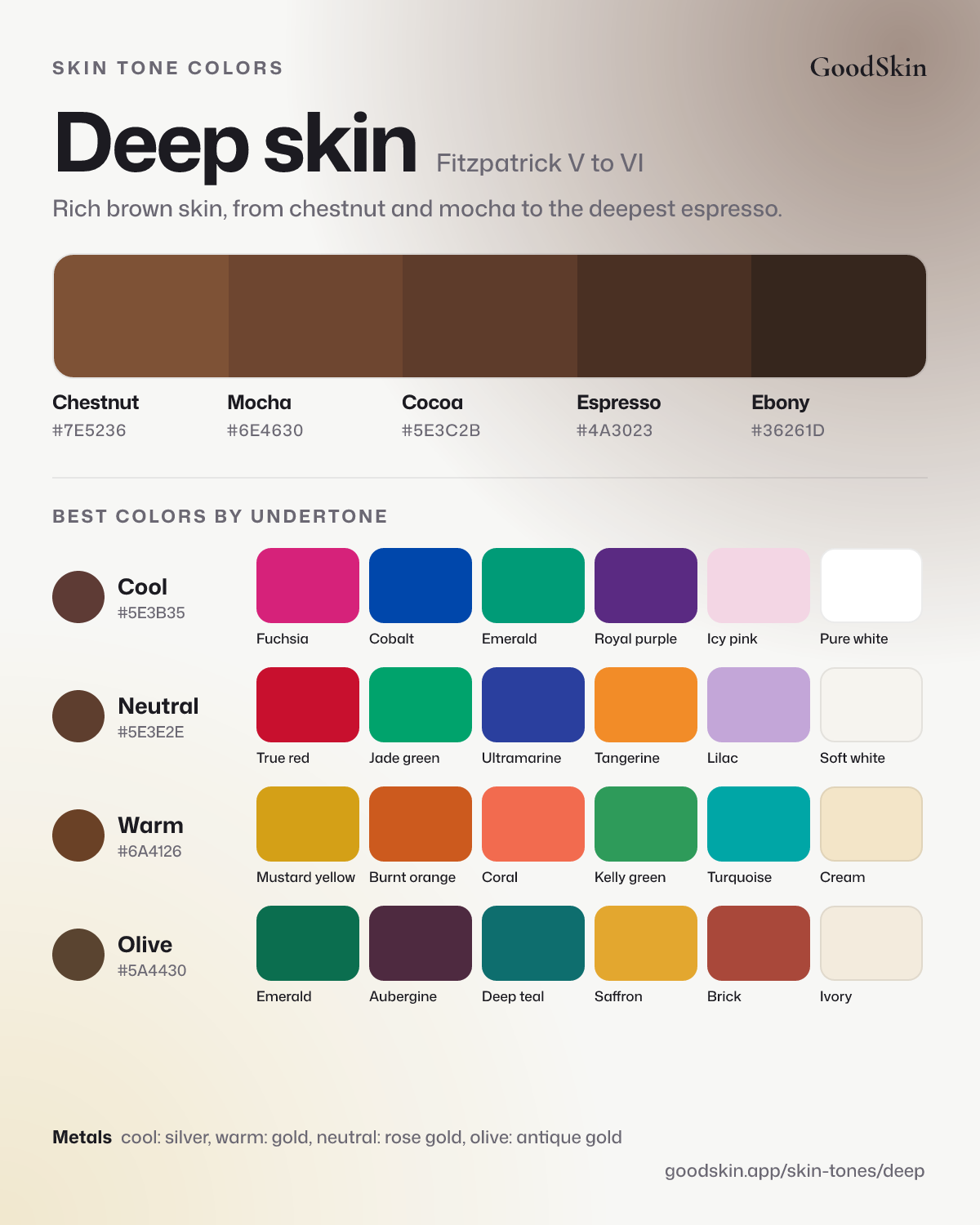
Save the deep skin colors
The skin swatches and all four undertone palettes on one card, with hex codes. Keep it on your phone and hold it next to clothes when you shop, near a window if you can.
Download the colorsMakeup for deep skin
Foundation
Swatch two or three shades in stripes along your jaw and pick the one that disappears by a window. Many people with deep skin match best with two shades: one for the center of the face and a slightly deeper one around the edges. Skip any shade that turns gray or ashy as it dries, which usually means it is too light or too cool, and try red-toned and golden deep shades even if you think you are neutral.
Foundation by undertone
- Cool
- Neutral
- Warm
- Olive
Most brands mark undertone with a letter after the shade number: C for cool, N for neutral, W for warm, and O for olive where they offer it.
Blush
- Berry
- Burnt orange
- Raspberry
Rich berry, burnt orange, and raspberry. Highly pigmented blush shows true; sheer formulas can disappear.
Bronzer
- Espresso bronze
- Red bronze
A deep espresso or red-brown bronzer adds warmth and dimension. Avoid any that look gray on your skin.
Lipstick
- Cocoa nude
- Wine
- Bright fuchsia
- Orange red
Cocoa nude, wine, bright fuchsia, and orange-red all look striking. For a nude, match your lips rather than your skin.
Best hair colors for deep skin
- Soft blackDeep, glossy black with a hint of brown is softer than jet black.
- BurgundyA wine tint looks rich on cool and neutral deep skin, especially in sunlight.
- CopperA bold copper or ginger glows against warm deep skin.
- Honey blondeA warm honey blonde gives dramatic, flattering contrast on warm deep skin.
Hair colors to skip
- Ash blonde: gray-based blondes can make deep skin look dull or ashy.
- Pale yellow blonde: can look brassy rather than golden next to deep skin; ask for honey or caramel instead.
Whatever you choose, test it first: the NHS advises testing hair dye at least 48 hours before you use it.
Gold or silver for deep skin?
Deep skin makes high-shine metals glow: polished yellow gold on warm deep skin, silver and platinum on cool, and either on neutral. Bold, sculptural pieces look at home, and so do vivid stones like emerald, citrine, and sapphire.
Sun care for deep skin
Usual Fitzpatrick type
V to VI
Rarely or never burns, tans darkly
Whatever your depth, the American Academy of Dermatology recommends a broad-spectrum, water-resistant sunscreen with SPF 30 or higher, reapplied about every two hours outdoors. For deep skin, add these:
- Choose a tinted sunscreen. It disappears on deep skin, and the AAD notes that its iron oxide helps protect against visible light, a cause of dark spots.
- Sunburn may not look red on deep skin, the NHS notes, so treat soreness, heat, or peeling as a burn.
- When you check your skin, include your palms, soles, nails, and the inside of your mouth, where skin cancer in darker skin often appears.
Common skin concerns for deep skin
Every skin tone can have any skin concern, but some show up more often, or more visibly, at each depth. These are the ones worth knowing for deep skin.
Hyperpigmentation
Dark marks after a breakout, rash, or injury are more common on deep skin, and they can be more intense and last longer, as DermNet explains. The AAD recommends a tinted sunscreen with iron oxide and ingredients like azelaic acid, vitamin C, and retinoids to fade dark spots; a mark a few shades darker than your skin usually fades within 6 to 12 months.
Ashiness
Dry skin on deep skin tones can take on a whitish or gray cast, often called ashy skin. The AAD's advice for dry skin in darker skin tones: short, warm showers, moisturizer on damp skin, and thick creams or ointments rather than lotions. If dryness lasts, see a dermatologist, since eczema and other conditions can look similar.
Skin cancer that is found late
Skin cancer is less common in deep skin, but the AAD notes it is often advanced by the time it is diagnosed, partly because it can appear where the sun rarely reaches. Look for a dark streak in a nail, a growing spot on a palm or sole, or any spot that changes.
See a board-certified dermatologist about any spot, rash, or color change that is new, growing, or worrying you.
Color seasons for deep skin
Deep skin often belongs to the deep seasons: Deep Winter for cool and neutral deep skin, Deep Autumn for warm and olive deep skin. With very high contrast and clear eyes, Bright Winter and True Winter fit too.
Want a full palette for your coloring? Try the free seasonal color analysis.
Frequently asked questions
What colors look best on dark skin?
Saturated color and bright light shades both look striking. Cool deep skin shines in fuchsia, cobalt, and icy pink; warm deep skin in mustard, burnt orange, and kelly green; neutral deep skin in true red, jade, and lilac.
Do people with dark skin need sunscreen?
Yes. Deep skin rarely burns, but sun still darkens spots and causes damage, and skin cancer in darker skin is often found late. The AAD recommends a tinted, broad-spectrum sunscreen with SPF 30 or higher.
How do you get rid of ashy skin?
Moisturize right after a short, warm shower while your skin is still damp, and use a thick cream or ointment. If it keeps coming back, see a dermatologist, since conditions like eczema can look similar.
What foundation shade is best for dark skin?
The one that vanishes on your jaw in daylight, usually checked against two or three neighbors. Many people with deep skin use two shades, one for the center of the face and a deeper one for the edges.