
Acne & breakouts
How to get rid of a cystic pimple fast, and stop the next one
The fastest fix for a cystic pimple is a cortisone shot that flattens it in 1-3 days. The at-home plan, what not to do, and the treatments that stop new cysts.

Key takeaways
- A cystic pimple is a large, painful lump deep in the skin. It's the most severe kind of acne and the kind most likely to scar.
- The fastest fix is a cortisone shot from a dermatologist: most people see the cyst flatten and hurt less within 24-72 hours.
- At home, hold wrapped ice on it for about 10 minutes when it throbs, use a warm compress three times a day, apply a thin layer of an acne treatment, and never squeeze it.
- Nothing at home flattens a cyst overnight. A single nodule can last weeks or even months.
- If cysts keep coming back, see a dermatologist early. Prescription retinoids, antibiotics, spironolactone, or isotretinoin stop new ones, and early treatment means fewer scars.
The fastest way to get rid of a cystic pimple is a cortisone shot: a dermatologist injects a dilute corticosteroid straight into the cyst, and most people see it flatten and hurt less within 24-72 hours. At home, nothing shrinks a cyst overnight, but you can calm it. Hold ice wrapped in a cloth on it for about 10 minutes when it throbs, use a warm compress for 10-15 minutes three times a day, dab on a thin layer of an acne treatment such as benzoyl peroxide, and don’t squeeze it, because squeezing pushes the inflammation deeper and raises the risk of a scar.
If cysts keep coming back, the shot only fixes today’s. Cystic acne is the kind most likely to leave permanent scars, so the real fix is prescription treatment that stops new cysts from forming. Below is how a cystic pimple differs from an ordinary or blind pimple, what the cortisone shot involves and what it can leave behind, the home plan, the mistakes that make a cyst worse, and the treatments that stop the cycle.
What is a cystic pimple?
Cleveland Clinic describes cystic acne as the most severe type of acne: painful, pus-filled pimples that form deep under the skin. It starts like any pimple, with a pore clogged by oil and dead skin cells, but the inflammation goes much deeper, so you get a sore red lump instead of a small spot at the surface.
Dermatologists split these deep breakouts into two kinds. The AAD explains that an acne cyst contains pus, while a nodule doesn’t, so a nodule feels harder, more like a knot under the skin. People use “cystic pimple” for both, and they’re treated the same way. Despite the name, an acne cyst isn’t a true cyst: DermNet notes it has no capsule around it and shows up alongside other acne.
Cystic pimple vs blind pimple vs regular pimple
“Blind pimple” is the everyday name for any pimple under the skin with no head, from a small, tender bump that’s gone in a week or two to a full cyst. If you have one sore bump and no history of cysts, our guide to the blind pimple is the place to start. A cystic pimple is the deepest, largest end of that range, and it behaves differently:
| Regular pimple | Blind pimple | Cystic pimple | |
|---|---|---|---|
| Where it sits | Near the surface | Under the skin, no head | Deep in the skin, often large |
| How it feels | Small and tender | A sore lump | Painful, swollen, sometimes several joined together |
| How long it lasts | Days | About one to two weeks with care | Weeks or even months |
| Can home care handle it? | Usually | Usually | Rarely on its own: it needs a dermatologist |
Cystic acne tends to appear on the face, which has plenty of oil glands, and also on the neck, chest, back, shoulders, upper arms, and buttocks. Teenagers are most prone to it, it runs in families, and DermNet says the most severe form is seen most often in young men. Many adult women get a different pattern: deep, tender breakouts along the chin, jaw, and neck, which we cover under hormonal acne below.
The fastest fix: a cortisone shot
A cortisone shot, also called an intralesional steroid injection, is the one treatment that reliably shrinks a cyst within days. The dermatologist uses a fine needle to put a small dose of a diluted corticosteroid, usually triamcinolone, right into the lump, where it calms the inflammation from the inside. According to a dermatologist-reviewed guide from GoodRx Health, most people see the lesion flatten and the pain ease within 24 to 72 hours, with steady improvement over 3 to 7 days. That’s why Cleveland Clinic dermatologists suggest it before an important event. The AAD adds that the shot speeds healing and lowers the risk of an acne scar.
Know the limits before you book. The AAD says the shot is for one especially painful blemish, can’t be used to treat lots of breakouts, and isn’t recommended more than a few times. It treats the cyst you have, not the acne behind it, so it works best alongside regular acne treatment, which is how the AAD’s acne guidelines list it.
It can also leave marks. DermNet lists a small dent in the skin a few weeks after the injection, from thinning of the fat underneath, as the most common delayed side effect, along with lighter or darker patches at the spot, and says these can be permanent. GoodRx Health notes they may fade but can take 6-12 months. That’s one reason dermatologists use a weak dilution for acne: 2.5 mg/mL was the most common strength in a 2020 survey of dermatology clinicians.
For a very large cyst, a dermatologist may drain it instead, with a sterile needle or blade. When you book, say you have a painful cyst you’d like injected and ask what the visit will cost.
How to shrink a cystic pimple at home
Home care won’t flatten a cyst the way a shot does, but it eases the pain, keeps the swelling down, and stops you from turning it into a scar. Here’s the plan:
- Hands off. Squeezing a deep lump pushes it deeper, and more on that below.
- Ice it when it throbs. Cleveland Clinic dermatologist Jonathan Braue says icing is never a bad idea for a painful spot. Wrap an ice cube or ice pack in a washcloth or a thick paper towel and hold it on the cyst for about 10 minutes. Never put ice straight on bare skin, because it can burn. Cold eases the swelling and dulls the ache, so it’s the most useful step before a photo or a night out.
- Use a warm compress. The AAD suggests a clean washcloth soaked in hot water, held on the spot for 10-15 minutes three times a day, with a fresh cloth each time. Keep it comfortably warm, not scalding.
- Apply a thin layer of an acne treatment. The AAD lists adapalene, azelaic acid, benzoyl peroxide, and salicylic acid, and warns that using too much irritates the skin even more. Set your expectations, though: Cleveland Clinic says over-the-counter creams aren’t effective at treating nodular acne, so the cream won’t reach a deep cyst the way an injection does. It still treats the smaller pimples around it.
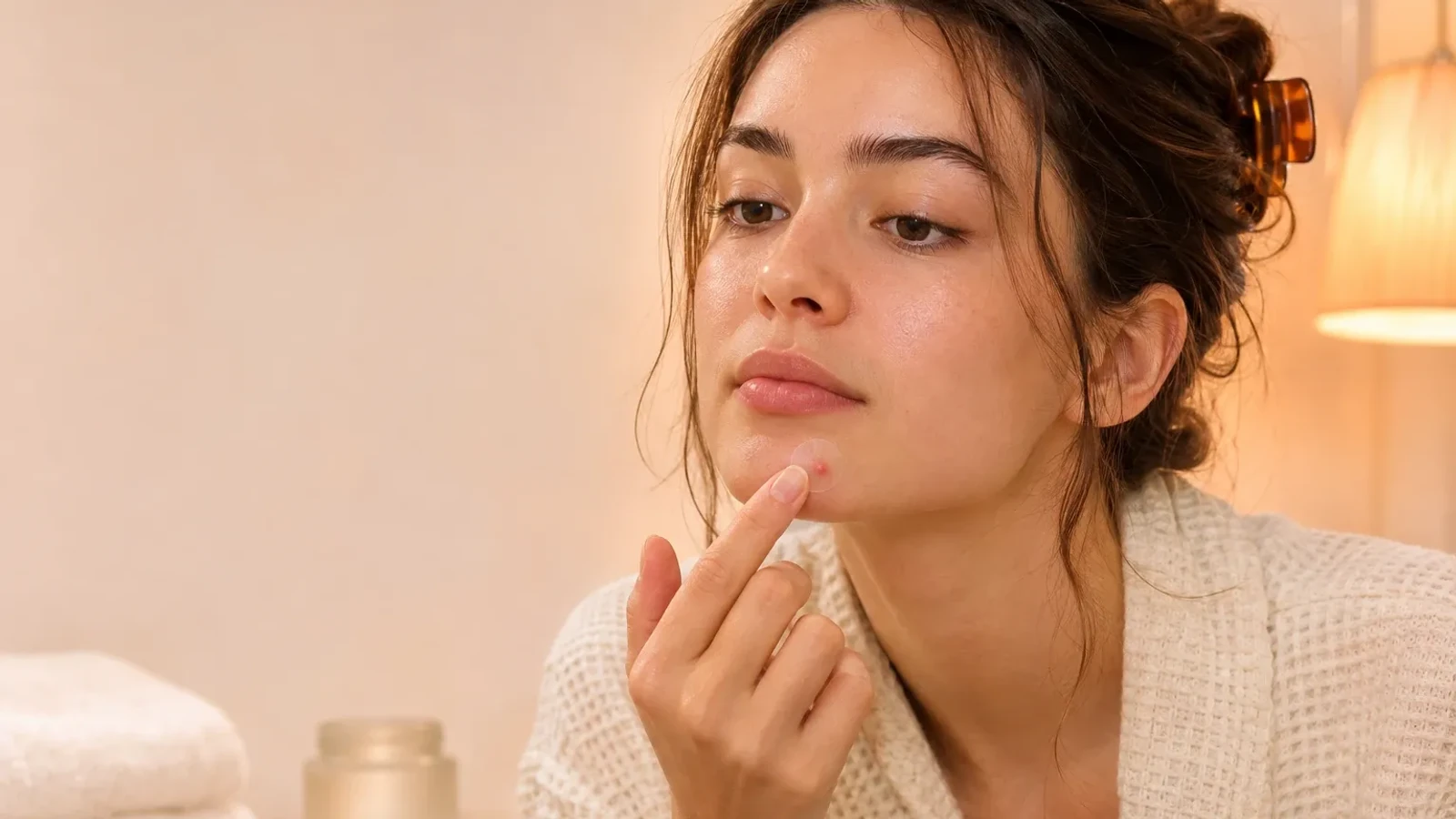
- Cover it if you can’t stop touching it. A hydrocolloid patch, which the AAD also suggests, protects the spot and keeps your fingers off it.
- Wear sunscreen. Some acne ingredients make skin more sensitive to the sun, so the AAD recommends a broad-spectrum, water-resistant SPF 30 or higher that won’t clog pores.
Wash gently in the meantime: Cleveland Clinic suggests a mild foaming cleanser, lukewarm water, and your fingers, not a washcloth or sponge.
Looking for a quick fix for an ordinary whitehead instead? Our guide on how to get rid of a pimple overnight covers the surface spots that really can look better by morning.
What not to do with a cystic pimple
- Don’t squeeze, pop, or pierce it. The AAD explains that popping often pushes what’s inside deeper into the skin, which increases inflammation, brings bacteria from your hands, and can leave permanent scars. Cleveland Clinic adds that opening an acne cyst raises the risk of scarring and of skin infections like cellulitis.
- Don’t try to drain it yourself. Dr. Braue says plainly that he doesn’t encourage draining a cyst at home. A dermatologist does it with sterile tools.
- Don’t pile on spot treatments. Layering benzoyl peroxide, acids, and retinol on one sore lump irritates the skin around it without reaching the cyst.
- Don’t wait it out if they keep coming. One cyst a year is bad luck. New ones every month is cystic acne, and that needs treatment.
Why cystic pimples keep coming back
A cyst forms when a clogged pore traps oil, dead skin cells, and acne bacteria deep in the skin and the area becomes badly inflamed. Cleveland Clinic explains that higher levels of androgens, hormones everyone makes, can thicken the oil in your skin and make pores clog more easily. Hormone changes in the teenage years and sometimes around menopause, stress, and a family history of cystic acne all raise the odds.
Hormonal cystic acne on the chin and jaw
Many adult women get cysts in one place: the chin, jawline, and neck. The AAD says women with deep, tender acne on the lower face, jawline, or neck tend to have good results from hormonal treatment, covered below. Our acne face map explains what breakouts in each zone really point to, and why location alone doesn’t prove a hormone problem. If cysts come with irregular periods, extra hair growth, or hair loss, ask your doctor about polycystic ovary syndrome (PCOS), which Cleveland Clinic notes can sit behind cystic acne in younger women and teens.
Products that clog pores
Every acne cyst starts as a clogged pore, so what you put on your skin matters. The AAD suggests looking for “non-comedogenic” or “won’t clog pores” on the label. If you suspect a moisturizer, sunscreen, or foundation is part of the problem, paste its ingredient list into our free checker.
Free toolPore clogger checkerPaste any ingredient list and see which ingredients clogged pores in tests, and where they sit.On food, the evidence is thinner than social media suggests. Dr. Braue says the foods people usually blame haven’t been scientifically linked to cystic acne, though there does seem to be a link between drinking skim milk and more severe acne.
Prescription treatments that stop cystic acne
Over-the-counter products rarely control cystic acne, and DermNet says topical treatment on its own is usually ineffective for it. A dermatologist will usually combine treatments, and the AAD’s acne guidelines recommend all of these:
- Topical retinoids. Prescription adapalene, tretinoin, or tazarotene, usually applied in the evening, keep pores from clogging so fewer new breakouts start. The AAD says acne treatment takes at least 6-8 weeks before you see fewer breakouts, and the first weeks can bring a short flare, which our guide to skin purging explains.
- Oral antibiotics. Pills such as doxycycline calm the acne bacteria and the inflammation they cause. Cleveland Clinic lists them, with prescription gels or creams, as a common treatment for cystic acne. The AAD says they’re prescribed for the shortest time needed, usually several months, together with benzoyl peroxide, and that they don’t treat nodular acne, the hardest kind.
- Spironolactone and the pill, for women. Spironolactone slows the hormones that drive oil and breakouts, and the AAD says you may see fewer breakouts and less oil within a few weeks, while a combined birth control pill takes 2-3 months. Spironolactone can cause serious birth defects, so you’ll need reliable birth control while you take it, and it isn’t prescribed for acne in men.
- Isotretinoin. This daily pill is what dermatologists prescribe for nodular acne that hasn’t responded to other treatment, and DermNet calls it the recommended treatment for nodulocystic acne, started early to prevent scars. According to the AAD, a course usually takes about four to five months, often clears acne for a long time, and for some people clears it for good. You see your dermatologist every 30 days, and anyone who can get pregnant takes pregnancy tests before and during treatment, because it must not be taken in pregnancy.
Be patient with whichever plan you start. Cleveland Clinic says it can take three months or more to clear acne cysts, and steady treatment in that time is what stops the next one.
Cystic acne scars: why to see a dermatologist early
This is the strongest reason not to wait. The AAD says nodules and cysts go deep into the skin and often cause permanent acne scars when they heal, that you’ll need a dermatologist’s help to treat them, and that the sooner you start treatment, the fewer permanent scars you’ll have. Cleveland Clinic says untreated nodular acne can lead to severe scars, and that seeking treatment early lowers that risk.
The marks come in two kinds. The NHS describes scars such as shallow holes in the skin, called ice-pick or boxcar scars, and Cleveland Clinic notes that cysts can also leave lasting spots that are pink, purple, red, brown, or black. Flat marks can fade, and the AAD says a retinoid can help lighten dark spots once acne clears, but pitted scars are permanent, which is why stopping new cysts early beats treating scars later. If you already have marks or dents, the guide to pimple scars shows what fades them and which treatments improve them.
When it’s not acne: a boil, an epidermoid cyst, or HS
A few lumps look like a cystic pimple but need different care:
| Cystic pimple | Boil | Epidermoid cyst | Hidradenitis suppurativa | |
|---|---|---|---|---|
| What it is | A deep, inflamed acne breakout | A hard, painful lump that fills with pus | A sac under the skin filled with keratin | Deep, painful lumps that heal and come back |
| Clues | Comes with other acne | Often a yellow and white center | Usually 1-3 cm, often a small central pore | Armpits, groin, buttocks, inner thighs |
| Treatment | Acne treatment, a cortisone shot | Warm compresses, a doctor if it’s on the face | Surgical removal of the whole sac if needed | A dermatologist’s diagnosis |
The NHS advises an urgent appointment for a boil on your face, or one where the skin around it is hot and swollen or you feel hot, cold, or shivery. An epidermoid cyst can turn red and tender when it leaks, and DermNet says it comes back unless the whole sac is removed. Deep lumps that keep returning in the armpits or groin can be hidradenitis suppurativa, which the AAD says often starts out looking like an acne cyst or a boil, so see a board-certified dermatologist.
When you’re working through a treatment plan, it helps to see the trend rather than one bad week. GoodSkin’s AI skin analysis scores acne and 13 other traits from a single selfie, so you can watch your breakouts calm scan to scan and show your dermatologist exactly what changed.
Sources
- Cleveland Clinic: Cystic acne
- Cleveland Clinic: Nodular acne
- Cleveland Clinic Health Essentials: Home remedies for cystic acne
- Cleveland Clinic Health Essentials: Popping these pimples is not an option
- American Academy of Dermatology: Tips to treat a deep, painful pimple
- American Academy of Dermatology: Acne signs and symptoms
- American Academy of Dermatology: How to treat different types of acne
- American Academy of Dermatology: Acne diagnosis and treatment
- American Academy of Dermatology: Pimple popping, why only a dermatologist should do it
- American Academy of Dermatology: Hormonal therapy for acne
- American Academy of Dermatology: Isotretinoin
- American Academy of Dermatology: Acne clinical guideline
- American Academy of Dermatology: Hidradenitis suppurativa, signs and symptoms
- NHS: Acne
- NHS: Polycystic ovary syndrome
- NHS: Boils
- DermNet: Intralesional steroid injection
- DermNet: Nodulocystic acne
- DermNet: Epidermoid cyst
- GoodRx Health: Do cortisone shots for acne work? (reviewed by a board-certified dermatologist)
- Gallagher et al. Dermatologist use of intralesional triamcinolone in the treatment of acne. J Clin Aesthet Dermatol, 2020
Frequently asked questions
Can you get rid of a cystic pimple overnight?
No. A cyst sits too deep for anything you put on your skin to flatten it in one night. Wrapped ice can ease the swelling and the throb for a while, which helps before a photo or an event. The fastest real fix is a cortisone shot, which flattens most cysts within 24-72 hours.
How long does a cystic pimple last?
Longer than a regular pimple. Cleveland Clinic says acne nodules can last for weeks or even months, and that clearing cystic acne can take three months or more of treatment. A cortisone shot shortens one cyst to a few days, and squeezing usually makes it last longer.
Will a cystic pimple come to a head?
Sometimes. An acne cyst contains pus and can form a whitish-yellow head and drain by itself. Many never do and slowly shrink instead. Don't try to force a head with a needle or by squeezing, because the pus is deep and pressure pushes it deeper.
Can a cortisone shot for cystic acne leave a dent?
It can. DermNet says a small dent can appear a few weeks after the injection, along with a lighter or darker patch, and that these can be permanent. They may fade, but that can take 6-12 months. That's why dermatologists keep the shot for one or two big, painful cysts and don't repeat it often.
Is cystic acne on the chin hormonal?
Often, in adult women. The AAD says deep, tender acne on the lower face, jawline, or neck tends to respond well to hormonal treatment such as spironolactone or a combined birth control pill. If cysts come with irregular periods, extra hair growth, or hair loss, ask your doctor about polycystic ovary syndrome (PCOS).
This article is general education, not medical advice. GoodSkin is a cosmetic tool and does not diagnose skin conditions. If something hurts, spreads, bleeds, or changes quickly, see a dermatologist.