
Acne & breakouts
Closed comedones: what they are and how to get rid of them
Closed comedones are tiny skin-colored bumps from sealed, clogged pores. How to tell them from milia, why they cluster on the forehead, and what clears them.
Key takeaways
- Closed comedones are pores plugged with oil and dead skin and sealed under a thin layer of skin. They look like tiny skin-colored bumps you can often feel more than see.
- They're the mildest form of acne and are most common on the forehead and chin, where oil glands are busiest and hair products land.
- A retinoid such as adapalene 0.1%, used over the whole area every night, is the most reliable treatment. Salicylic acid and azelaic acid help alongside it.
- Expect 8-12 weeks before a clear improvement. Closed comedones are slower to clear than blackheads because the plug is sealed in.
- Don't squeeze them. With no opening, pressure pushes the plug sideways into the skin, which can turn a flat bump into a red pimple or a scar.
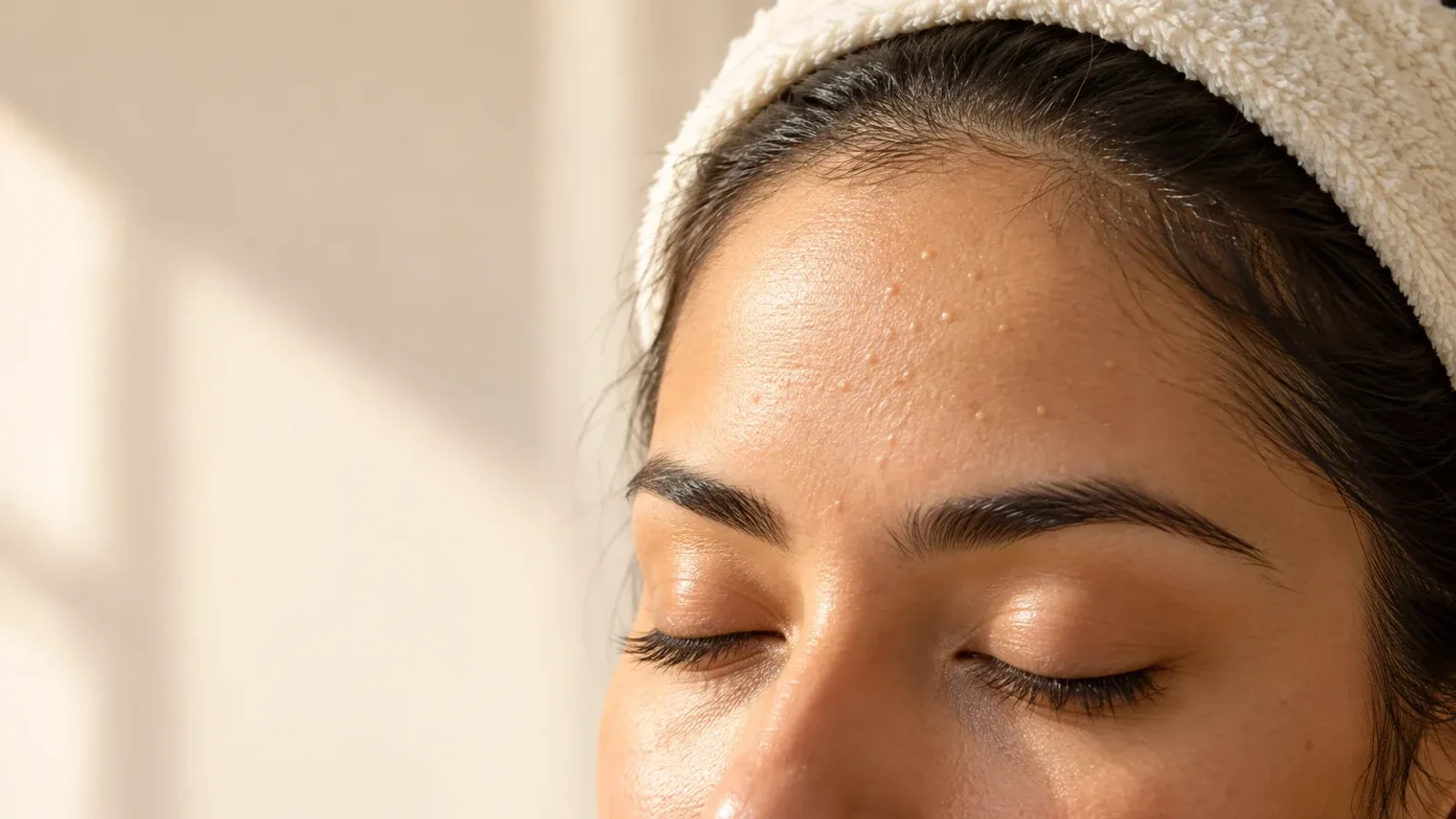
Closed comedones are pores plugged with oil and dead skin cells and sealed over by a thin layer of skin. They look like tiny, skin-colored or whitish bumps, usually smaller than 2-3 mm, that you often feel more than see, most often on the forehead and chin. They’re the mildest form of acne, and they’re not dangerous.
The most reliable way to get rid of closed comedones is a retinoid such as adapalene 0.1% gel, spread over the whole area every night, often paired with salicylic acid or azelaic acid. Expect 8-12 weeks before you see a clear difference. Squeezing, scrubbing, and steaming don’t speed it up, and squeezing can turn a flat bump into a pimple.
“Closed comedone” is the medical name for a whitehead. In everyday speech, “whitehead” also covers the white or yellow top of a pimple, which is a different thing. If your spots come to a head and go in a few days, see our guide on how to get rid of whiteheads. This guide is about the stubborn, flat-topped kind that never seems to change.
What are closed comedones?
A comedone is a hair follicle that has filled with sebum (oil) and dead skin cells. If the opening stays open, the plug shows at the surface as a blackhead. If skin grows over the opening, you get a closed comedone. Cleveland Clinic describes closed comedones as small, plugged follicles covered by skin, so their contents never reach the air.
That covering explains almost everything about them. They stay skin-colored because the plug isn’t exposed, they’re hard to squeeze because there’s no exit, and they’re slow to clear because treatments have to work through the skin to loosen the plug.
What do closed comedones look like?
- Tiny domes, usually smaller than 2-3 mm. DermNet calls closed comedones larger than that “macrocomedones.”
- Skin-colored, white, or slightly yellow, with no redness around them.
- Painless, unless one becomes inflamed.
- Clustered, often in a patch on the forehead, chin, or along the jaw.
- Easier to feel than to see. The American Academy of Dermatology notes that some are so subtle you can feel but not see them. They show up best in side light, or when you gently stretch the skin.
What causes closed comedones?
Four things work together inside the pore, according to Cleveland Clinic: extra oil, skin cells that don’t shed properly and stick together, androgen hormones, and a rise in acne bacteria. DermNet adds a longer list of triggers, and several are within your control:
- Pore-clogging ingredients. DermNet names oily pomades, isopropyl myristate, propylene glycol, and some cosmetic dyes.
- Overhydrated skin. Rich moisturizers, humidity, and the days before a period can all swell the skin around the pore opening.
- Damaged follicles. Squeezing, abrasive scrubbing, strong peels, and laser treatments can rupture the pore lining and lead to more comedones.
- Hormones. Puberty, pregnancy, and the menstrual cycle all play a part.
- Smoking. DermNet notes comedonal acne is more common in smokers.
- Diet, possibly. Milk products and high-glycemic foods are linked to comedones in some studies, though the evidence is weaker than for the triggers above.
If a new product is the likely culprit, check its full ingredient list. The free checker below flags ingredients commonly linked to clogged pores.
Free toolPore clogger checkerPaste any ingredient list and see which ingredients clogged pores in tests, and where they sit.Closed comedones on the forehead
The forehead is the most common place for closed comedones, and it’s not a coincidence. The skin there is oily, and it’s where hair and everything you put on it rests against your face.
- Hair products. The AAD explains that oil from shampoos, conditioners, gels, waxes, sprays, and especially pomades can reach the skin and cause whiteheads and tiny skin-colored bumps along the hairline and upper forehead. Once you stop the culprit, the AAD says to expect 4-6 weeks for them to clear.
- Fringes and bangs. Hair resting on the forehead keeps those products, and your scalp’s own oil, against the skin all day.
- Hats, headbands, and helmets. Friction, heat, and sweat under a band can block follicles.
- Pillowcases and caps. The AAD suggests washing the residue out of everything your head touches.
One lookalike is worth knowing. If the bumps along your hairline are itchy, all the same size, and some have tiny pus tips, they may be fungal acne (Malassezia folliculitis). In a review of 110 cases, most patients had recently taken antibiotics for acne, and the bumps sat on the forehead running into the hairline. Acne treatments don’t fix it, but antifungals do. Our guide to small bumps on the face shows how to tell these apart.
Closed comedones vs milia
Both look like tiny white bumps, and both are common on the face. The difference is what’s inside and whether there’s a pore involved.
| Closed comedone | Milium | |
|---|---|---|
| What it is | A pore plugged with oil and dead skin | A tiny cyst of trapped keratin |
| Color | Skin-colored or whitish | Bright pearly white |
| Feel | Soft to slightly firm | Hard, like a grain of sand |
| Usual spots | Forehead, chin, jaw, anywhere oily | Eyelids, under the eyes, upper cheeks |
| Comes with other acne? | Often, alongside blackheads or pimples | No, it isn’t acne |
| What helps | Retinoid, salicylic acid, azelaic acid | Time, or removal by a dermatologist |
Location is the quickest clue. Hard white dots on or under the eyelids, where there are few oil glands, are almost always milia, which our milia guide covers in full. Bumps on the oily forehead and chin that come with the odd blackhead are almost always comedones.
How to get rid of closed comedones
The goal is to change how the pore sheds so plugs stop forming, then let the existing ones work their way out. Treat the whole area where you get them, not just the bumps you can see.
1. A retinoid, every night
Retinoids are the treatment dermatologists rely on most for comedones. The AAD recommends one for whiteheads and blackheads, and the 2024 AAD acne guidelines give topical retinoids a strong recommendation. Adapalene 0.1% gel is available without a prescription in the US.
- Apply a pea-sized amount to clean, dry skin over the whole forehead, chin, or wherever you get them.
- Start every other night for 2-3 weeks, then go nightly if your skin is comfortable.
- Expect some dryness and flaking at first. A plain moisturizer on top helps.
- Wear SPF 30 or higher every morning, since retinoids make skin more sun-sensitive.
- Don’t use a retinoid if you’re pregnant, trying to conceive, or breastfeeding.
You may see a few extra spots in the first weeks as comedones that were already forming surface. Our guide to skin purging explains how to tell that apart from a reaction. If adapalene isn’t enough after three months, a dermatologist can prescribe a stronger retinoid such as tretinoin or tazarotene.
2. Salicylic acid
Salicylic acid dissolves in oil, so it works inside the pore to loosen the plug. Use a leave-on product with 0.5-2%, a few times a week at first. On retinoid nights, skip it until your skin has adjusted, then use them on alternate nights or put the acid in your morning routine.
3. Azelaic acid
Azelaic acid helps skin shed normally inside the pore, calms redness, and fades the dark marks old spots leave behind. Both DermNet and Cleveland Clinic list it for comedonal acne. Products with around 10% are sold without a prescription in many places, and 15-20% versions are prescription-only. It’s usually gentler than a retinoid, so it’s a good option if your skin is sensitive.
4. Benzoyl peroxide, if you also get pimples
Benzoyl peroxide works mainly on acne bacteria, so it matters most when your closed comedones come with red, inflamed spots. A 2.5-5% wash, left on for a minute before rinsing, is gentle enough to use alongside a retinoid. It bleaches fabric, so use white towels and pillowcases.
At a glance
| Ingredient | Typical strength | How often | Best for |
|---|---|---|---|
| Adapalene | 0.1% gel | Nightly, after a slow start | The main treatment for most people |
| Salicylic acid | 0.5-2% leave-on | 3-7 times a week | Oily skin, blackheads alongside |
| Azelaic acid | 10% OTC, 15-20% prescription | Once or twice a day | Sensitive skin, leftover dark marks |
| Benzoyl peroxide | 2.5-5% wash | Once a day | Comedones plus red pimples |
How long does it take to clear closed comedones?
Plan on 8-12 weeks of steady use before you see a clear difference, which is the timeline Cleveland Clinic gives for comedonal acne, and several months to clear completely. The AAD suggests judging any acne treatment at 6-8 weeks at the earliest. Closed comedones are often the slowest part of acne to go, because the plug is sealed in, and they come back if you stop, so most people keep a lighter version of the routine going for good.
Should you extract closed comedones?
Not at home. A blackhead has an opening that pressure can push the plug through. A closed comedone doesn’t, so squeezing forces the plug sideways into the surrounding skin. That’s how a flat, painless bump becomes a red, sore pimple. Cleveland Clinic warns that extracting comedones yourself can cause scars, infection, more comedones, and inflammatory acne. On medium and deep skin tones, it often leaves a dark mark that lasts longer than the comedone would have.
If they’re stubborn, a dermatologist or licensed esthetician can extract them with sterile instruments. For persistent or larger comedones, DermNet lists gentle cautery (electrosurgery), cryotherapy, and microdermabrasion, and Cleveland Clinic adds chemical peels. These work best on top of a retinoid routine, not instead of one.
A simple routine for closed comedones
Morning
- Gentle, non-comedogenic cleanser
- Light, oil-free moisturizer
- Broad-spectrum sunscreen, SPF 30 or higher
Evening
- Gentle cleanser
- Adapalene over the whole area (every other night for the first 2-3 weeks)
- Moisturizer
After a month, if your skin is comfortable, add salicylic acid or azelaic acid on the mornings or on alternate nights. Keep hair products off your forehead, wash pillowcases and hat bands weekly, and change one product at a time so you can tell what helps.
Want to know where your breakouts sit and what each area tends to point to? Our acne face map goes zone by zone. For a fuller picture of your skin, GoodSkin’s AI skin analysis scores acne, pores, and texture from one selfie.
When should you see a dermatologist?
Sources
- Cleveland Clinic: Comedonal Acne
- DermNet: Comedonal acne
- American Academy of Dermatology: How to treat different types of acne
- American Academy of Dermatology: Are your hair care products causing breakouts?
- Reynolds et al. Guidelines of care for the management of acne vulgaris. J Am Acad Dermatol, 2024
- Prindaville et al. Pityrosporum folliculitis: A retrospective review of 110 cases. J Am Acad Dermatol, 2018
Frequently asked questions
Do closed comedones go away on their own?
Some do, especially single ones. Clusters tend to stay as long as the cause does, whether that's oily skin, a pore-clogging product, or hormones, which is why most people need a retinoid to clear them.
Can closed comedones turn into pimples?
Yes. If the plug irritates the follicle wall and bacteria multiply, a closed comedone can become a red bump or a pus-filled spot. Squeezing makes that much more likely.
Are closed comedones the same as fungal acne?
No. Closed comedones are clogged pores. Fungal acne is a yeast overgrowth in the hair follicles that causes itchy, uniform red bumps and small pustules, often along the hairline, and it needs an antifungal rather than acne treatment.
Should I stop using moisturizer if I have closed comedones?
No. Switch to a light, non-comedogenic one instead. Retinoids and acids dry the skin, and dry, irritated skin is harder to treat consistently.
This article is general education, not medical advice. GoodSkin is a cosmetic tool and does not diagnose skin conditions. If something hurts, spreads, bleeds, or changes quickly, see a dermatologist.