Aging & firmness
Crow's feet: why they form and how to soften them
Crow's feet are the lines that fan out from the corners of your eyes. What causes them, what softens them at home, and how Botox for crow's feet works.

Key takeaways
- Crow's feet are lines from the ring-shaped muscle around your eye, which squeezes every time you smile or squint. They start as movement lines and set in over years of sun and collagen loss.
- Crow's feet in your 20s are common and usually only show when you smile. That's normal, and the best response is sunscreen and sunglasses, not injections.
- A retinoid softens crow's feet over 3-6 months. You don't need a high strength: low-strength tretinoin worked about as well as a stronger one with less irritation.
- Botox is FDA approved for crow's feet. Results show in 3-7 days and last about 3-4 months.
- Eye cream is optional. A gentle moisturizer and a retinoid applied carefully near the eye do the same job.
Crow’s feet are the lines that fan out from the outer corners of your eyes when you smile or squint. They start as movement lines from the muscle that circles the eye, then slowly stay visible at rest as sun and age thin the skin. Daily sunscreen and sunglasses plus a retinoid soften them over a few months, and Botox is the most effective treatment for the lines that show when you smile.
Some crow’s feet are part of having a face that laughs, and many people like them. If yours bother you, here’s what causes them, what works at each stage, and what’s a waste of money.
What are crow’s feet?
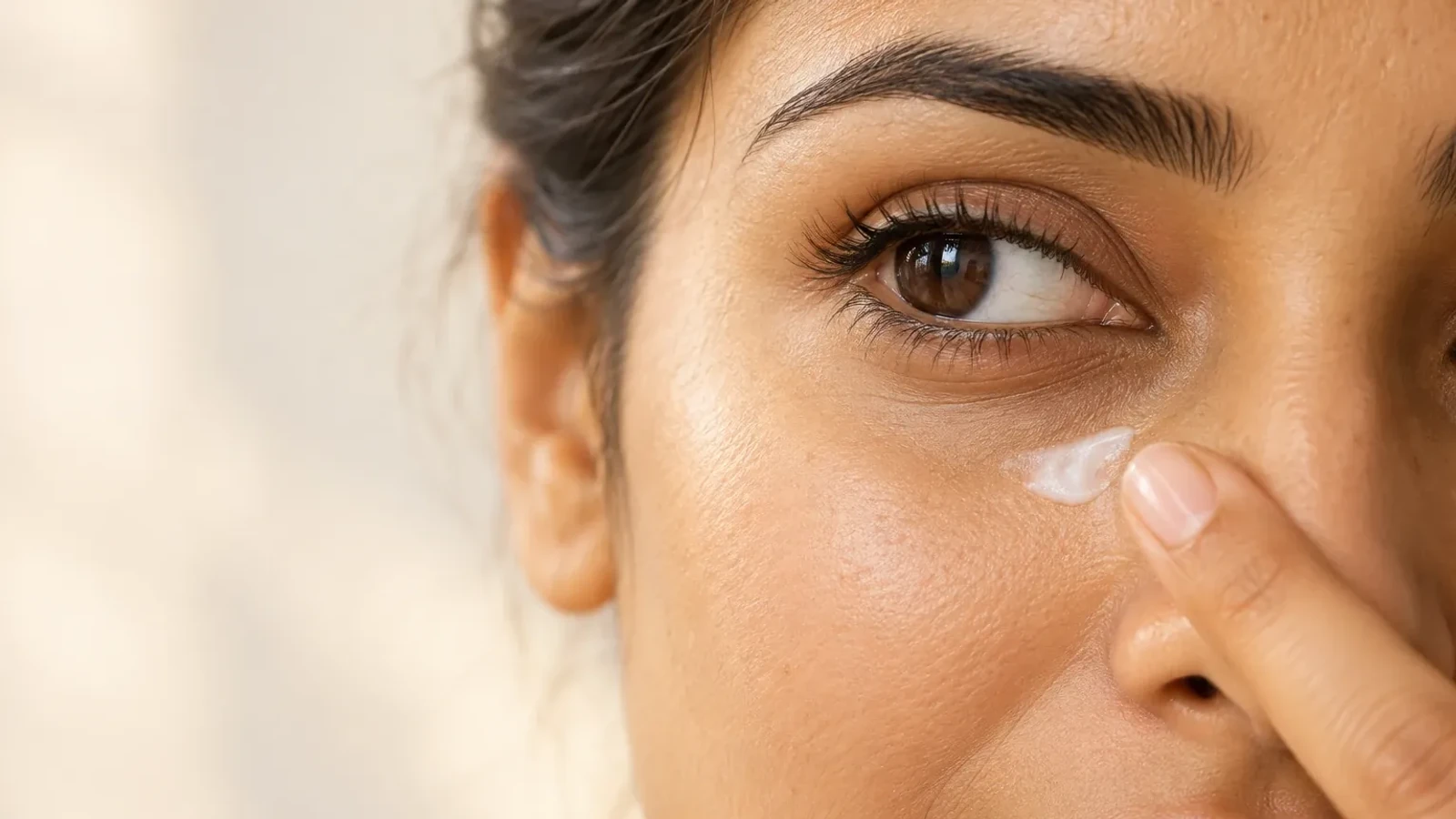
Crow’s feet (lateral canthal lines, in dermatology) are the creases at the outer corners of your eyes. They form at right angles to the orbicularis oculi, the ring-shaped muscle around the eye that squeezes it closed when you smile, laugh, or squint.
They come in two stages:
- Dynamic crow’s feet appear only when you smile or squint and vanish when your face relaxes.
- Static crow’s feet stay visible even with your face at rest.
The American Academy of Dermatology explains how one becomes the other: contract the same muscles for many years and the lines become permanent. The skin here makes the process faster. Cleveland Clinic notes that the skin around your eyes is the thinnest on your body, which also means it gets dry and irritated easily.
What causes crow’s feet?
- Smiling and squinting. Every smile folds the skin in the same place. Squinting into the sun or at a screen does the same, often for hours.
- Sun exposure. UV breaks down the collagen and elastin that let creased skin spring back. The outer eye area catches a lot of sun and is easy to miss with sunscreen.
- Thin, dry skin. With few oil glands and thin skin, the area dehydrates fast, which makes lines look deeper.
- Smoking. It speeds up skin aging, and the squint of smoke in your eyes adds extra creasing.
- Sleep position. Side and stomach sleepers press the outer eye into the pillow for hours. A 2016 review in Aesthetic Surgery Journal describes these sleep lines as a separate type from expression lines.
- Genetics and skin type. Fair, sun-sensitive skin tends to show crow’s feet earlier. Deeper skin tones have more built-in protection from UV and often show them later.
Crow’s feet in your 20s: should you worry?
No. Faint lines that appear when you smile in your 20s are dynamic crow’s feet, and they’re very common. Check by relaxing your face completely in front of a mirror in daylight. If the lines disappear, nothing has set in yet.
Prevention at this age is simple and cheap: sunscreen every morning, including right up to the outer corners of your eyes, and sunglasses outdoors. A retinoid is reasonable if you want one, but start slowly near the eyes.
What about “preventive Botox” for crow’s feet?
It’s popular, but the evidence is thin. The most cited support is a published comparison of one pair of identical twins, in which the twin who had regular injections for 13 years had fewer lines at rest on her forehead and between her brows. That’s an interesting observation, not proof, and it didn’t look at crow’s feet. If lines only show when you smile, injections are optional, and sun protection does more for the long run.
How to get rid of crow’s feet at home
At-home care won’t stop the muscle from folding the skin, but it can make the skin itself smoother and more resilient so the lines look softer and deepen more slowly.
1. Sunscreen and sunglasses
Sunscreen has the strongest evidence of any anti-aging step. In a randomized trial of 903 adults, people who used broad-spectrum sunscreen every day showed no detectable increase in skin aging over 4.5 years. Apply SPF 30 or higher to the outer eye area each morning. If chemical filters sting your eyes, a mineral sunscreen with zinc oxide or titanium dioxide usually doesn’t.
The AAD also points out that sunglasses help reduce lines caused by squinting. Wraparound or larger frames cover more of the crow’s feet zone.
2. A retinoid, used carefully
Retinoids help skin rebuild collagen and are the best-studied topical for lines like these. Strength matters less than consistency: in a 48-week trial, tretinoin 0.025% improved sun-damaged skin about as well as 0.1%, with significantly less redness and scaling. That’s useful near the eyes, where irritation is the main reason people quit.
- Start with retinol or a low-strength prescription retinoid 2-3 nights a week.
- Apply it on the bone at the outer corner of the eye, not on the eyelid or into the lash line.
- Put moisturizer on first if your skin is sensitive. It buffers the retinoid without stopping it working.
- Give it 3-6 months. Expect a little dryness at first.
- Skip retinoids if you’re pregnant, trying to conceive, or breastfeeding.
3. Moisturizer, or an eye cream if you prefer
Dry skin makes crow’s feet look deeper within hours, and hydration makes them look softer within minutes. Any gentle, fragrance-free moisturizer works around the eyes. Eye creams aren’t magic, but they’re often formulated to sting less, and some include ingredients with real evidence. Look for:
| Ingredient | What it does | Evidence |
|---|---|---|
| Retinol or retinal | Prompts new collagen, smooths lines | Strong, over months |
| Peptides | May signal skin to make collagen | Limited, mostly small studies |
| Hyaluronic acid, glycerin | Draws water into the skin | Good for instant plumping, temporary |
| Ceramides | Repairs the skin barrier | Good for dryness and irritation |
| Caffeine | Briefly reduces puffiness | No effect on lines |
Pat products on with your ring finger rather than rubbing. Not sure how to layer an eye cream with the rest of your products? The skincare routine builder puts them in order, morning and night.
Free toolSkincare routine builderPick the products you use and get them in the right order, morning and night.What doesn’t work for crow’s feet
- Eye yoga and facial exercises. No study has tested them on crow’s feet. Exercises that squeeze the eye muscle would, if anything, work the muscle that creates the lines.
- Taping and silicone patches. They hold or hydrate the skin while they’re on, so lines look smoother for a few hours. There’s no good evidence of lasting change.
- “Instant” wrinkle creams. Many contain film-forming ingredients that tighten the surface for a few hours. Enjoy them for an event, but they don’t treat anything.
- Rubbing eye creams in hard. Pulling the thin skin around the eye irritates it. Gentle patting is enough.
Botox for crow’s feet: what to expect
Neurotoxin injections are the most effective treatment for dynamic crow’s feet, because they relax the part of the muscle that folds the skin. The AAD lists crow’s feet among the FDA-approved uses, and Botox Cosmetic received that approval in 2013.
- When it works: most people see results within 3-7 days.
- How long it lasts: about 3-4 months, sometimes longer, then the lines return gradually.
- The appointment: a few small injections at the outer corner of each eye, done in one office visit.
- Side effects: the AAD lists swelling, redness, soreness, and bruising that can last about a week. A temporarily droopy eyelid or brow from weakness in a nearby muscle is rare.
A skilled injector leaves some movement so your smile still reaches your eyes. If you want to look rested rather than frozen, say so. Injectors generally advise waiting until after pregnancy and breastfeeding. The AAD warns against injections at spas, parties, or homes, and against product bought online.
Botox softens movement, so it does less for deep lines that stay at rest. Those usually need a second approach.
Other in-office treatments
- Laser resurfacing removes thin layers of damaged skin and prompts collagen. It’s the strongest option for etched crow’s feet and crepey texture, with roughly 5-7 days of downtime for resurfacing lasers.
- Non-resurfacing lasers and microneedling need several sessions but much less downtime.
- Chemical peels at light to medium depth improve fine lines and uneven tone.
- Combining treatments is common: Botox for movement plus a laser or retinoid for the lines that remain at rest.
When should you see a dermatologist?
Tracking your crow’s feet
Crow’s feet change slowly and look different with every smile, so judge progress with photos taken once a month in the same window light, once relaxed and once smiling. GoodSkin’s AI skin analysis scores visible wrinkles alongside skin age and texture from one selfie and keeps your history on your phone.
Lines under the eye behave a little differently from crow’s feet, with thinner skin and a crepey texture, and our guide to under eye wrinkles covers them. For the bigger picture on early lines, read fine lines vs wrinkles.
Sources
- American Academy of Dermatology: Botulinum toxin therapy overview
- American Academy of Dermatology: Botulinum toxin therapy FAQs
- American Academy of Dermatology: 11 ways to reduce premature skin aging
- Annals of Internal Medicine: Sunscreen and prevention of skin aging (2013)
- Archives of Dermatology: 0.1% vs 0.025% tretinoin for photoaging (1995)
- Aesthetic Surgery Journal: Sleep wrinkles (2016)
- Cleveland Clinic: How to choose the right eye cream
Frequently asked questions
At what age do crow's feet start?
Many people see faint crow's feet when they smile in their 20s, and lines that stay at rest usually show up from the 30s on. Fair skin, years of sun, smoking, and a habit of squinting all bring them forward.
Do crow's feet come back worse after Botox wears off?
No. As the muscle recovers over a few months, the lines return gradually to how they were before treatment. They don't rebound deeper, and the time without movement may even slow how quickly they etch in.
Can crow's feet go away on their own?
True crow's feet don't, though lines that only appear when the skin is dry can vanish with moisturizer. Sunscreen and a retinoid can make set-in lines noticeably softer over several months.
Is it bad to smile a lot if I'm worried about crow's feet?
No. Smiling contributes, but sun damage is the bigger factor you can control, and nobody should ration their smile. Sunglasses outdoors, which cut squinting, are the practical swap.
This article is general education, not medical advice. GoodSkin is a cosmetic tool and does not diagnose skin conditions. If something hurts, spreads, bleeds, or changes quickly, see a dermatologist.