Oval face shape: signs, best haircuts, and frames
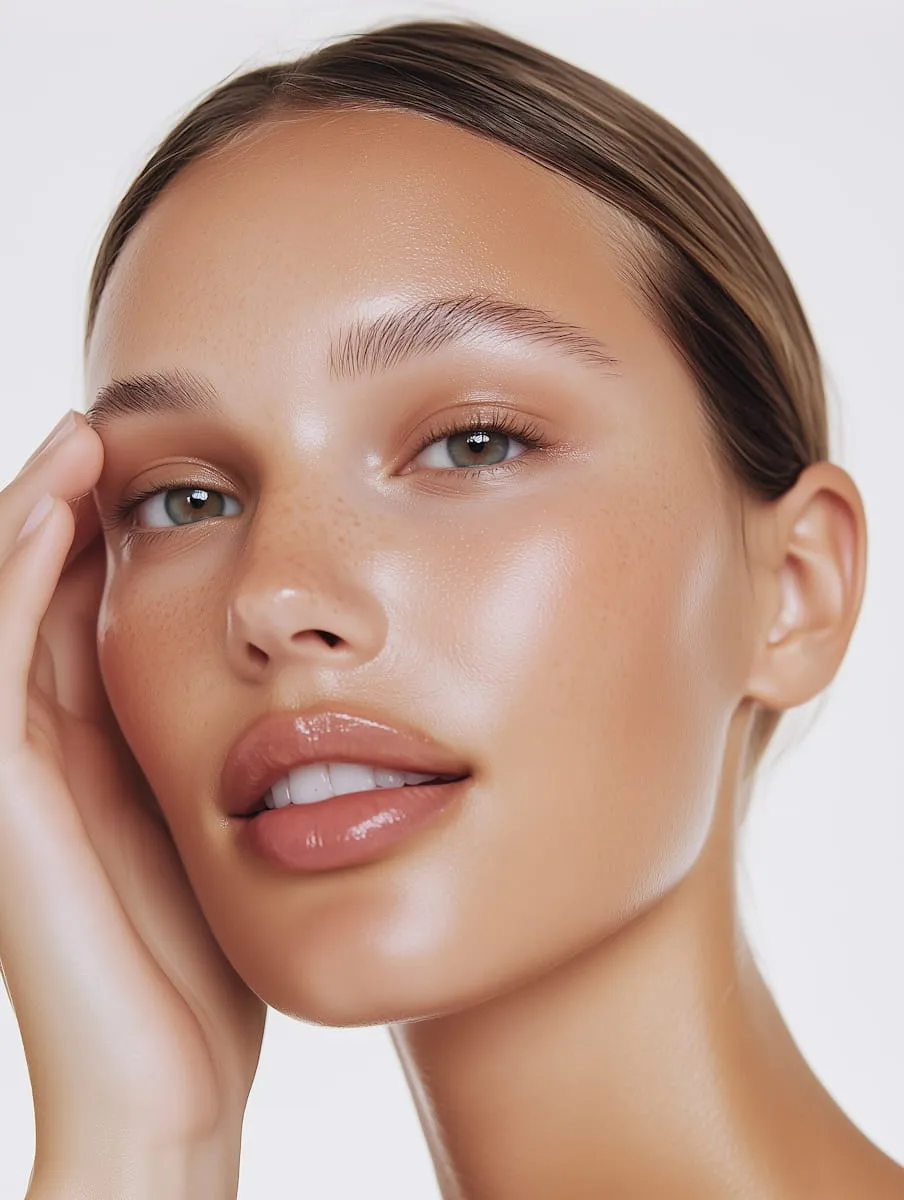
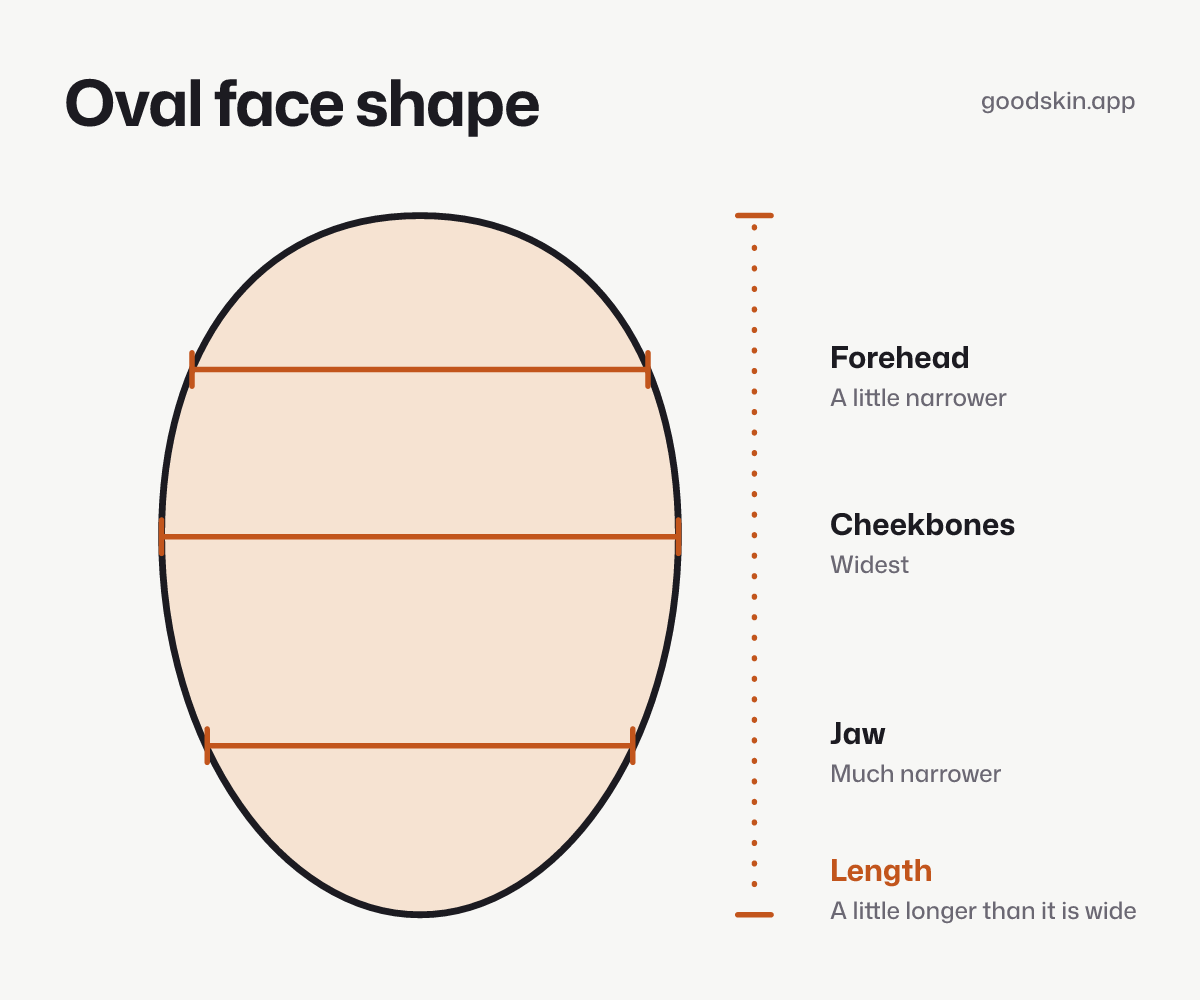
An oval face shape is a little longer than it is wide, with the cheekbones as the widest point, a forehead just slightly narrower, and a jaw that curves into a softly rounded chin. Because no zone dominates, nearly every cut and frame suits you, so the real choice comes down to your hair texture and what you want to show off. Not sure it is you? Our free face shape detector measures your proportions from a selfie.
How to tell if you have a oval face
Pull your hair back, look straight into a mirror in even light, and check these:
- With your hair pulled back, your face looks a bit longer than it is wide, but not strikingly long.
- Your cheekbones are the widest point, and your forehead is only a touch narrower.
- Running a fingertip along your jaw from ear to chin, you feel one smooth curve rather than a corner.
- Your chin is rounded, neither pointed nor broad and flat.
- If you trace your reflection on a steamy mirror, the outline looks like an egg standing on its narrow end.
- Forehead
- Slightly narrower than your cheekbones and slightly wider than your jaw, with a gently curved hairline.
- Cheekbones
- The widest part of your face, but only by a little, so the outline flows without a sudden bulge.
- Jaw
- Narrower than the forehead, with corners that curve rather than turn a sharp angle.
- Chin
- Softly rounded and a bit narrower than the jaw, without a point.
- Length
- Clearly longer than the cheekbone width, though not so long that length is the first thing you notice.
Oval or oblong or round?
Oval vs oblong
Both are longer than they are wide, so look at the sides. An oblong face keeps almost the same width from temples to jaw, which makes the cheeks look straight and the length obvious at first glance. An oval face narrows gently above and below the cheekbones, so it reads balanced instead of long.
Oval vs round
A round face has the same soft curves but is roughly as wide as it is long. Hold a pen upright from your hairline to your chin, then sideways across your cheekbones: on an oval face the upright distance is clearly longer, while on a round face the two are close.
Hairstyles for a oval face
Chin-length blunt bob
A straight hemline at the chin shows off the gentle taper from cheekbones to jaw, and since your proportions are already even, the cut needs no corrective angles.
Long layers with face-framing pieces at the cheekbones
The shortest layer lands at your widest point and points to it, while the length keeps the outline smooth. On wavy hair, the layers also stop the ends from bunching into a triangle.
Textured crop or short taper
With no wide zone to disguise, you can go very short: close sides and an inch or two of texture on top keep the outline clean.
Rounded curly or coily shape, cut dry
Curls shaped to be fullest around cheekbone level echo your outline instead of stretching it. Cutting dry lets your stylist shape each curl where it actually sits.
Sleek high ponytail, bun, or braids pulled up
Taking all the hair off your face shows the whole outline, and unlike most shapes, yours needs no hair at the sides for balance.
Shoulder-length shag with curtain bangs
Choppy layers add movement at the cheeks and jaw without changing your proportions, and the bangs frame your eyes.
Bangs
You can wear almost any bang, so let your hair and your forehead decide. A full blunt fringe suits an average or tall forehead; if yours is short, go wispy so the top of your face does not look cropped. Curly bangs should be cut dry and slightly longer than you want them, because they spring up.
What to skip
- Tall volume at the crown with flat sides, such as a high pompadour or a teased top: it stretches your face toward oblong.
- Heavy hair hanging over both cheeks: it hides your natural balance and can make the face look narrow and long in photos.
- Frames much wider than your face: lenses that overhang the temples throw off proportions that are already even.
Glasses for a oval face
- Wide rectangular frames. Match the frame width to your cheekbones, your widest point. The straight top and bottom lines add a crisp contrast to your soft curves.
- Geometric frames (hexagon or octagon). A few angles give structure to a face with no strong corners, without fighting its balance.
- Browline frames. The bold upper bar sits along your brows and the thin lower rim leaves the cheeks open, so the look is defined rather than heavy.
- Classic aviators. The teardrop lens tapers downward the way an oval face tapers toward the chin.
Makeup, brows, and beards
Contour and blush
You are not correcting anything, so keep contour minimal: a soft shade just under the cheekbones, blended toward the top of the ear, adds definition. Sweep blush from the apples toward the temples, and highlight the top of the cheekbones, the center of the forehead, and the chin to catch light along your natural shape.
Brows
Follow your natural shape with a soft arch that peaks about two-thirds of the way out from the inner corner. A very high, sharp arch can lengthen an oval face, and a flat, heavy line can shorten it.
Beards and facial hair
Almost any facial hair works, from stubble to a full beard. Keep the sides a little shorter than the chin so the beard follows your outline instead of boxing it in.
How the detector reads it
Oval is the detector's default: every face starts with a small lead for oval, and another shape needs a stronger signal to beat it. In practice you get oval when your length sits between about 1.24 and 1.5 times your cheekbone width and your forehead and jaw land near the typical readings of about 90% and 77% of cheekbone width (the landmark points sit just inside your outline, so these read lower than a tape measure would). Very soft jaw corners, with an angle wider than 160 degrees, add a little to the oval score. A sharp jaw corner (under 148 degrees) on an otherwise oval face usually shows up as "Oval, with some square traits".
Try the free face shape detector. It measures your face from one photo, and the photo never leaves your device.
Frequently asked questions
Why is the oval face shape called the ideal?
Stylists use oval as the reference shape because its proportions are balanced: a little longer than wide, with no zone much wider than the rest. Most styling advice for other shapes aims to recreate that balance, which is where the label comes from. It describes proportions, not beauty, and every face shape can look striking.
Is oval the most common face shape?
It is often described that way, but there is no reliable count of face shapes across the population. Oval is also the label for a face without one standout feature, and many people are a blend of oval and a second shape, so it gets applied a lot.
Can you have short hair with an oval face?
Yes. Pixie cuts, buzz cuts, and short crops are easy on an oval face because there is no wide zone or long line for the hair to balance.
Does a middle part suit an oval face?
Yes. A center part splits the face into two even halves and shows off its balance. If your face is on the longer side of oval, add curtain bangs or waves so the part does not draw one long straight line.