
Ingredients
Retinol vs retinoid: what's the difference, and how to use retinol
Retinol vs retinoid: retinol is one type of retinoid, gentler and slower than tretinoin. Compare retinol, retinal, adapalene, and tretinoin, and how to start.
Key takeaways
- Retinoid is the family name for every vitamin A ingredient used on skin. Retinol is one member: an over-the-counter cosmetic ingredient your skin has to convert before it works.
- The difference is strength. Retinol is roughly ten times weaker than prescription tretinoin, so it's gentler but slower.
- Adapalene 0.1% is a prescription-strength retinoid sold over the counter in the US, and it's the best place to start if your goal is acne.
- Start with a pea-sized amount 2 nights a week, build up over 6-8 weeks, and wear sunscreen every morning.
- Don't use any retinoid, including retinol, while pregnant or trying to conceive.
Retinoid is the umbrella term for every vitamin A ingredient used on skin, and retinol is one of them. The difference between retinol and other retinoids is strength. Retinol is a cosmetic ingredient your skin has to convert, in two steps, into retinoic acid before it does anything, so it’s gentler and slower. Prescription retinoids such as tretinoin are retinoic acid itself, so they work faster and irritate more.
So “retinol vs retinoid” isn’t really a contest: every retinol is a retinoid, but not every retinoid is a retinol. The useful question is which retinoid fits your skin and your goal. Below: how the main ones compare, which to start with, exactly how to use retinol, and why all of them are off the table in pregnancy.
What is a retinoid?
Retinoids are a family of compounds related to vitamin A. On skin, they bind to receptors that control how skin cells grow and shed. That one mechanism explains their range of uses:
- Acne and clogged pores: they keep dead cells from sticking together inside the pore, which is how blackheads and whiteheads start.
- Fine lines: over months, they increase collagen production in the dermis.
- Texture and tone: faster, more even shedding leaves skin smoother and helps fade dark marks.
They’ve been around a long time. The American Academy of Dermatology notes that tretinoin was approved for acne in 1971, which makes retinoids among the best-studied ingredients in skin care.
Retinol vs retinoid: the family tree
Every cosmetic retinoid has to become retinoic acid in your skin before it works. The more conversion steps it needs, the weaker and gentler it is:
Retinyl esters (such as retinyl palmitate) → retinol → retinaldehyde (retinal) → retinoic acid (tretinoin)
A 2022 review in Advances in Therapy puts numbers on it: retinol is about ten times less potent than tretinoin, and retinyl palmitate is weaker still. Tolerability runs in the opposite direction. The review ranks the esters gentlest, retinol and retinal about equal, and retinoic acid by far the most irritating.
Adapalene, tazarotene, and trifarotene sit outside this chain. They are synthetic retinoids designed to act on the same receptors directly, without conversion.
| Retinoid | Prescription or OTC | Typical strengths | Strength and irritation | Best for |
|---|---|---|---|---|
| Retinyl palmitate | OTC cosmetic | Often not disclosed | Weakest, gentlest | Very sensitive skin, a first taste |
| Retinol | OTC cosmetic | 0.1-1% | Moderate | Fine lines, texture, a first retinoid |
| Retinaldehyde (retinal) | OTC cosmetic | Often 0.05-0.1% | Stronger than retinol, similar irritation | The next step after retinol |
| Adapalene | OTC 0.1% in the US, prescription 0.3% | 0.1%, 0.3% | Least irritating prescription retinoid | Acne, blackheads, clogged pores |
| Tretinoin | Prescription | 0.025%, 0.05%, 0.1% most common | Strongest evidence, most irritating | Acne, wrinkles, dark spots |
| Tazarotene, trifarotene | Prescription | Varies by product | Strong | Acne (and psoriasis for tazarotene) |
The irritation ranking for adapalene and tretinoin comes from DermNet. The AAD adds a catch for shoppers: over-the-counter products don’t have to disclose their retinol percentage, so a “retinol serum” may contain very little. In the EU, a 2024 rule caps retinol in face products at 0.3%.
Retinol vs retinal vs tretinoin: which is stronger?
Tretinoin is the strongest of the three and has the best evidence, especially for sun-related wrinkles and dark spots. Retinal is one conversion step away from it, so it should be more potent than retinol at a similar level of irritation, though it has been studied much less. Retinol is the slowest, but it’s the most researched cosmetic retinoid and it does work. In a 2007 trial in Archives of Dermatology, 0.4% retinol applied up to three times a week for 24 weeks significantly improved fine wrinkles compared with a plain lotion, and raised markers of collagen production in skin samples.
The trade-off is speed against comfort. Cleveland Clinic notes that tretinoin may work faster than over-the-counter retinol, while retinol usually takes several months to make a visible difference to wrinkles.
Adapalene vs retinol
These two answer different goals.
Adapalene is an acne drug. The FDA moved adapalene 0.1% gel from prescription to over-the-counter sale in July 2016, for people aged 12 and older, and in May 2026 it approved a nonprescription gel combining adapalene 0.1% with benzoyl peroxide 2.5% (both on the FDA’s prescription to nonprescription switch list). It’s the strongest retinoid you can buy without a prescription in the US, and the obvious first choice for blackheads, whiteheads, and breakouts. Our guide to getting rid of blackheads shows how it fits a routine.
Retinol is a cosmetic ingredient aimed mostly at aging: fine lines, texture, and dullness. It’s gentler, and formulas often include moisturizing ingredients that make it easier to live with.
Which retinoid should you start with?
- Breakouts or clogged pores: adapalene 0.1% gel.
- Fine lines, rough texture, or dullness, and you’ve never used a retinoid: retinol at a low strength, around 0.1-0.3%.
- You’ve used retinol for a few months without trouble: a higher-strength retinol or a retinal product.
- Dry or sensitive skin: the lowest-strength retinol in a cream. DermNet notes creams are the least irritating formulation.
- Deeper wrinkles, stubborn acne, or you want the fastest result: ask a dermatologist about tretinoin.
- Pregnant, trying to conceive, or breastfeeding: none without talking to your doctor. See the warning below.
How to use retinol
Here’s a start-low, go-slow plan that works for retinol, retinal, and adapalene.
- Patch test first. Apply a little to a small area for several days before using it on your face.
- Use it at night only. The AAD advises nighttime use because retinoids can make your skin more sensitive to sunlight.
- Apply to completely dry skin. Wait a few minutes after washing. Damp skin lets more through, which can mean more stinging.
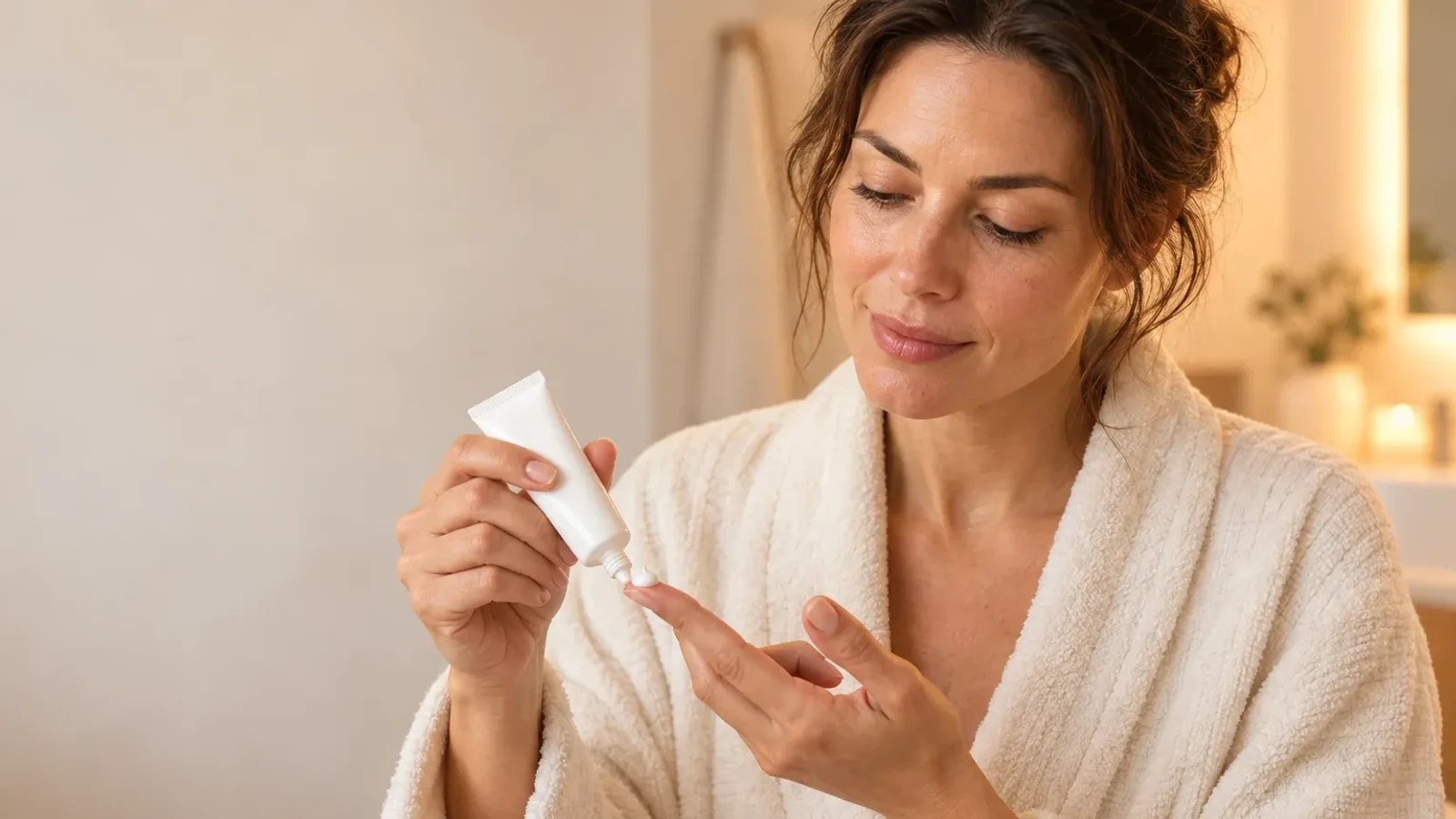
- Use a pea-sized amount for your whole face. Cleveland Clinic recommends a dose about the size of a pea. Dot it on your forehead, cheeks, and chin, then spread it thinly. Keep it away from the corners of your nose, your lips, and your eyelids.
- Moisturize afterward. Moisturizer limits dryness and irritation, according to the AAD.
- Wear sunscreen every morning. Broad-spectrum SPF 30 or higher, even on cloudy days.
How often to use retinol when you start
| Weeks | How often |
|---|---|
| 1-2 | 2 nights a week, such as Monday and Thursday |
| 3-4 | 3 nights a week |
| 5-8 | Every other night |
| 9 and on | Every night, if your skin stays comfortable |
Move to the next row only when your skin has settled. If it stings or peels, stay where you are or step back a row. Keep exfoliating acids off your retinoid nights. A skin cycling schedule gives each one its own night, and our guide to mixing skincare ingredients covers which other pairings are fine.
Free toolSkincare routine builderPick the products you use and get them in the right order, morning and night.What to expect: a realistic timeline
- Weeks 1-4: dryness, flaking, mild redness, or stinging. This adjustment phase is normal and usually fades as your skin gets used to it. Some people also get a short flare of small spots where they usually break out. Our guide to skin purging explains how to tell that from a reaction.
- Weeks 4-12: skin calms down and starts to feel smoother. DermNet notes it can take 12 weeks or longer to see improvement in acne.
- Months 3-6: the slower changes to fine lines, texture, and tone. The 2007 retinol trial ran for 24 weeks.
Those changes are gradual, which makes them easy to miss in the mirror. Take photos in the same light every couple of weeks. GoodSkin’s AI skin analysis scores wrinkles, texture, and redness from one selfie, so with Premium’s scan history you can see whether lines are softening while redness stays flat.
How to start retinol with sensitive or dry skin
- Try the sandwich method. Apply a thin layer of moisturizer, then your retinol, then more moisturizer. It dilutes the dose slightly and cushions your skin.
- Pick a moisturizer with niacinamide. In a 2006 split-face study funded by a skin care company, a niacinamide moisturizer helped people get through the early, irritating phase of tretinoin. Our guide to what niacinamide does covers it in more detail.
- Go slower on medium and deep skin tones. The AAD warns that retinoid irritation can trigger dark marks (hyperpigmentation) in darker skin, which defeats the purpose.
- Skip retinoids if your skin is already red or inflamed. The AAD advises people with significant redness or inflammation to avoid retinoids. Calm your skin first.
Retinoids in pregnancy
When to see a dermatologist
See a board-certified dermatologist if over-the-counter retinol or adapalene hasn’t helped after about 3 months, if your acne is deep, painful, or scarring, or if you want tretinoin. Also stop and get help if a retinoid causes swelling, blistering, or a rash that doesn’t settle within a week of stopping.
The bottom line
Retinol vs retinoid comes down to strength and speed. All retinoids work the same basic way. Retinol is the gentle, over-the-counter version that needs converting, adapalene is the best non-prescription choice for acne, and tretinoin is the strongest and fastest. Pick the one that matches your goal, use a pea-sized amount at night, build up slowly, wear sunscreen, and give it at least 3 months before you judge it.
Sources
- American Academy of Dermatology: Retinoid or retinol?
- Cleveland Clinic: Retinol
- Advances in Therapy: Use of Retinoids in Topical Antiaging Treatments (2022)
- DermNet: Topical retinoids
- PubMed: Improvement of naturally aged skin with vitamin A (retinol) (Arch Dermatol, 2007)
- U.S. Food and Drug Administration: Prescription to Nonprescription Switch List
- American Academy of Dermatology: Dermatologist-approved pregnancy skin care
Frequently asked questions
Can I use retinol every night?
Yes, once your skin has adjusted. Most people get there after 6-8 weeks of building up, but some skin types stay happiest at every other night, and that still works.
Should I use retinol in the morning or at night?
At night. The American Academy of Dermatology advises using retinoids only at night because they can make skin more sensitive to the sun, and light breaks down many retinoid formulas.
What is the strongest retinoid you can buy without a prescription?
In the US, adapalene 0.1% gel, which was a prescription drug until the FDA approved it for over-the-counter sale in 2016. Among cosmetic ingredients, retinaldehyde is the closest to the active form.
Can I put retinol around my eyes?
Carefully. The skin there is thin and reacts more, so use a smaller amount, stay on the bone around the eye rather than the lid, and keep it away from the lash line. Some people prefer a low-strength retinol made for the eye area.
This article is general education, not medical advice. GoodSkin is a cosmetic tool and does not diagnose skin conditions. If something hurts, spreads, bleeds, or changes quickly, see a dermatologist.